MECHANISMS OF SUNSCREEN ACTION
When applied properly, sunscreens form a film or coating on the surface of the stratum corneum that attenuates or “filters out” radiation that would otherwise reach the living epidermis and dermis. The active
• SPF
agents in sunscreen products do this by either absorbing or scattering photons before they penetrate the skin surface. Nowadays, many sunscreen products contain combinations of agents that work by one or both mechanisms. Active sunscreen ingredients have conventionally been divided into so-called organic “chemical” agents which are wateror oil-soluble and function through photon absorption versus inorganic metal oxide “physical” agents which are insoluble and scatter light energy. However, there are limitations and exceptions to this seemingly clear-cut distinction.
When organic sunscreen agents absorb radiation, they are initially raised to a higher-energy, excited molecular state. Upon reverting to their ground state, this stored energy is usually dissipated in the form of heat, which is barely perceptible and non-damaging to the skin. However, some sunscreen agents, once excited, can undergo photochemical reactions with other sunscreen components (e.g. ecamsule), resulting in loss of their photoprotective efficacy. As a result, such agents (particularly avobenzone) lack photostability, i.e. they are deemed to be photolabile. In order to preserve efficacy, sunscreen agents such as avobenzone are combined with photostabilizers (e.g. salicylates, octocrylene).
In the past, opaque topical sun protection products consisting of insoluble metal oxide filters were considered “sunblockers”, but since 1999 the FDA has not considered the concept of achieving complete blockage via topical photoprotection to be valid. Whereas absorption of solar radiation is directly related to chemical structure, optical physical scattering (and reflection) by inorganic agents is based primarily on particle size. Because sunscreens formulated with large-particle inorganic agents are cosmetically unacceptable due to their opaque appearance, particles are now micronized and the resultant products are significantly less visible. However, there is evidence that within the UV spectrum these inorganic agents such as particulate titanium dioxide, especially when micronized, also exhibit significant direct photon absorption that may be more important than their photon scattering effects.
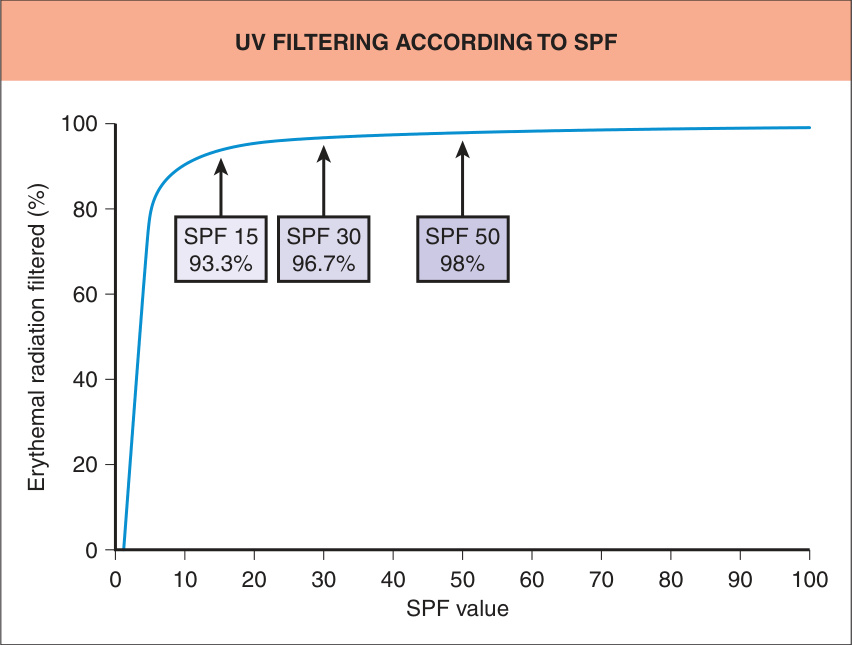
Fig. 132.2 Relationship between sun protection factor (SPF) and the amount of UV radiation that is filtered by a sunscreen. The percentage of UV blockage basically levels off above SPF 30.
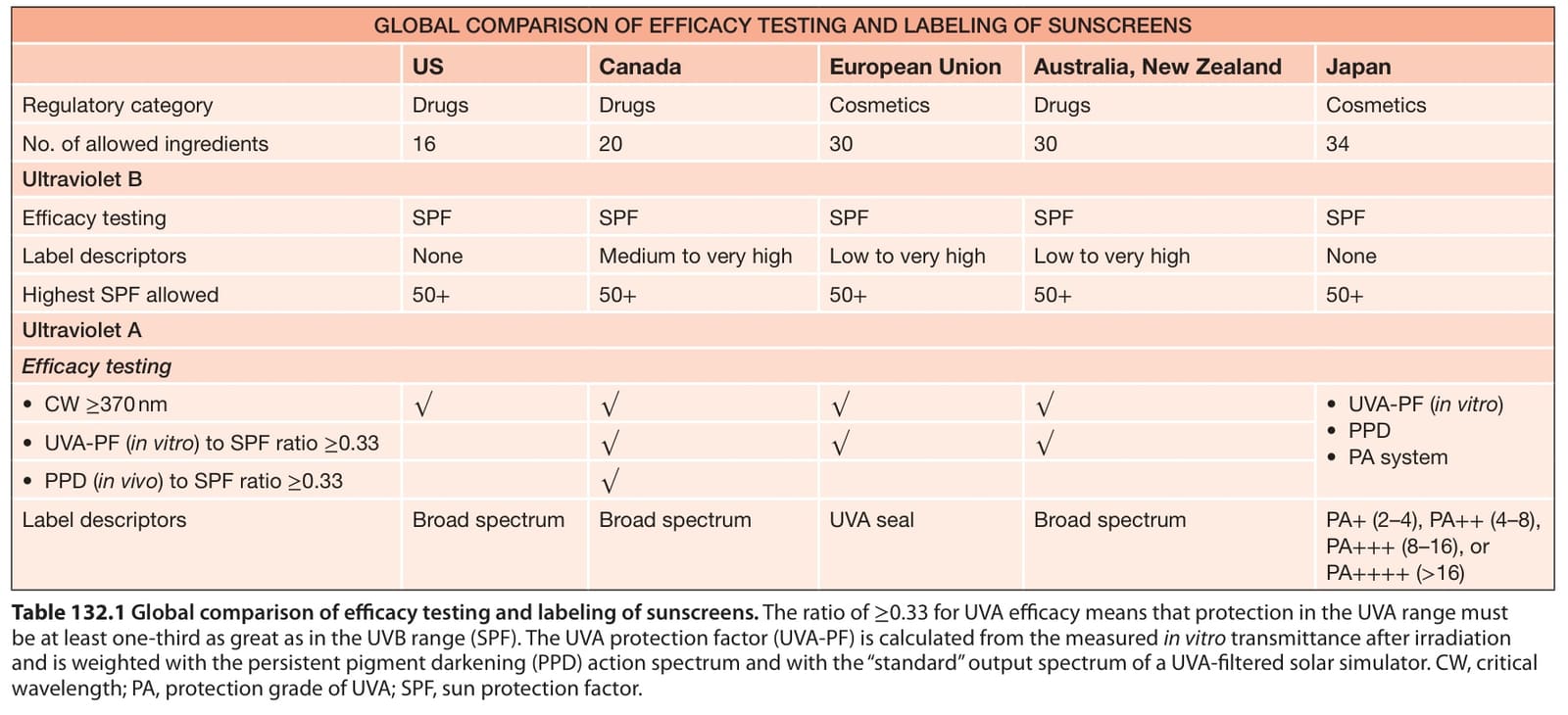
Table 132.1 Global comparison of efficacy testing and labeling of sunscreens. The ratio of ≥0.33 for UVA efficacy means that protection in the UVA range must be at least one-third as great as in the UVB range (SPF). The UVA protection factor (UVA-PF) is calculated from the measured in vitro transmittance after irradiation and is weighted with the persistent pigment darkening (PPD) action spectrum and with the “standard” output spectrum of a UVA-filtered solar simulator. CW, critical wavelength; PA, protection grade of UVA; SPF, sun protection factor.
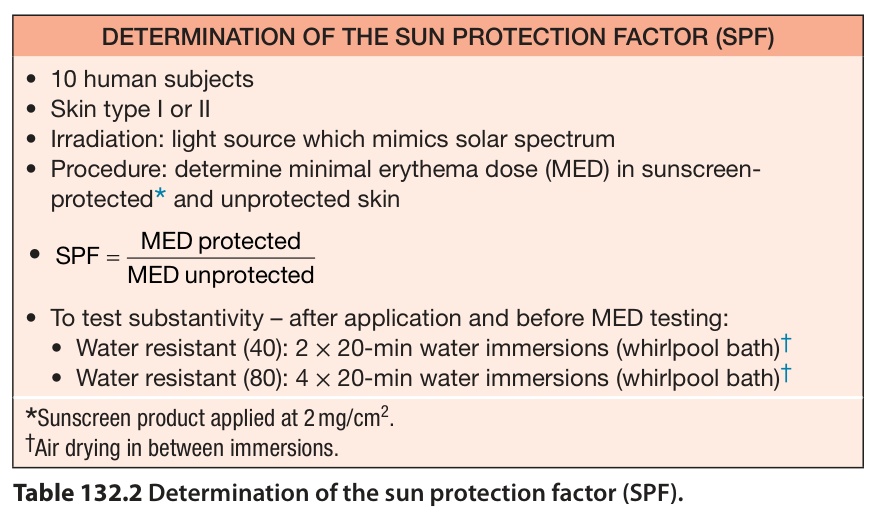
Table 132.2 Determination of the sun protection factor (SPF).