INTRODUCTION
This chapter considers laser and light applications for both medical and aesthetic purposes as related to the skin. Anderson and Parrish developed the concept of selective photothermolysis whereby laser energy could be used for targeted destruction of skin components (see Ch. 136). Their 1983 treatise continues to support our understanding of laser–tissue interactions and still drives new therapeutic applica tions of lasers in dermatology. Given the multiplicity of lasers available (Fig. 137.1), the laser surgeon must understand the capabilities and limitations of each device so that the appropriate system can be selected and the parameters tailored to treat the intended target. Safe and effective laser therapy is achieved when the operator understands the nature of the target, its location within the skin, and the potential collateral damage. Other energy-based devices, such as those that utilize radiofrequency waves, intense focused ultrasound, or microwaves, are also discussed.
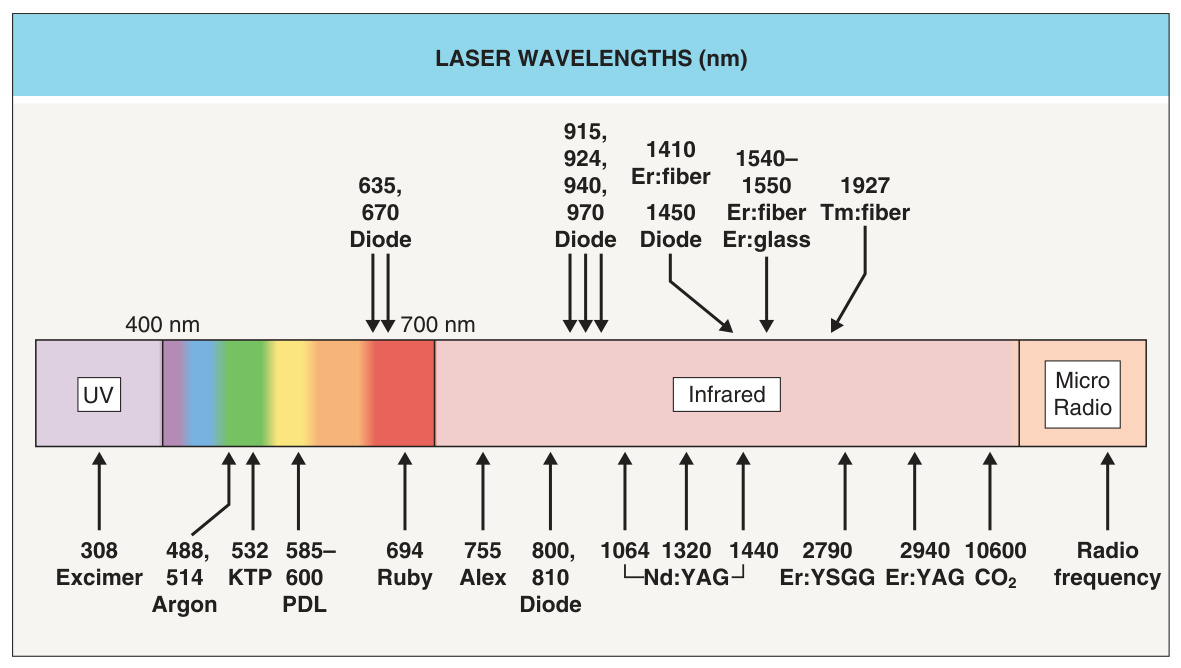
Fig. 137.1 Laser wavelengths (nm). Laser wavelengths lie predominantly within the ultraviolet, visible and infrared portions of the electromagnetic spectrum. Alex, alexandrite; Er, erbium; KTP, potassium titanyl phosphate; Micro, microwaves; Nd, neodymium; PDL, pulsed dye laser; Radio, radio waves; Tm, thulium; UV, ultraviolet; YAG, yttrium–aluminum–garnet; YSGG, yttrium–scandium–gallium–garnet.