PRINCIPLES OF CRYOSURGERY AND CRYOBIOLOGY
Cryosurgery is defined as a surgical procedure that utilizes very low temperatures to destroy living tissue. The term cryotherapy should be reserved for when living tissue is exposed to cold in order to induce physiological changes but not tissue destruction. Cryobiology represents the study of the effects of low temperatures on living tissues.
Heat transfers from hot to cold, and the larger the temperature difference between a cryogen and its target tissue, the faster the heat transfer. The ideal cryogen has the lowest possible temperature and is capable of producing the parameters necessary to destroy both benign and malignant cells; for the latter, the tissue temperature needs to be below −50°C. The most commonly used cryogen is LN which boils at −196°C (77°K; −321°F). LN is relatively safe to handle, non-toxic, and commercially available. For the treatment of actinic keratoses (AKs) and cutaneous carcinomas, LN is the recommended cryogen whereas for benign lesions, cryogens with higher boiling points (e.g. liquid nitrous oxide [−88°C], carbon dioxide gas [−78°C], other compressed organic gases [−55 to −75°C]) can also be employed.
The mechanisms of injury in cryosurgery can be attributed to both direct and indirect effects (Table 138.1). Such events are the result of fast freezing followed by slow thawing, i.e. a freeze–thaw cycle. Repeated freeze–thaw cycles increase the destructive effects of cryosurgery. The material interposed between the cryogen and the lesion to be treated is also a determinant of the speed of freezing. Air is a poor conductor of cold such that the greater the distance between the skin lesion and the source of the cryogen, the lesser the freezing. Water is a better conductor than air (e.g. a presoaked verruca freezes faster), and ice is better than water as in the intra- and extracellular ice crystals present after the first freeze–thaw cycle. Finally, metal is an excellent conductor explaining the deep and fast freezing of tissue that results from frozen metal probes placed in direct contact with the skin.
Different cells and tissues have different sensitivities to cold. The lethal temperature for melanocytes is around −4°C, while that for keratinocytes is −35°C. Keratinocyte cancer cells require around −50°C, sarcoma cells −60°C, and vascular endothelium −15°C to −40°C. Of note, cartilage and bone are quite resistant to freezing.
Cryoimmunology
Cryoimmunology is the study of the innate and humoral immune responses to antigens derived from frozen skin lesions. Development of newer immunologic assays has made it possible to measure such responses, which can be either immunostimulatory or immunosuppressive.
One major difference between conventional excisional surgery and cryosurgery is that the latter leaves the tumor “in situ”. At the center of the frozen lesion, there will be necrosis due to direct cellular damage (see Table 138.1), leading to release of tumor-specific antigens capable of stimulating an immune response. Once the innate immune system is activated, antigen-presenting cells (APCs) engulf tumor fragments and present processed antigens to T cells, initiating both T and B cell immune responses (see Ch. 4). At the periphery, the temperatures are higher and therefore sublethal, with the cells undergoing apoptosis rather than necrosis. This leads to “silent cell death” associated with minimal inflammation (see Table 138.1).
The response to cryosurgery can be enhanced by the addition of adjuvants. These include agents that augment ice injury (e.g. glycine), inducers of apoptosis (e.g. topical 5-fluorouracil), and immunomodulators (e.g. topical imiquimod). Such combinations have been termed immunocryosurgery, with promising results having been published. However, further studies are needed to better understand the under-lying mechanisms of cryoimmunology, define the ideal parameters for tumor destruction, and determine the precise interactions between cryosurgery and potential adjuvants.
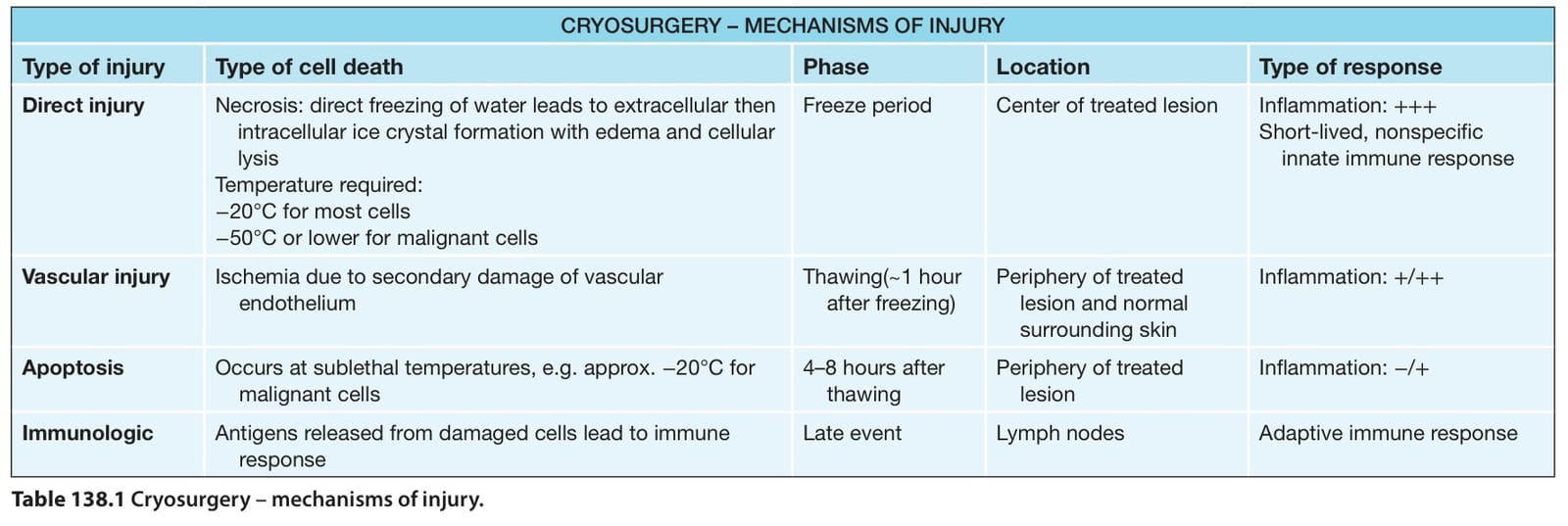
Table 138.1 Cryosurgery – mechanisms of injury.