INTRODUCTION
Worldwide, skin cancer is the most common type of cancer in fairskinned individuals. This chapter will introduce our current under-standing of the fundamental principles underlying cancer development. Notably, skin cancer research has provided significant contributions to the unraveling of the cellular and molecular mechanisms by which environmental carcinogens can cause cancer. The following sections review the remarkable advances in cancer genetics, cancer biology, and cancer immunology made during the 21st century that have initiated a revolution in cancer therapy.
To facilitate our understanding of these novel insights, an increasing number of “hallmarks of cancer” have been defined. As a conceptual framework, these hallmarks are presented along three dimensions of biologic organization: (1) the evolution of cancer genomes; (2) the biology of cancer cells; and (3) the development of cancer ecosystems (Fig. 107.1). This is followed by a review of recent insights into the molecular pathogenesis of keratinocyte carcinomas. The chapter concludes with a brief survey of ongoing technological advances that will shape the future of patient care, enabling improved prevention, earlier detection, and patient-specific therapeutic interventions.
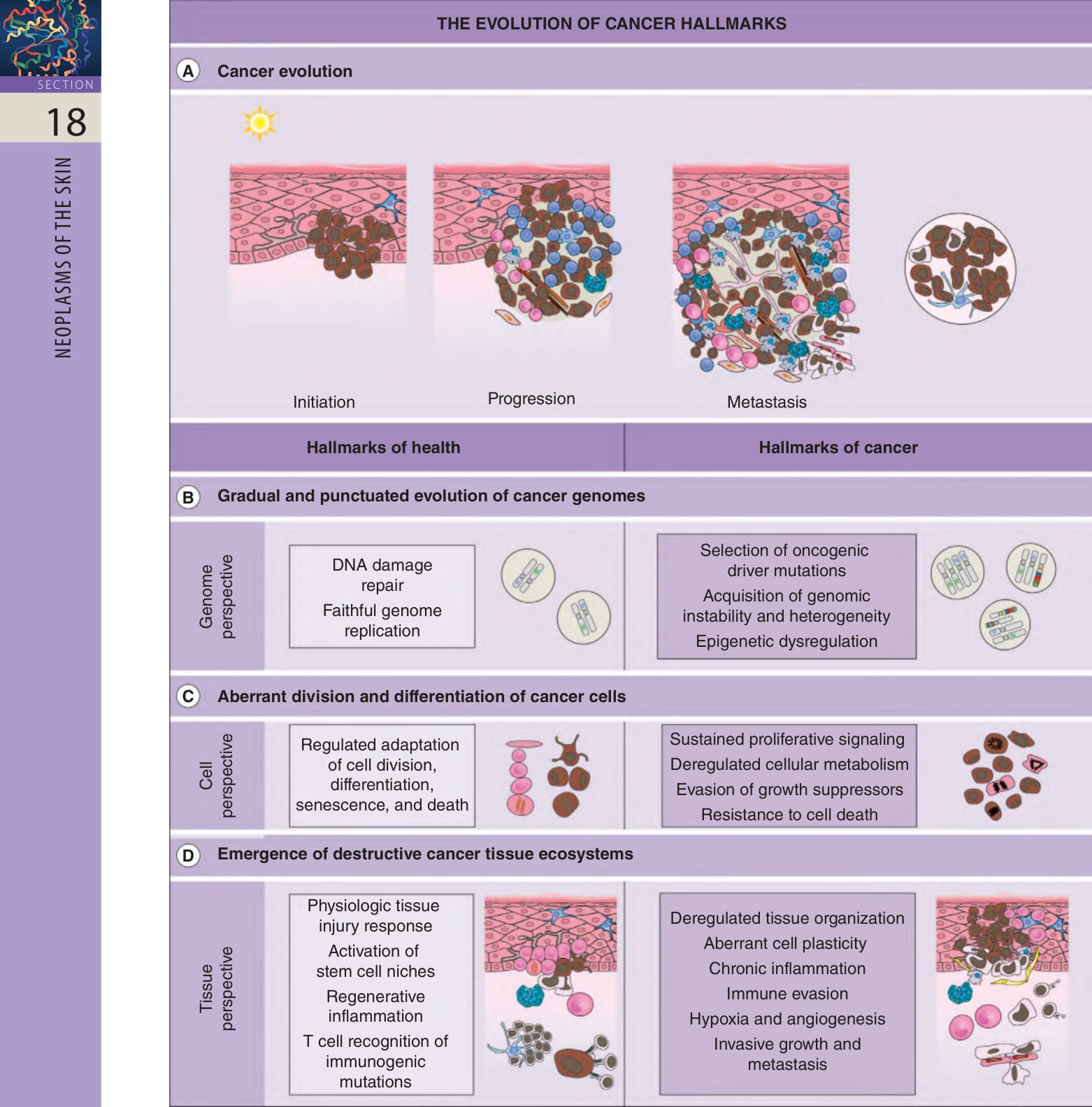
Fig. 107.1 The evolution of cancer hallmarks.A Schematic representation of the cancer initiation, local progression, and metastatic dissemination of skin cancer using melanoma as an example. B–D A simplified view integrating the concepts of cancer evolution and cancer hallmarks. Cancer development disrupts three principal levels of biological organization: genomes, cells, and tissues.