INTRODUCTION
As a dermatologist walks into the examination room of the patient in Fig. 123.1, several diagnostic possibilities likely come to mind. The patient’s history, additional physical findings, and other clues help narrow the differential diagnosis. In this case, knowing the patient’s history of atopic dermatitis lends context to the appearance of monomorphous punched-out erosions and allows one to arrive at the diagnosis of eczema herpeticum. Therefore, awareness of the epidemiology of a disease, how it is distributed within populations, and the factors that influence its distribution can assist in establishing a diagnosis.
Considering the high or increasing prevalence of many skin conditions, dermatologists have the potential to play an important role in public health research and policy. This chapter highlights the relevance of dermatologic conditions to public health, the impact epidemiology can have on a dermatology practice, and major types of public health studies, as well as research design concepts and terminology used in epidemiology.
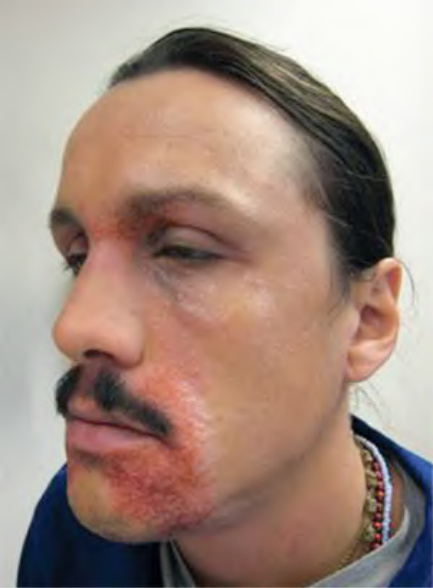
Fig. 123.1 Eczema herpeticum: diagnosis facilitated by knowledge of epidemiology. Grouped vesicles and punched-out erosions are evident. Based on this information alone, eczema herpeticum is in the differential diagnosis. However, awareness of the patient’s history of atopic dermatitis, in combination with knowledge regarding the epidemiology of eczema herpeticum, allows for greater certainty in establishing the diagnosis.