ACTIVE INGREDIENTS IN SUNSCREENS
Currently, most sunscreens contain a combination of two or more agents in order to achieve broad spectrum protection. Fig. 132.4 lists, according to type of activity and spectrum of protection, the active agents currently used in sunscreens.
Organic (Soluble) Filters
Para-aminobenzoic acid and derivatives
PABA and its derivatives, including padimate O (octyl dimethyl PABA), are highly effective UVB absorbers. PABA is no longer marketed in the US, due in part to safety concerns.
critical wavelength (CW) ≥ 370 nm and UVA1/UV ratio ≥ 0.7
Critical wavelength (CW) ≥ 370 nm
Cinnamates
Octyl methoxycinnamate (octinoxate) is a good UVB absorber but is not as potent as PABA and its esters. Presently, it is one of the most common sunscreen ingredients in the US.
Salicylates
The salicylates are relatively weak UVB absorbers but have the ability to stabilize other agents, thereby preventing photodegradation. Consequently, they are used in combination with other organic filters and include octisalate, homosalate, and trolamine salicylate. The latter is no longer included in US sunscreens, due in part to safety issues.
Benzophenones
Benzophenones are good UVA absorbers, although their effectiveness is primarily in the UVA2 range. Oxybenzone is the most commonly used agent in this group and actually affords both UVB and UVA protection. Sulisobenzone and dioxybenzone have similar protective spectra but are infrequently utilized.
Other organic filters
Octocrylene is a commonly used UVB filter which is primarily employed to stabilize photolabile agents. Ensulizole is likewise a photostable UVB absorber. Avobenzone is an excellent UVA filter with absorption well into the UVA1 range, but is very photolabile. It is therefore combined with other agents which assist in stabilizing its protective ability. Menthyl anthranilate is a UVA filter with a maximum absorption in the UVA2 range, but its efficacy is relatively weak. Ecamsule has maximum absorption at 345 nm, but was FDA-approved for use in only a single line of commercial products.
Agents currently awaiting approval in the US include amiloxate (UVB), enzacamene (4-methyl-benzylidene camphor; UVB), ethylhexyl triazone (UVB), iscotrizinol (UVB and UVA), drometrizole trisiloxane (UVB and UVA), bisoctrizole (UVB and UVA), and bemotrizinol (UVA) (see Fig. 132.4).
Inorganic (Insoluble) Filters
The two major inorganic sunscreens are titanium dioxide and zinc oxide. These inorganic compounds are the sole sunscreens in so-called “chemical-free” products but they are also combined with organic filters. Micronized zinc oxide appears to have better activity in the UVA1 range than does titanium dioxide at comparable concentrations. With the advent of nanotechnology (see below), smaller particles of inorganic agents can be incorporated into sunscreen products.
Other Photoprotective Agents
Dihydroxyacetone is the compound most commonly used in sunless tanners. This agent, which when applied is colorless, binds to and
and ultraviolet A (UVA) protection and labeling requirements. Active ingredient safety nd dosage forms are addressed in Table 132.3. For an explanation of critical wavelength and UVA1/UV ratio, see text and Fig. 132.3. SPF, sun protection factor. Adapted fromUS Food and Drug Administration. Proposed Order (OTC000008): Amending Over-the-Counter (OTC) Monograph M020: Sunscreen Drug Products for OTC Human Use. 2021. https://dps-admin.fda.gov/omuf/omuf/sites/omuf/files/primary-documents/2022-09/Proposed%20 Administrative%20Order%20OTC000008_Amending%20M020_Sunscreen_Signed24Sept2021.pdf.
“stains” the stratum corneum to produce a tanned appearance. Although it has a very low SPF, it does offer some protection from long-wave radiation (even into the visible range). Iron oxide offers protection across the UV spectrum and into the visible range, and is used as a colorant in some products (e.g. tinted sunscreens).
Other “active” ingredients have been added to sunscreens, with claims of increasing efficacy of the finished products. The most popular of these are antioxidants, including vitamins E and C and green tea polyphenols, some of which have decreased UV-induced damage in in vitro and in vivo assays11a. However, factors including chemical structure, concentration, and stability in a finished product cannot be determined from package labels, so at this point there are no accepted standards whereby clinicians and consumers can judge efficacy.
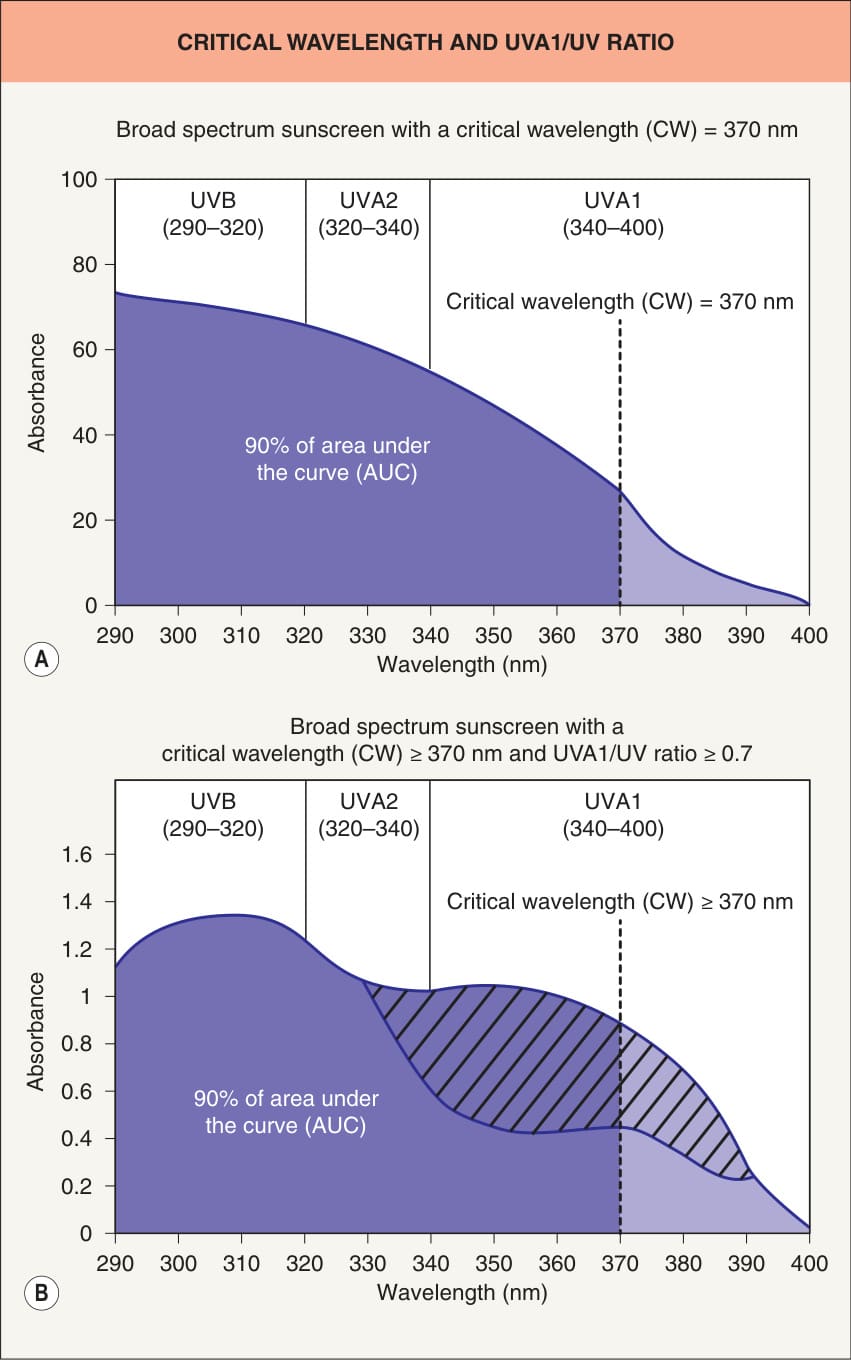
Fig. 132.3 Critical wavelength and UVA1/UV ratio. Critical wavelength (CW) represents the wavelength at which 90% of solar-simulated radiation above 290 nm is cumulatively absorbed by the sunscreen. A A broad spectrum sunscreen with CW = 370 nm. B A broad spectrum sunscreen with both a CW ≥370 nm and a UVA1/UV ratio of ≥0.7. The area with parallel lines represents the absorption needed for a sunscreen to have a UVA1/UV ratio of ≥0.7. Adapted from Diffey BL, Tanner PR, Matts PJ, et al. In vitro assessment of the broad spectrum ultraviolet protection of sunscreen products. J Am Acad Dermatol 2000;43:1024–35 and the Federal Register 2019;84:6204–75.
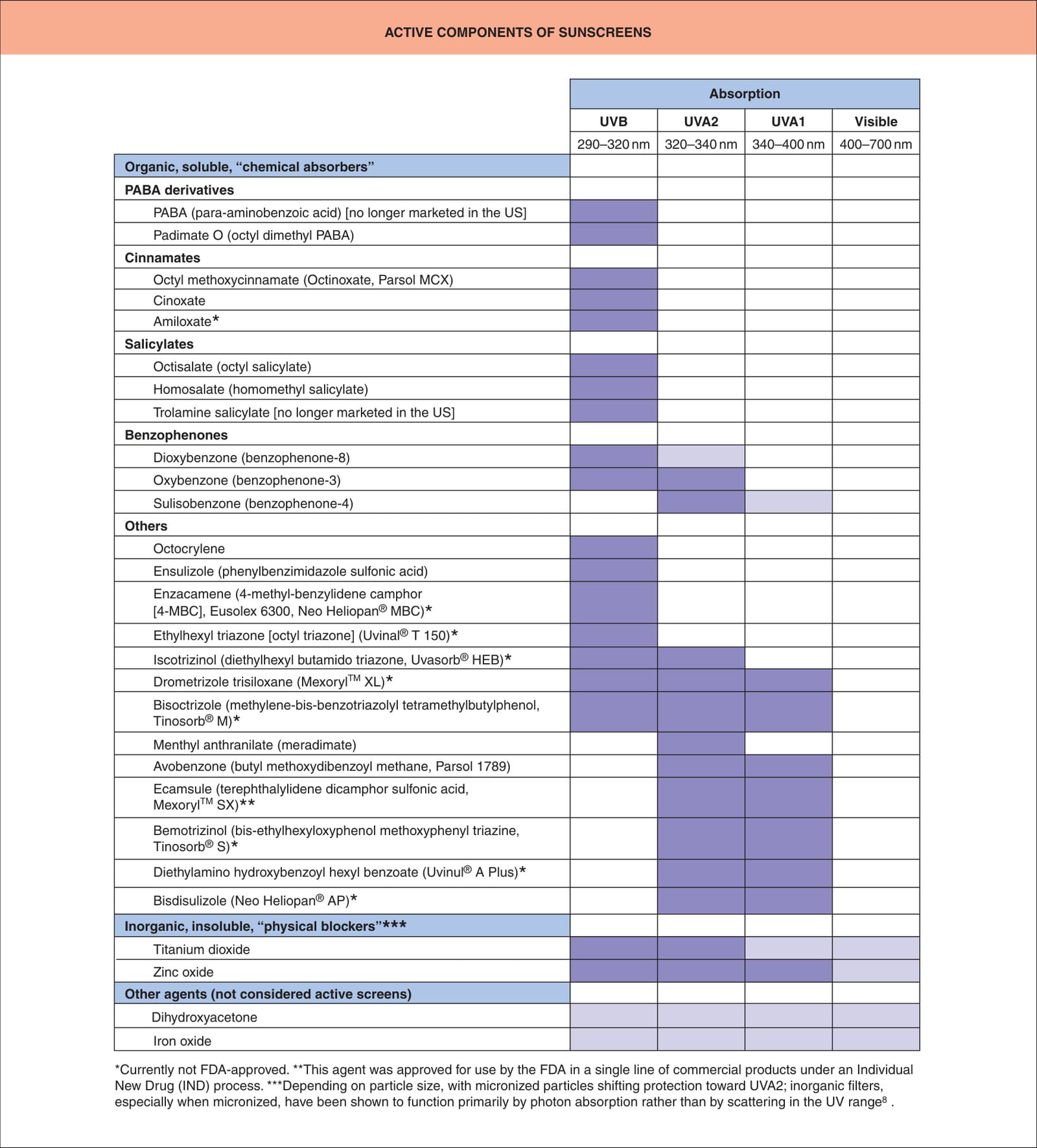
Fig. 132.4 Active components of sunscreens. Lighter colored bars represent variable efficacy. “Boosters” that are not UV filters are also added to sunscreen products, e.g. tiny spheres that scatter incoming radiation and agents that increase the spread of the sunscreen on the skin.
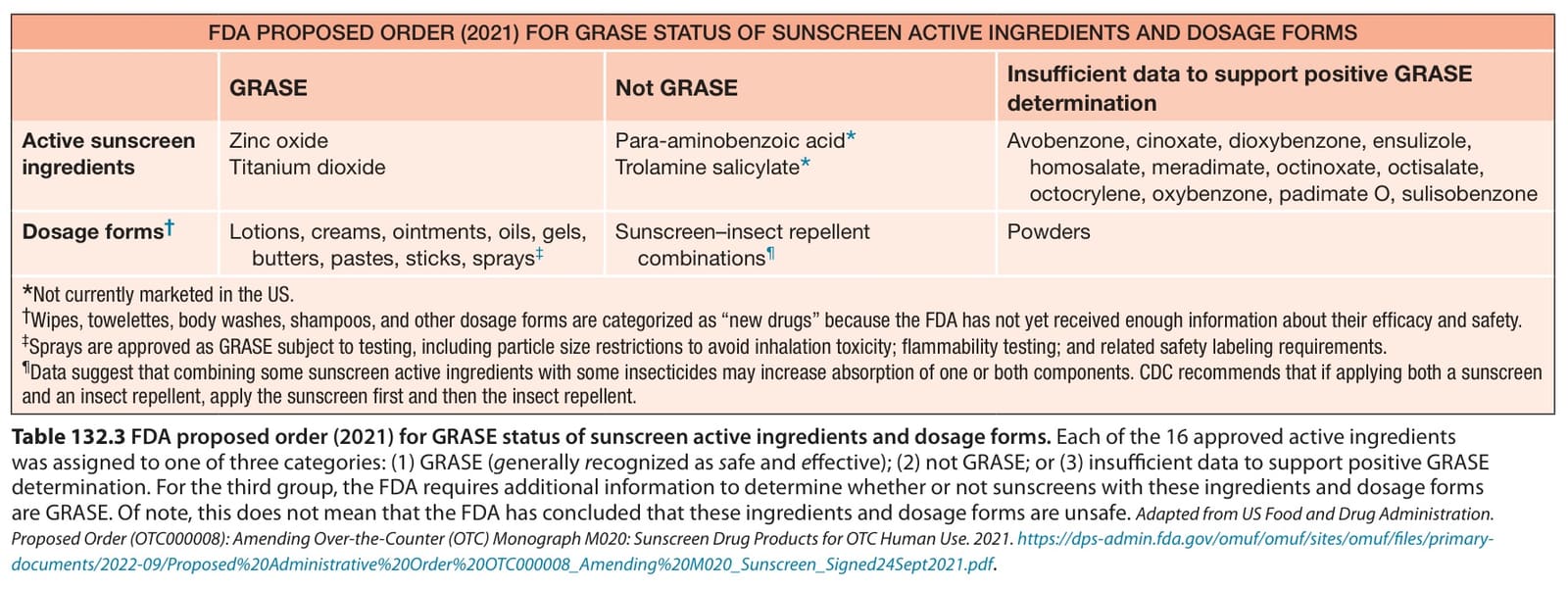
Table 132.3 FDA proposed order (2021) for GRASE status of sunscreen active ingredients and dosage forms. Each of the 16 approved active ingredients was assigned to one of three categories: (1) GRASE (generally recognized as safe and effective); (2) not GRASE; or (3) insufficient data to support positive GRASE determination. For the third group, the FDA requires additional information to determine whether or not sunscreens with these ingredients and dosage forms are GRASE. Of note, this does not mean that the FDA has concluded that these ingredients and dosage forms are unsafe. Adapted from US Food and Drug Administration. Proposed Order (OTC000008): Amending Over-the-Counter (OTC) Monograph M020: Sunscreen Drug Products for OTC Human Use. 2021. https://dps-admin.fda.gov/omuf/omuf/sites/omuf/files/primarydocuments/2022-09/Proposed%20Administrative%20Order%20OTC000008_Amending%20M020_Sunscreen_Signed24Sept2021.pdf.
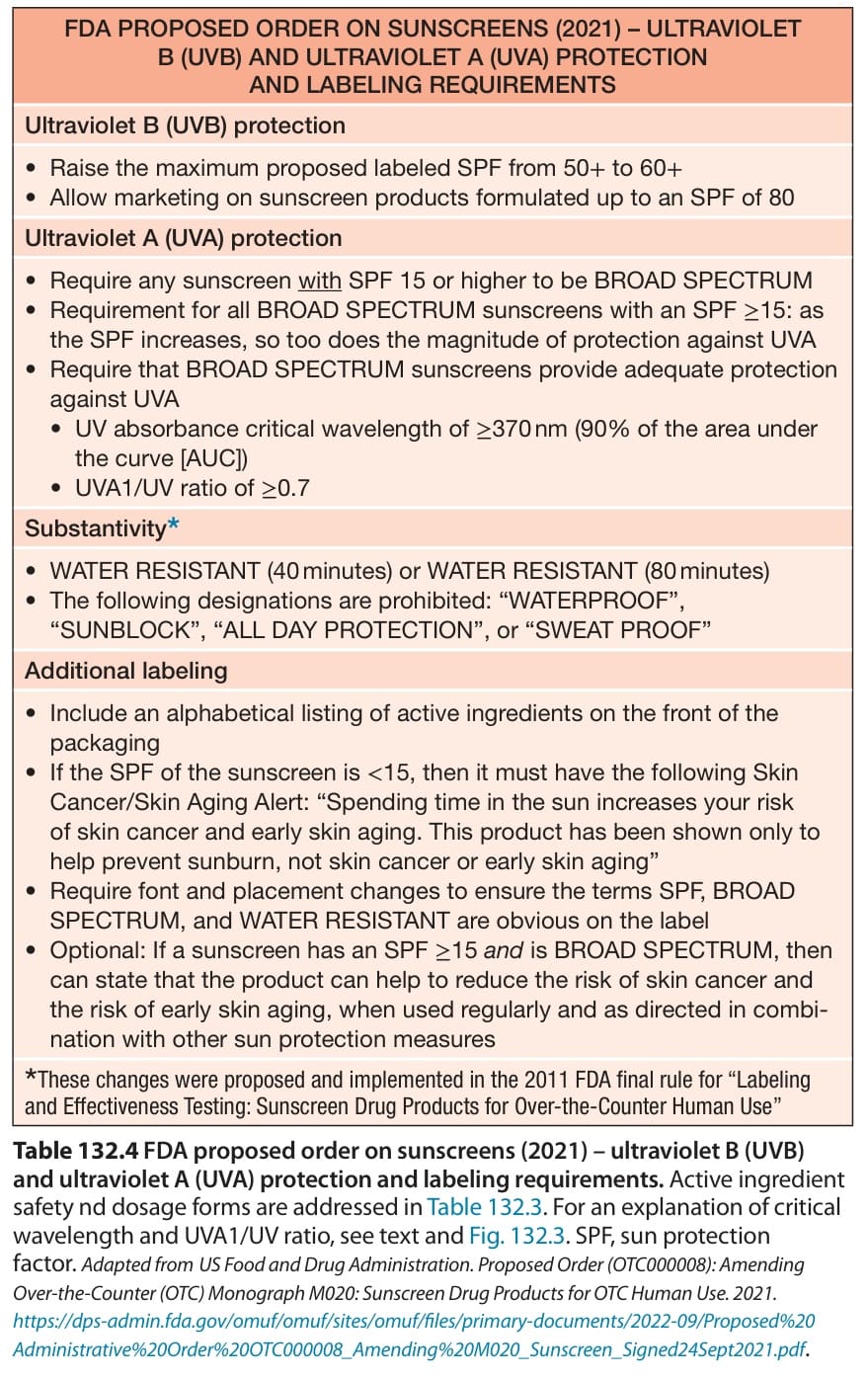
Table 132.4 FDA proposed order on sunscreens (2021) – ultraviolet B (UVB)