SUNSCREEN BENEFITS
An effective sunscreen should protect against sunburn, carcinogenesis, photoaging, photoimmune suppression, and photosensitivity. Efficacy of a given sunscreen product is usually assumed if the combined absorption spectra of the agents in a product match the action spectrum of a given adverse event. The action spectra for the adverse effects of sun exposure are listed in Table 132.5. There is abundant evidence that sunburn, photoaging, keratinocyte carcinoma induction, and photoimmune suppression are all most efficiently produced by UVB radiation. However, studies have shown that for some of these events, UVA also plays a greater or lesser role. For example, UVB is about 1000 times as effective at inducing erythema in human skin as is UVA. On the other hand, photoaging was originally thought to be primarily due to UVB radiation, but UVA penetrates more deeply into the dermis and is likely to have an important role in this process. Similarly, although most studies (in a number of model systems) demonstrated that the maximally effective radiation for inducing photoimmune suppression is in the UVB range, sunscreens providing only UVB protection were not totally effective in blocking this effect.
With regard to cutaneous squamous cell carcinoma (SCC), epidemiologic and animal studies, combined with the identification of UVB and UVA “signature” mutations in human SCCs, strongly support causation primarily by UVB, but UVA may also play a role. Most evidence also supports the role of UVB in basal cell carcinoma (BCC) induction, but the action spectrum for melanoma remains controversial. Still, UVB seems the most likely culprit. For example, in transgenic mice in which melanocytes are aberrantly located in the epidermis, a single erythemal (burning) dose to neonatal mice greatly enhanced melanoma formation.
It must also be remembered that even though UVA may be less effective at inducing a given event in the skin when compared to UVB, there is 10 to 20 times more UVA than UVB in sunlight. In terms of the relative UV doses received by the skin, this ratio is even higher when an individual wears a UVB-protective sunscreen, especially if the SPF is ≥8; this allows a person to stay in the sun longer and results in relatively higher levels of UVA absorption. Therefore, the use of broad spectrum sunscreens should be a goal of any photoprotection strategy.
Although the effectiveness of the protection of a given product might be predicted from a comparison of the action spectrum (see Table 132.5) versus the absorption spectrum (see Fig. 132.4), the most valid measures of efficacy are prospective studies in human subjects. However, for skin cancer and photoaging, such studies are difficult to conduct because these photobiologic processes have such a long latency period. Animal models can be utilized, as has often been done for photoaging and SCC induction, but their availability has been quite limited for BCC (e.g. mice with only one normal allele for Ptch) and melanoma (e.g. opossums). Another approach has been to employ assays that measure the effect of sunscreens on biologic endpoints known to be important pathophysiologic precursors, but before the development of recognizable lesions. Examples would be studying the effects of sunscreens on the development of actinic keratoses or assaying for DNA damage or mutated genes in human skin.
Much of the information on sunscreen efficacy is based on retrospective case–control studies. Because of the lower level of validity of these studies, the variability of study design, and especially inherent recall bias, many such studies arrive at conflicting results.
Sunburn
Myriad unpublished SPF studies performed during the pre-marketing testing of sunscreens attest to their ability to prevent sunburn. However, controlled human studies in “real world” settings have found that sunscreen usage does not always prevent sunburn. The major reason for this discrepancy is that individuals actually do not apply sunscreens at the same surface density as is utilized in controlled SPF testing, i.e. 2 mg/cm. Some studies have shown that most sunscreen users apply only 20%–50% of that quantity. This means that the SPF is correspondingly reduced, i.e. applying only one-half of the standard amount of an SPF 15 product may result in protection comparable to a product with an SPF of 7.5 or even less. The proper quantity of sunscreen to cover the skin of an adult is ~30–45 ml or 2–3 tablespoons. Strategies to improve compliance include applying the product twice to gain the proper surface density, which also reduces the occurrence of “skip” areas, or to use a product with twice the SPF as desired. A recent randomized, double-blind trial demonstrated significantly greater sunburn protection with SPF100+ sunscreen compared to SPF50+ sunscreen during five days under actual use conditions.
Photoaging
In an actinic keratosis study, a significant reduction in dermal elastosis was noted with daily sunscreen use over a 2-year period. A shorter-term study found that sunscreens with broad spectrum coverage that extended significantly into the UVA spectrum prevented many biochemical measures of sun damage (from solar-simulated radiation) in human volunteers. More recently, 903 Australian
adults were studied for a period of 4.5 years. Half were instructed to use sunscreen daily while the remainder were allowed discretionary use of sunscreens. At the conclusion of the study, the daily sunscreen group showed no detectable increase in photoaging whereas skin aging was 24% higher in the discretionary group.
Photoimmunologic Suppression
Immune suppression by UV radiation was first reported in animal studies which showed that mice could no longer reject UV-induced skin tumors if they had been irradiated with non-tumorigenic doses of UV before transplantation of the tumors. This immunosuppressive
effect of UV has been shown to affect delayed-type hypersensitivity and contact sensitivity as well as tumor rejection and it occurs in humans as well as animals. While the responsible action spectrum has been shown to be predominantly in the UVB range, in experimental studies UVB sunscreens have not always afforded protection against immune suppression. In an elegantly designed study in a large number of human volunteers, Kelly and colleagues reported that sunscreen did offer some protection against immune suppression but the level of protection was not as great as for sunburn. The researchers quantified photoprotection from immune suppression as the immune protective factor (IPF) and compared the IPF with the erythema protection factor (EPF), a measure similar to SPF. In their study, the IPF was only 4.9, while the EPF was 14.2. The authors postulated that this difference was due to UVA radiation not blocked by the applied sunscreen. Some investigators concerned about the effect of photoimmune suppression on various aspects of human health have suggested that sunscreens should be tested and labeled for IPF as well as SPF, although its clinical relevance is not directly apparent.
Actinic Keratoses and Keratinocyte Skin Cancer
Because of the long latency period for the development of SCC and BCC, the first two prospective studies in humans examining the effect of sunscreen on cancer prevention tracked actinic keratoses, precursors of SCC, as surrogates for SCC development. In a group of 53 individuals with a previous history of actinic keratoses, an SPF 29 sunscreen was applied daily over a 2-year period; the sunscreen-treated group had significantly fewer actinic keratoses over the 2-year period compared with the placebo group. The difference between the two groups with regard to skin cancers was not significant, probably due to the relatively short duration of the trial.
During a single Australian summer, 588 individuals (>40 years of age) were randomized to daily application of an SPF 17 sunscreen versus vehicle cream. A significant reduction in the number of actinic keratoses in the sunscreen-treated group was observed. Several years later, a prospective Australian study compared an active intervention group, in which SPF 17 sunscreen was supplied and its daily use encouraged, against the background rate of sunscreen use in the general population. The number of SCCs was found to be significantly less in the sunscreen-treated group, but there was no difference in the number of BCCs between the two groups. From clinical observations regarding anatomic distribution, the relationship between UV radiation and BCC is known to be more complex than with SCC.
In a prospective trial involving 120 solid organ transplant recipients (all of whom received education regarding sun protection), 60 individuals were given free broad spectrum sunscreen to apply daily to the head and neck, forearms, and hands. Over a period of 24 months in which an average of 5.6 applications per week was recorded, significantly fewer new actinic keratoses and SCCs developed in the sunscreen group as compared to the control group. While the baseline actinic keratosis count was equal in the two groups, there was also a significant overall reduction in the number of actinic keratoses and fewer invasive SCCs in the sunscreen group. The reduction in BCCs was not statistically significant.
Cutaneous Melanoma
Developing sunscreen efficacy studies for decreasing the risk of melanoma is difficult and some might not consider them to be ethical. As with SCC and actinic keratoses, a number of researchers have used the development of melanocytic nevi in children as a surrogate marker for melanoma risk. The number of nevi has been related not only to sun exposure in children, but also to an enhanced risk for melanoma. In several retrospective epidemiologic studies, researchers have actually reported that children who used sunscreens had an increased number of nevi. However, in the only prospective controlled study published to date, it was demonstrated that sunscreens could suppress the development of melanocytic nevi. This latter study was conducted over a 3-year period with an SPF 30 sunscreen in a total of 485 Canadian schoolchildren 6 to 9 years of age.
Retrospective case–control studies of melanoma patients have produced conflicting results with regard to sunscreen usage and the risk of developing melanoma. Some of these studies showed a decreased risk, while others actually showed an increased risk. Meta-analyses of the published studies by two different groups concluded that sunscreen usage did not increase the risk of developing melanoma, but the analyses could not confirm a protective effect from using sunscreen.
This dichotomy of results has led to a significant controversy concerning the use of sunscreens. The controversy is based on two different but related lines of reasoning. The first relates to the action spectrum for induction of melanoma. If in fact the action spectrum for melanoma is in the UVA range (as suggested by studies in fish but not other animal models), then wearing sunscreens with UVB protection will allow individuals to stay in the sun longer and receive larger doses of UVA, thereby increasing their risk of developing melanoma. The second theory is based on the concept that sunscreen usage decreases vitamin D levels in humans. Because vitamin D has been shown to reduce proliferation and increase differentiation of various normal and tumor cells, low vitamin D levels might increase the risk of developing some cancers, including melanoma.
However, in a prospective study, 1621 Australians (ages 25–75 years) were randomly assigned to daily or discretionary sunscreen application to the head and arms (in combination with 30 mg β-carotene or placebo supplements) for a period of 4 years. They were then followed for another 10 years, and over that time period, 11 new primary cutaneous melanomas were identified in the daily sunscreen group and 22 in the discretionary group. This represented a reduction in the observed rate in the former group (hazard ratio [HR], 0.50; 95% CI, 0.24 to 1.02; p = 0.05); the reduction in invasive melanomas was more substantial: 3 in the daily group versus 11 in the discretionary group.
Photosensitivity Disorders (see Ch. 87)
Some of these reactions are caused by UVB radiation, but the majority of affected individuals react to UVA and/or visible light. Therefore, they require photoprotection with agents that absorb or reflect longer wavelengths and a small number of studies have confirmed the efficacy of such agents. Currently, the most protective formulations appear to be avobenzone- and ecamsule-containing products. Other useful agents include inorganic titanium and zinc oxides and benzophenones. The self-tanners containing dihydroxyacetone in combination with regular sunscreen usage may offer some benefit and iron oxide-containing products may also be helpful. In general, conventional sunscreens are of limited value in patients with cutaneous porphyria because the Soret band includes the violet–blue visible range (see Ch. 49).
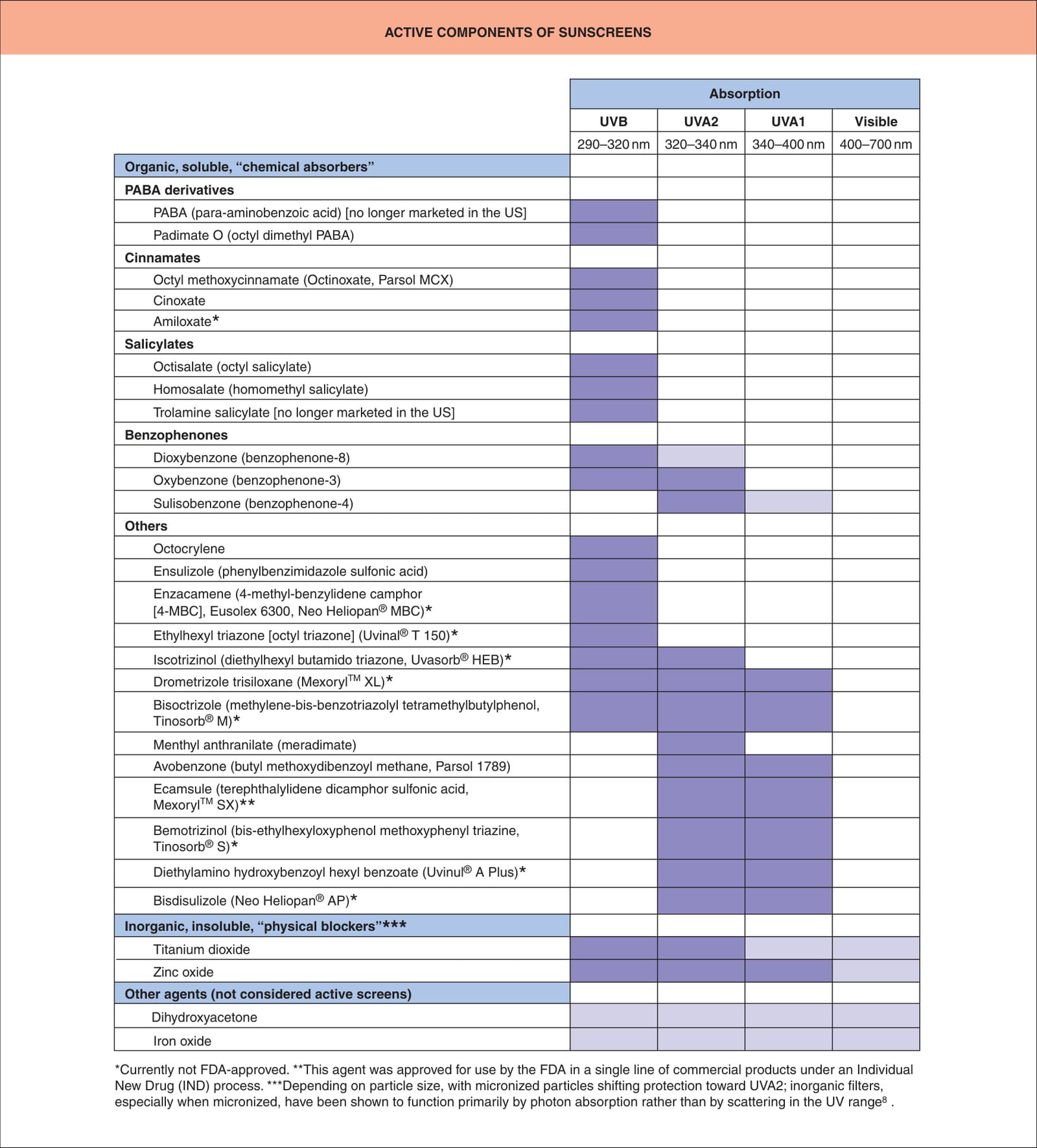
Fig. 132.4 Active components of sunscreens. Lighter colored bars represent variable efficacy. “Boosters” that are not UV filters are also added to sunscreen products, e.g. tiny spheres that scatter incoming radiation and agents that increase the spread of the sunscreen on the skin.
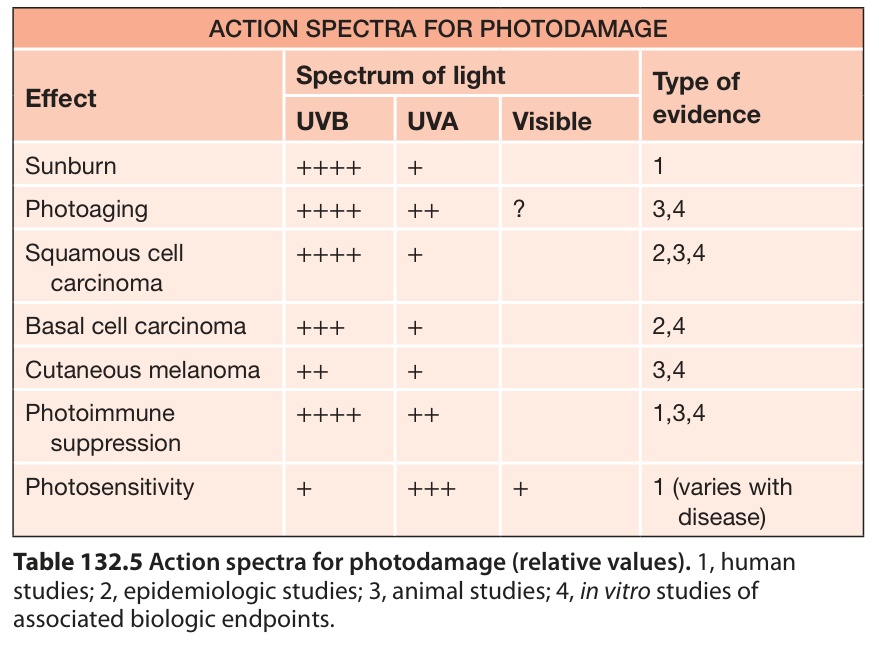
Table 132.5 Action spectra for photodamage (relative values). 1, human studies; 2, epidemiologic studies; 3, animal studies; 4, in vitro studies of associated biologic endpoints.