FUTURE DIRECTIONS
Controlled trials and cumulative clinical experience continue to redefine the spectrum of PDT applications. On the horizon are new photosensitizers and novel ways of delivering ALA. Knowledge gained from D-PDT, including less associated pain, has led to investigations in which low irradiance LED sources are used instead of conventional light sources. Advances in PDT have been accompanied by progress in imaging techniques such as confocal reflectance microscopy. Combination of the two in the future could lead to noninvasive diagnosis and delineation of cutaneous carcinomas as well as treatment and long-term evaluation.
Additional figures available in our eBook (see inside front cover for access code).
for field treatment of actinic keratoses: a randomized clinical trial. JAMA Dermatol. 2017;153:637–643.7. Szeimies RM, Stockfleth E, Popp G, et al. Long-term
Photoradiation therapy for the treatment of malignant tumors. Cancer Res. 1978;38:2628–2635.2. Kennedy JC, Pottier RH, Pross DC. Photodynamic therapy protocol involving irradiation with a light-emitting, fabric-based device (the Flexitheralight protocol) compared with the conventional protocol involving irradiation with the Aktilite CL 128 lamp. Br J Dermatol. 2019;180:765–773.12. Wiegell SR, Fabricius S, Heydenreich J, et al. Weather follow-up of photodynamic therapy with a self-adhesive 5-aminolaevulinic acid patch: 12 months data. Br J Dermatol. 2010;162:410–414.8. Kim BS, Kim JY, Song CH, et al. Light-emitting diode laser with endogenous protoporphyrin IX: basic principles and present clinical experience. J Photochem Photobiol B. 1990;6:143–148.3. Rubel DM, Spelman L, Murrell DF, et al. Daylight photo- conditions and daylight-mediated photodynamic therapy: protoporphyrin IX-weighted daylight doses measured in six geographical locations. Br J Dermatol. 2013;168:186–191.13. Wiegell SR, Wulf HC, Szeimies RM, et al. Daylight photo- versus pulsed dye laser-assisted photodynamic therapy in the treatment of actinic keratosis and Bowen’s disease. Dermatol Surg. 2012;38:151–153.9. Hasegawa T, Suga Y, Mizuno Y, et al. Efficacy of photody- dynamic therapy with methyl aminolevulinate cream as a convenient, similarly effective, nearly painless alternative to conventional photodynamic therapy in actinic keratosis treatment: a randomized controlled trial. Br J Dermatol. 2014;171:1164–1171.4. Hayami J, Okamoto H, Sugihara A, Horio T.
namic therapy with topical 5-aminolevulinic acid using intense pulsed light for Bowen’s disease. J Dermatol. 2010;37:623–628.10. Ibbotson SH, Ferguson J. Ambulatory photodynamic
Immunosuppressive effects of photodynamic therapy by topical aminolevulinic acid. J Dermatol. 2007;34:320–327.5. Bissonnette R, Tremblay JF, Juzenas P, et al. Systemic dynamic therapy for actinic keratosis: an international consensus: International Society for Photodynamic Therapy in Dermatology. J Eur Acad Dermatol Venereol. 2012;26:673–679.14. Wulf HC. Photodynamic therapy in daylight for actinic therapy using low irradiance inorganic light-emitting diodes for the treatment of non-melanoma skin cancer: an open study. Photodermatol Photoimmunol Photomed. 2012;28:235–239.11. Vicentini C, Vignion-Dewalle AS, Thecua E, et al.
photodynamic therapy with aminolevulinic acid induces apoptosis in lesional T lymphocytes of psoriatic plaques. J Invest Dermatol. 2002;119:77–83.6. Petukhova TA, Hassoun LA, Foolad N, et al. Effect of keratoses. JAMA Dermatol. 2016;152:631–632.15. Cottrell WJ, Paquette AD, Keymel KR, et al. Irradiance- dependent photobleaching and pain in delta-aminolevulinic acid-photodynamic therapy of superficial basal cell carcinomas. Clin Cancer Res. 2008;14(14):4475–4483.16. de Vijlder HC, Sterenborg H, Neumann HAM, et al.
Photodynamic therapy for actinic keratosis of the forehead and scalp: a randomized, controlled, phase II clinical study evaluating the noninferiority of a new expedited microneedle-assisted photodynamic therapy
Light fractionation significantly improves the response
indications and specific procedural steps guided by the individual practitioner’s experience and empiric preferences. One round of topical drug plus light (administered as a single exposure or as multiple fractionated exposures) can be considered a single PDT session. A “course” or “cycle” of PDT may involve one or more individual PDT sessions separated by a set time interval. What should not be underestimated is the time and staffing necessary to provide appropriate patient counseling and education as well as intraoperative support and supervision during the light exposure phase. Consensus recommendations and guidelines from various expert groups and dermatologic societies have been published to guide the use of PDT.
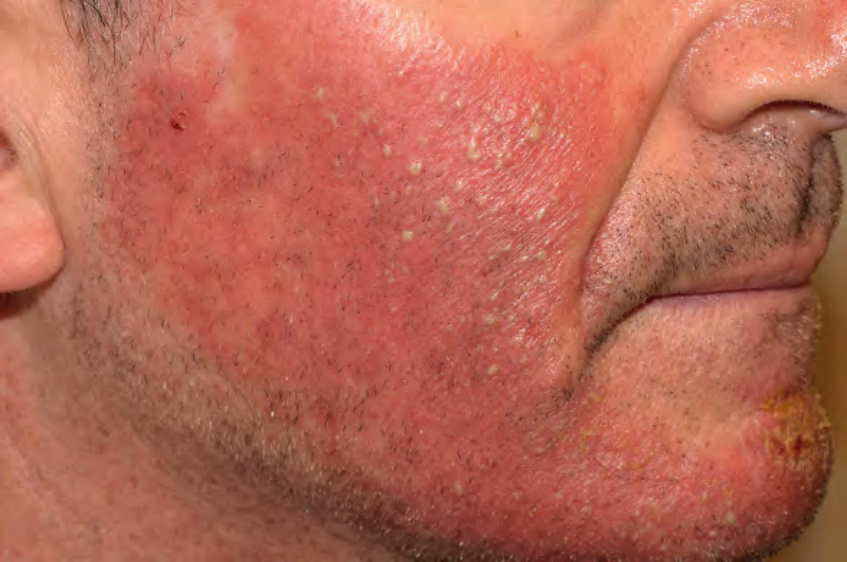
Fig. 135.8 Erythema, edema, and multiple pustules 4 days after photody- namic therapy (PDT) for actinic keratoses. Topical 20% 5-aminolevulinic acid (ALA) was followed by irradiation with red light from an LED (light-emitting diode).