ELECTROEPILATION
Electroepilation is the use of electricity for the permanent removal of hair. It predated the development of laser hair removal and is still used, in a variety of forms, by aestheticians and electrologists. The word electrolysis, which is used by most people as a generic term to mean the electrical destruction of hair, is technically the use of direct (galvanic) current for hair removal. Hair destruction with an alternating current occurs as a result of the accumulation of heat in the vicinity of the hair bulb and is designated thermolysis.
Electrolysis vs Thermolysis
Electrolysis uses direct current to create a destructive chemical reaction at the hair root. The negative electrode (anode) is inserted into the hair follicle (see Fig. 140.1). The positive electrode (cathode) is a moistened pad held in the patient’s hand. When direct current is applied, a chemical reaction at the tip of the anode causes the production of sodium hydroxide. The latter acts as a caustic and destroys the hair root. This process may take from 30 to 60 seconds to occur, so pure “galvanic electrolysis” is a tedious procedure to perform. Of note, electrolysis can also be used to treat small telangiectasias (see Fig. 140.1).
Thermolysis relies on heat to cause hair destruction. A high-frequency (13.56 MHz) alternating current is used. As the current passes through tissue, it encounters resistance, causing the current to stall and convert to heat. Current can be applied by the “slow” (manual) technique or the “flash” technique. Lower heat is used over 3–10 seconds in the slow technique. Gentle traction of the hair allows the operator to determine when destruction is complete. The flash technique uses higher heat, delivered by a preset mechanical timer (<1 second). Several such pulses may be required to cause hair root destruction. Theoretically, the flash technique is less painful.
The technique for needle insertion is the same as for electrolysis. A patient hand-held electrode is not required since the patient is not included in the electrical circuit. The speed of thermolysis allows for treatment of much larger areas over a shorter time period. For this reason, it has replaced galvanic electrolysis as the preferred manner of electroepilation. The blend is a form of electroepilation that takes advantage of attributes of both electrolysis and thermolysis, by blending the two types of current in one machine. The blend is slower than thermolysis, but may offer some advantages in rate of hair root destruction, particularly for coarser hairs.
Side Effects
Thermolysis and the blend are more painful than classic galvanic electrolysis and the risk of scarring and hair regrowth may be higher. However, highly motivated patients generally tolerate the pain and are treated with 30- to 60-minute sessions once or twice weekly. The use of topical anesthetics under occlusion for 1–2 hours pretreatment decreases the pain in some patients. Scarring is a real risk and is operatordependent. Generally, when this occurs, it presents as punctate or ice pick-like depressed scars. In some patients, small hypertrophic papules may appear.
Hair regrowth has been reported in the range of 15% to 50%, and this is also technique-dependent. Regrowth may be related, in part, to the hair cycle. Hairs treated while in telogen phase may not experience root destruction. Some electrologists recommend shaving 2 days prior to treatment so that only actively growing hairs will be apparent.
Varying degrees of erythema and edema may be present shortly after the procedure. Postinflammatory hypo- and hyperpigmentation have been reported. The theoretical risk of infections, both local and systemic, exists, but proper skin cleansing helps prevent this problem. Some patients have a higher propensity for developing post-treatment folliculitis and it is recommended that they cleanse with an antibacterial cleanser (e.g. chlorhexidine), before and after treatment. Disposable needles are the norm in the practice of permanent hair removal.
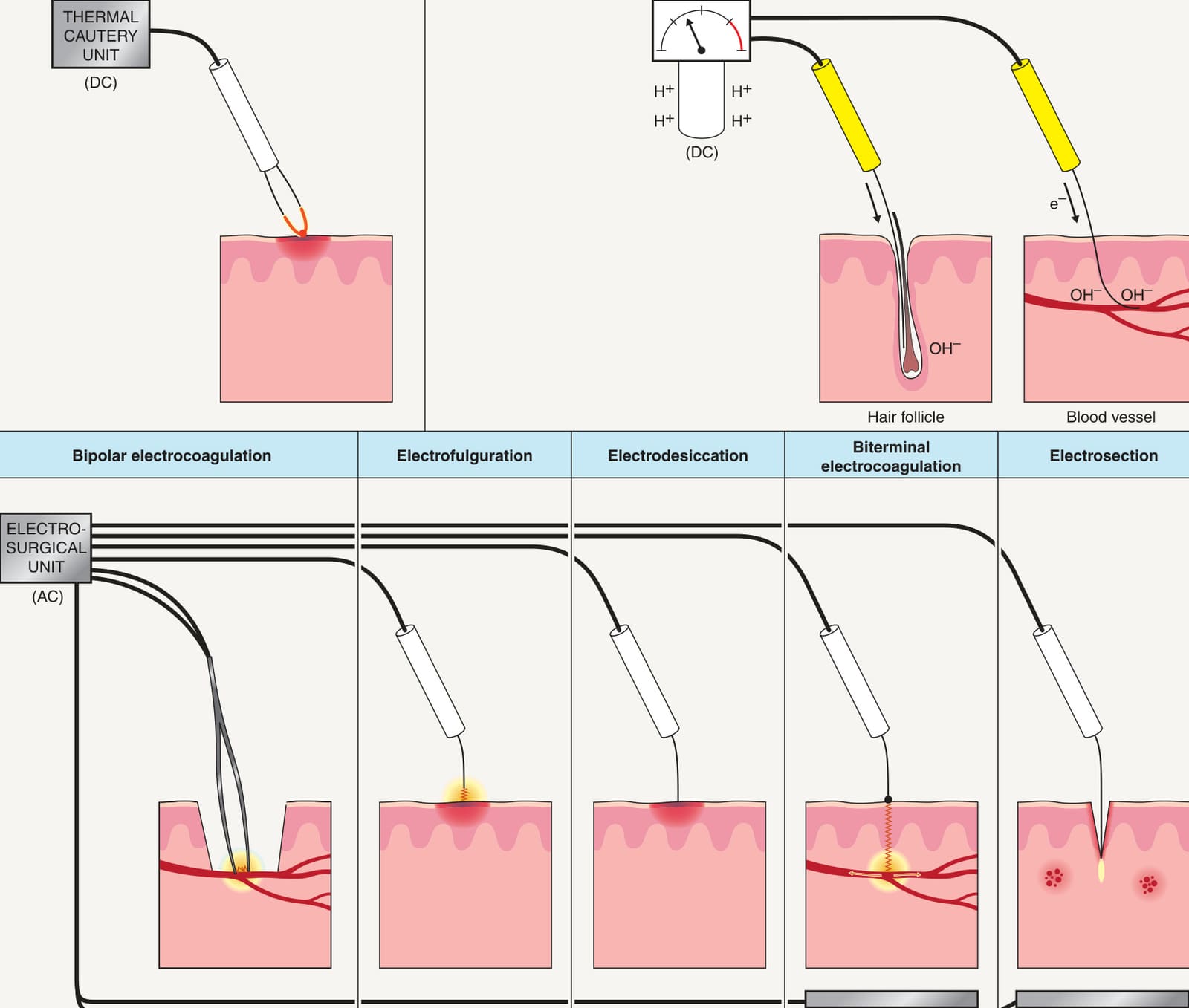
Fig. 140.1 Electrocautery, electrolysis, and different types of electrosurgery. AC, alternating current; DC, direct current; e−, electron; H+, proton; OH−, hydroxide ion.