Introduction
Amelia K. Hausauer and Derek H. Jones Injectable Soft Tissue Augmentation 158
Key features
Fillers are used to soften the appearance of superficial wrinkles and to recontour and smooth the deep folds of the face
Other indications include reducing the appearance of atrophic, traumatic, and acne scars; lip augmentation; and volumizing the face in areas of lipoatrophy or senescence-associated fat loss
Agents include hyaluronic acid derivatives, synthetic materials, autologous fat, and platelet-rich plasma
Selection of an agent depends on the size, depth, and location of the volume deficiency as well as the cost and longevity of the product
Agents are injected into the dermis, subcutaneous fat, or supra- periosteal space via a needle or cannula; various techniques, such as serial puncture, linear threading, fanning, cross-hatching or depot injection, are utilized and require an understanding of anatomy and best injection practices
Fillers can be used as monotherapy or as an adjunct to other
rejuvenating injectable techniques or surgical procedures in order to maximize longevity and aesthetic correction
Complications are technique-dependent or material-related, and include hypersensitivity reactions, granuloma formation, bacterial biofilms, contour irregularities, and vascular occlusion, in addition to common injection-related phenomena such as pain, edema, and purpura
Interventions for the aging face can be broadly categorized into the four “R’s” of facial rejuvenation: Resurfacing (chemical peels, dermabrasion, and ablative and non-ablative lasers); Redraping (the various pulling and lifting facial surgical procedures); Relaxing (chemodenervation with paralytic agents); and Replacement/Recontouring (the use of filling agents for superficial and deep soft tissue augmentation). This fourth “R” has witnessed remarkable growth as patient demand for safe and effective minimally invasive aesthetic techniques has increased. In concert, the number of available dermal fillers and agents for soft tissue augmentation has expanded exponentially. More recently, there has been a shift from filling wrinkles and lines to replacing volume loss associated with atrophied fat and bone.
Patients often do not adequately appreciate the degree and significance of their volume deficit and must first be educated about the underlying anatomy of what is producing their “wrinkle”. In addition to explaining the significance of volume deficits adjacent to the areas of primary concern, a distinction must be made between dynamic versus static lines as well as cutaneous changes due to photodamage versus those due to chronologic aging (senescence) (Table 158.1). Although these defects often appear in combination, they must be assessed individually. Patients should be made aware of newer, commercially available injectable products so that the physician is able to personalize
their treatment and cater to subtle nuances of their faces. Many of the newer products have unique characteristics and indications that make them more suitable for certain patients (Table 158.2).
While the type of defect is clearly important, so are its size, depth, and location, in addition to the appearance and integrity of the adjacent tissue. A discussion regarding therapeutic options should include alternatives such as surgery (e.g. rhytidectomy, excision), resurfacing (see Ch. 137), and chemodenervation agents (see Ch. 159), as well as no inter-vention at all. Patients should understand the indications, technique, advantages, disadvantages, and inherent risks of each procedure, and they should be given an estimate of the financial cost and “downtime”. As with any treatment, the degree of overall success is largely proportional to the creation (and achievement) of realistic and appropriate goals and expectations. Patients undergoing elective rhytide effacement and optimization with injectable fillers must realize that replacing lost or atrophic subcutaneous tissue is often temporary. Monotherapy with one agent may not be adequate, and multiple agents may be required. All wrinkles are not created equal; they come in many shapes and sizes, and there is no one filler agent that is suitable for all defects. The choice of an appropriate dermal or subcutaneous implant requires knowledge of the available options and their characteristics.
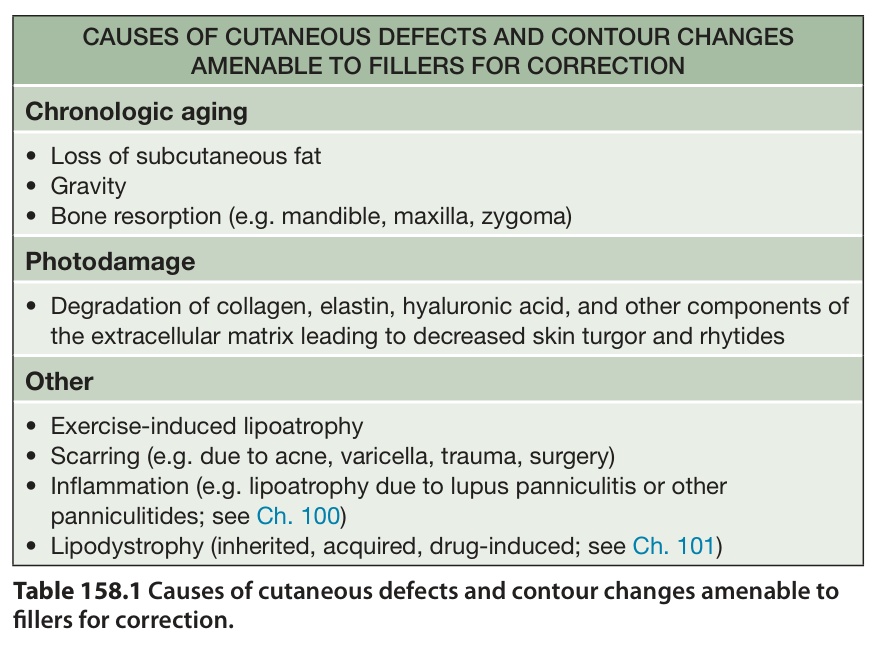
Table 158.1 Causes of cutaneous defects and contour changes amenable to fillers for correction.
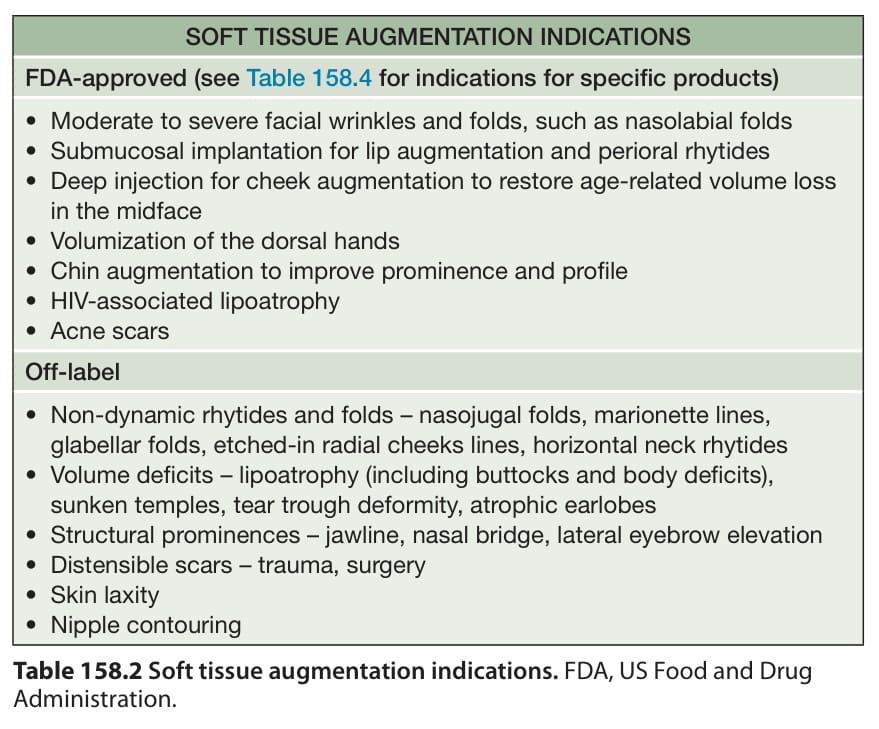
Table 158.2 Soft tissue augmentation indications. FDA, US Food and Drug Administration.