EPIDEMIOLOGY
Approximately 85 million people have been diagnosed with HIV disease since the start of the pandemic, and HIV/AIDS continues to be a major worldwide public health challenge in the 21st century. HIV/AIDS disproportionately affects resource-poor countries and key populations which include sex workers, individuals who inject drugs, gay men, other men who have sex with men (MSM), transgender people, and prisoners. Globally in 2021, 38 million people were estimated to be living with HIV, with the majority (~21 million) in Eastern and Southern Africa (Fig. 78.1). The proportion of people with HIV who are receiving ART has risen dramatically, from <3% in 2000 to 75% in 2021, and the number of yearly AIDS-related deaths worldwide decreased from a peak of 2 million in 2005 to ~650 000 in 2021. Globally, ~1.5 million people were newly diagnosed with HIV in 2021, representing a decline of almost 50% from 2.9 million in 2000.
Although the annual number of new HIV diagnoses in sub-Saharan Africa has been decreasing since 2010, the HIV pandemic still most severely affects this region, which accounted for two-thirds of all people living with HIV and ~60% of new HIV diagnoses in 2021. Of note, the HIV transmission rate has recently increased in Eastern Europe, Central Asia, the Middle East, North Africa, and Latin America. In 2021, key populations and their sexual partners accounted for 70% of new HIV disease globally, ranging from 46% in Eastern and Southern Africa to >95% in Europe, Asia, the Pacific, the Middle East, North Africa, and North America. Risk factors for HIV transmission include high viral load, condomless receptive anal intercourse, lack of circumcision, and the presence of other sexually transmitted infections.
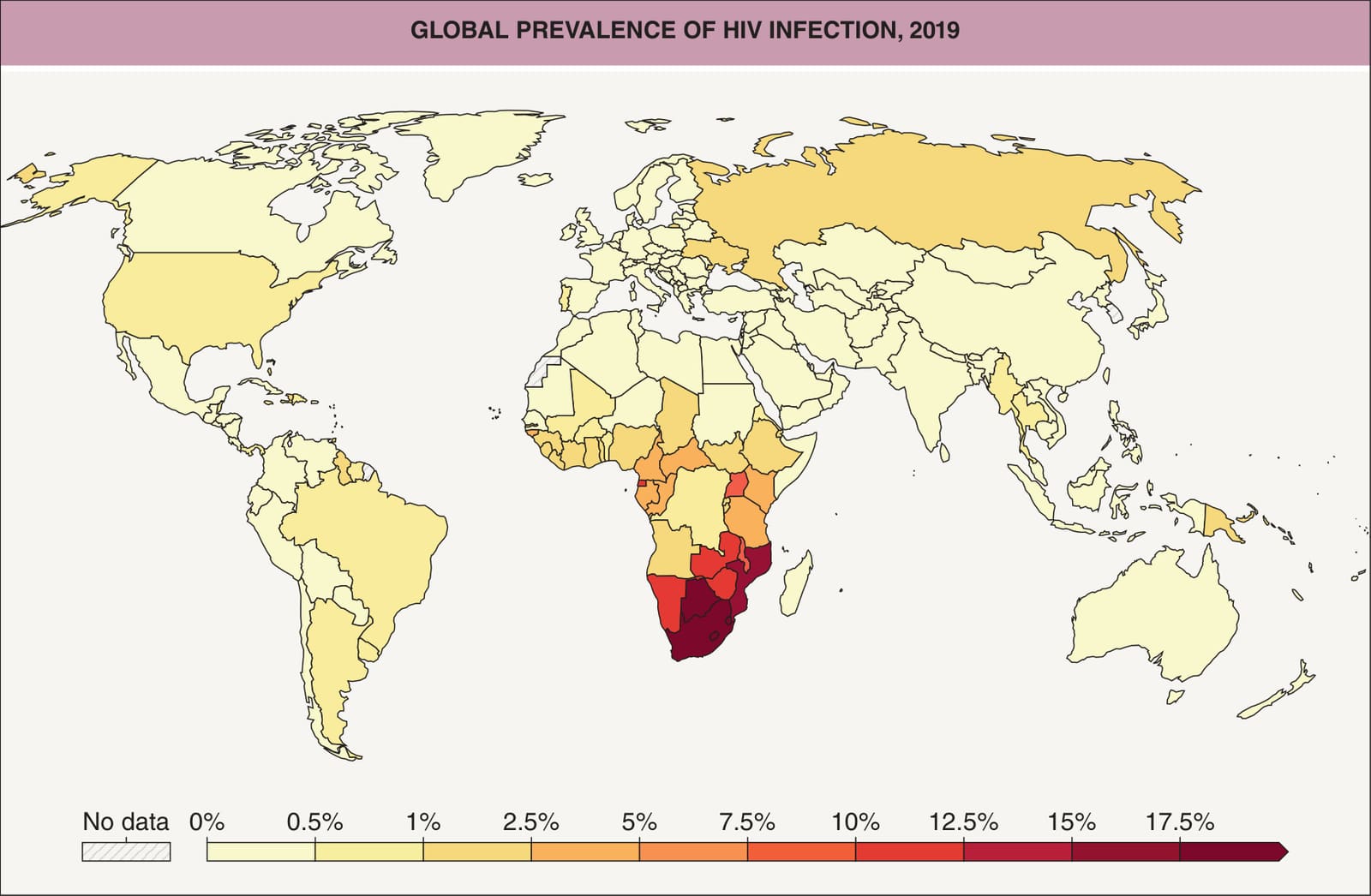
Fig. 78.1 Global prevalence of HIV infection, 2019. The worldwide estimate of the number of people living with HIV was 38.4 million in 2021, representing an overall prevalence of almost 0.5%. From the Institute for Health Metrics and Evaluation (IHME) 2019 Global Burden of Disease.