INTRODUCTION
“Psychodermatology” refers to any aspect of dermatology in which psychological factors play a significant role in the genesis, exacerbation, or sequelae of a skin condition. At least a third of patients seen in dermatology practices require consideration of associated emotional and psychosocial factors for effective management of their cutaneous disease.
Many patients with psychodermatologic problems decline referral to a mental health professional, and some become upset if such a referral is suggested. Ironically, the individuals who are the most psychologically “ill” often have the least insight into the psychogenic nature of their condition and frequently refuse a psychiatric referral. The dermatologist is then faced with two choices. The first is to try to address the psychologic condition. If a dermatologist decides to take this route, it is necessary to be familiar with the approach to diagnosis, therapeutic options (both pharmacologic and non-pharmacologic, including potential side effects of medications), and limitations of what can be accomplished in a dermatology practice. The other option is to disregard the psychologic problem and allow this component of the patient’s disorder to remain untreated. However, this option represents a disservice to the patient and may lead to unnecessary utilization of healthcare services and persistent psychopathology. Dermatologists can learn to effectively handle psychodermatologic issues within the limits of their training and practice setting. Although less comprehensive than treatment delivered in collaboration with a psychiatrist, in the authors’ opinion, management of these issues by a dermatologist is important.
Clinically useful methods of conceptualizing and classifying psycho dermatologic disorders are presented in Fig. 7.1. This incorporates updates from the fifth edition of the American Psychiatric Association’s Diagnostic and Statistical Manual of Mental Disorders (DSM-5™). Selected primary and secondary psychologic conditions that are commonly encountered in a dermatologic practice are discussed in this chapter. Strategies for the evaluation and management of patients with these disorders are reviewed, including pharmacologic and non-pharmacologic treatments. Disorders characterized by pruritus and dysesthesia are covered in Chapter 6.
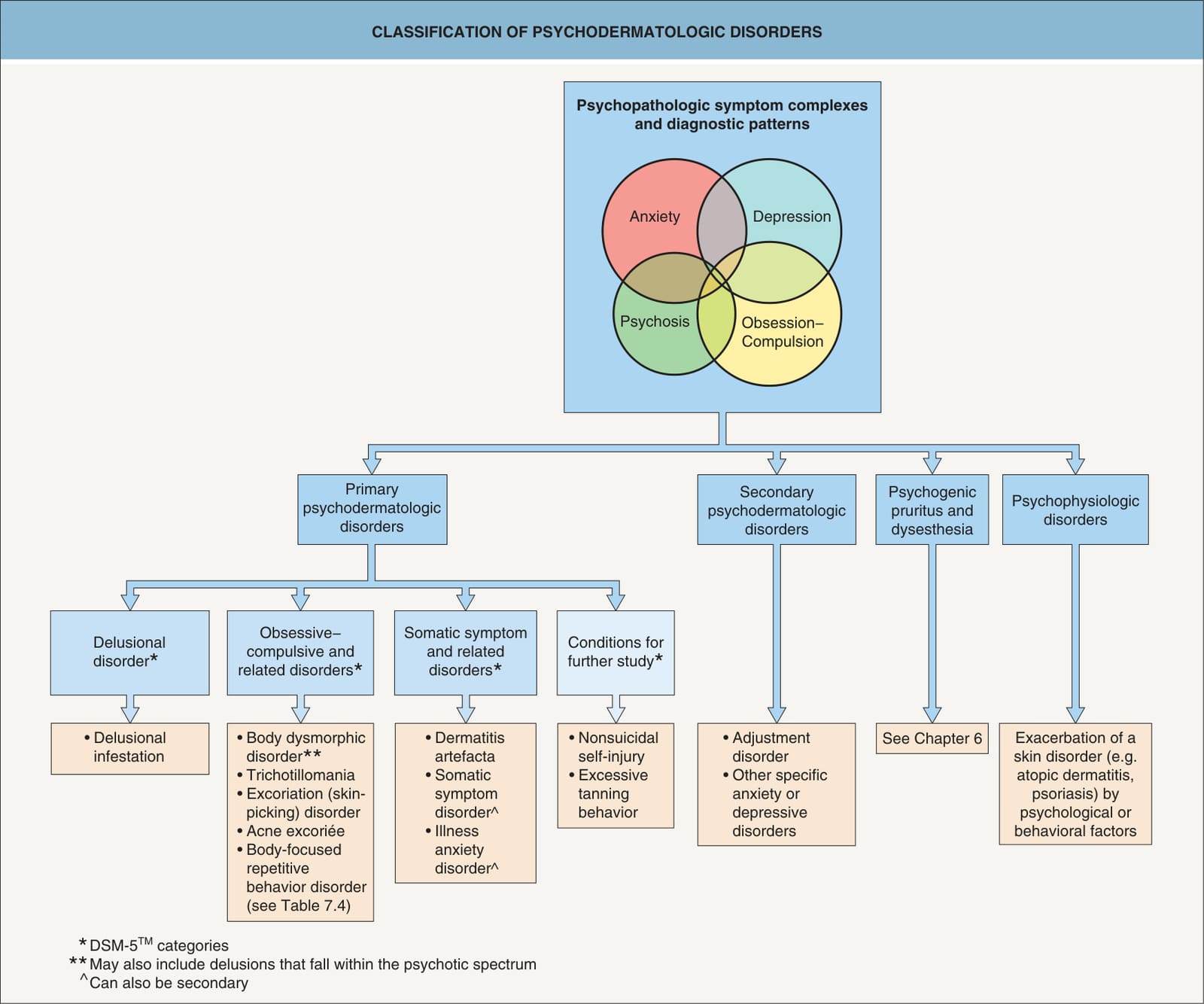
Fig. 7.1 Classification of psychodermatologic disorders. Psychocutaneous disorders can be conceptualized by: (1) the specific psychodermatologic condition and its classification; and (2) the presenting symptom complex of the underlying psychopathology. Primary psychodermatologic disorders are those in which the patient typically has no primary skin disease and cutaneous lesions are self-induced. Secondary psychodermatologic disorders are those in which the patient develops psychological distress or a psychologic disorder as a result of a skin disease. Psychophysiologic disorders are those in which a primary skin condition, such as psoriasis, is exacerbated by psychological or behavioral factors (e.g. stress, anxiety). A particular patient with a psychodermatologic disorder can have a presenting symptom complex with features from one or more of the four major psychopathologic patterns of anxiety, depression, psychosis, and obsessions/compulsions.