Trichotillomania
Synonyms: Habitual hair pulling Hair-pulling disorder
Key features
Recurrent pulling out of one’s hair, most often from the scalp, eyebrows, and eyelashes
Varying lengths of hair are typically seen within areas of alopecia
Behavior modification therapy is the mainstay of treatment
Introduction
Trichotillomania represents a body-focused repetitive behavior disorder characterized by hair pulling.
Epidemiology
The prevalence of trichotillomania in adolescents and adults in the general population is roughly 1%–2%. The female : male ratio is as high as 10 : 1 in adults but more equal in children. The peak onset of
hair pulling is around the time of puberty. The majority of patients also have other body-focused repetitive behaviors such as nail biting or skin picking (see Table 7.4). In dermatologic practice, trichotillomania is usually seen in relatively psychologically intact individuals. Of note, hair pulling in toddlers and preschool-aged children is more common in boys than girls and, unlike trichotillomania in older children, tends to resolve spontaneously.
Clinical features
The DSM-5™ diagnostic criteria for trichotillomania include: (1) recurrent pulling out of one’s hair, resulting in hair loss; (2) repeated attempts to decrease or stop the hair pulling; (3) significant distress or impaired functioning related to the hair pulling; and (4) no underlying medical condition or other mental disorder that explains the hair loss/ pulling. In dermatologic practice, the spectrum ranges from inattentive, habitual hair pulling to obvious obsessive–compulsive psychopathology involving well-planned rituals.
The most common sites of hair pulling are the scalp, eyebrows, eyelashes, and pubic region. Hair pulling typically occurs while alone or in the presence of close family members. It may be preceded or accompanied by anxiety or boredom, and some patients describe a prior tingling sensation. Pulling of the hair results in gratification, pleasure, or a sense of relief in some patients, while others display a more automatic behavior with less conscious awareness. Pulling may be confined to a specific time of the day and place, with ritualized manipulation of the pulled hairs prior to discarding them. Some patients practice trichophagy, the chewing and swallowing of the hair that has been pulled out, which can lead to intestinal obstruction from trichobezoars. Occasionally, affected individuals pull hair from family members, pets, dolls, sweaters, or carpets.
The classic physical finding is hairs of varying lengths distributed within the area of alopecia, with uninvolved areas appearing completely normal (Fig. 7.4); the hairs are sometimes referred to as “irregularly irregular”. This pattern likely reflects a hair-pulling technique of twisting multiple strands around the fingers and pulling them simultaneously. Lesions are often single and can be large; the vertex and parietal scalp are the most common sites. While broken hairs and black dots are seen
Note the hairs of varying lengths and small areas of sparing.
by trichoscopy, more specific findings include hook, coiled, tulip and flame hairs, the V-sign, and trichoptilosis (see Ch. 69). Patients may try to conceal the hair loss with make-up, scarves, hats, or wigs.
Diagnosis and pathology
Many patients admit to hair pulling, but trichoscopy and biopsy may be helpful when the diagnosis is in doubt. Another useful test is the “clipped hair square”, in which a small section of affected hair is clipped close to the scalp with scissors or shaving; too short to pull out, the hairs display uniform regrowth.
Histopathologic findings can include deformed hair shafts (trichomalacia), empty follicles, and pigmented hair casts (Fig. 7.5), which may also be seen with traction alopecia and other forms of follicular trauma. Inflammatory cells are usually sparse or absent. Perifollicular hemorrhage is sometimes found in early lesions, and perifollicular fibrosis represents a late change. If the follicle is destroyed, a vertical fibrous tract often remains at the site.
Differential diagnosis
The differential diagnosis includes other causes of circumscribed non-scarring alopecia such as alopecia areata (see Ch. 69), which occasionally coexists with trichotillomania, and tinea capitis. However, in trichotillomania there are no exclamation point hairs, scaling and pustules are absent, and fungal cultures are negative.
Treatment
The prognosis and approach to treatment of trichotillomania depend upon the age of onset and degree of underlying psychopathology. As noted above, preschool children typically outgrow the habit, and management usually involves bringing awareness to the parents and patient. Onset in the pre-adolescent to young adult years often portends a chronic, relapsing course requiring more intervention. Later adult onset is frequently associated with psychopathology that requires psychiatric referral.
Behavior modification therapy (e.g. habit reversal training, CBT) is the mainstay of treatment. This includes awareness training, teaching the patients to do something else whenever they feel the urge to pull their hair, relaxation techniques, and positive reinforcement. In addition, a family and peer support network may be helpful. Antidepressants (especially SSRIs and clomipramine) have been reported to be effective in some studies. However, two randomized controlled trials failed to show benefit of antidepressants compared to placebo, and several others found that behavioral therapy was more effective than antidepressants. In other randomized controlled studies, treatment with olanzapine or N-acetylcysteine (a glutamatergic agent; 1200–2400 mg/day) led to more improvement in adults with trichotillomania than did placebo.
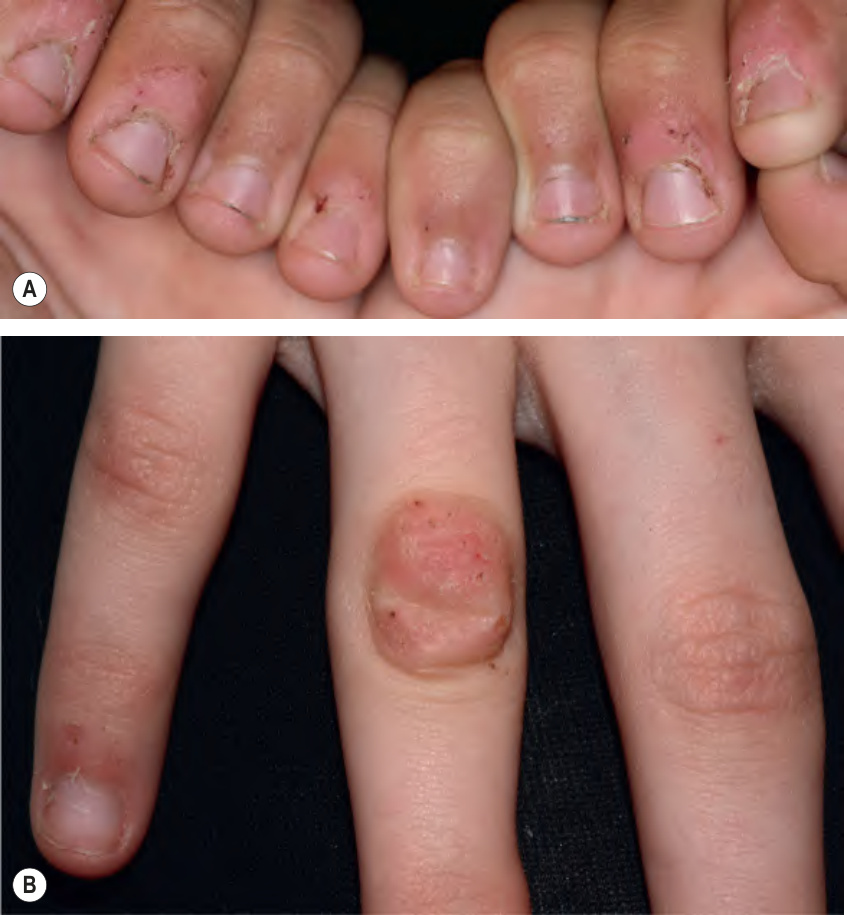
Fig. 7.3 Body-focused repetitive behaviors.A Sequelae of nail biting (onychophagia) and cuticle picking. B Pseudo-knuckle pad due to habitual repetitive hand movements. B, Courtesy Julie V. Schaffer, MD.
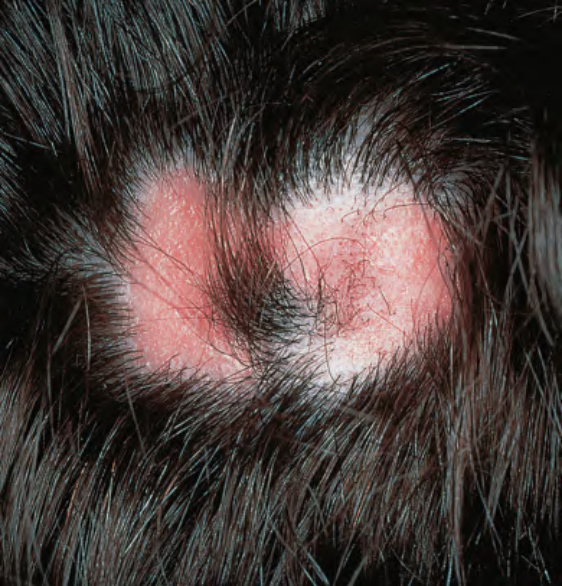
Fig. 7.4 Trichotillomania.
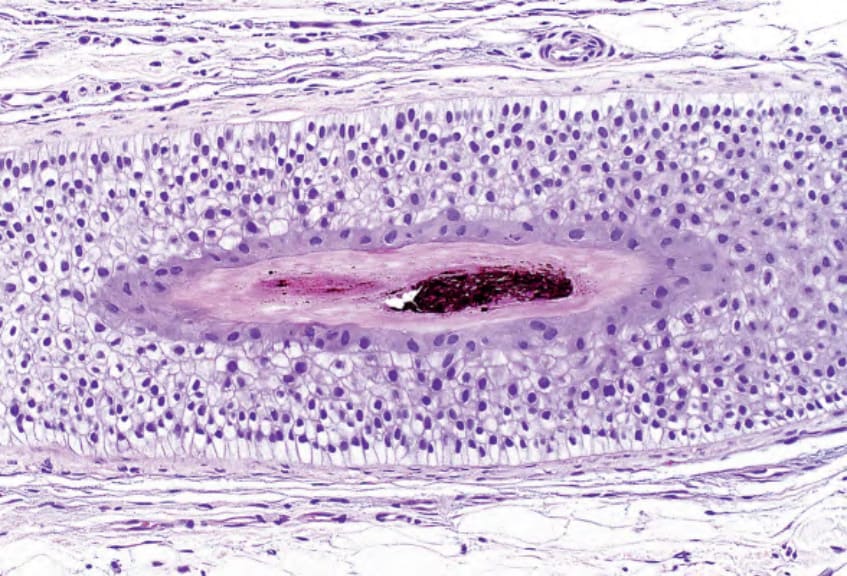
Fig. 7.5 Histopathology of trichotillomania. Pigmented follicular cast. Courtesy Ronald P. Rapini, MD.
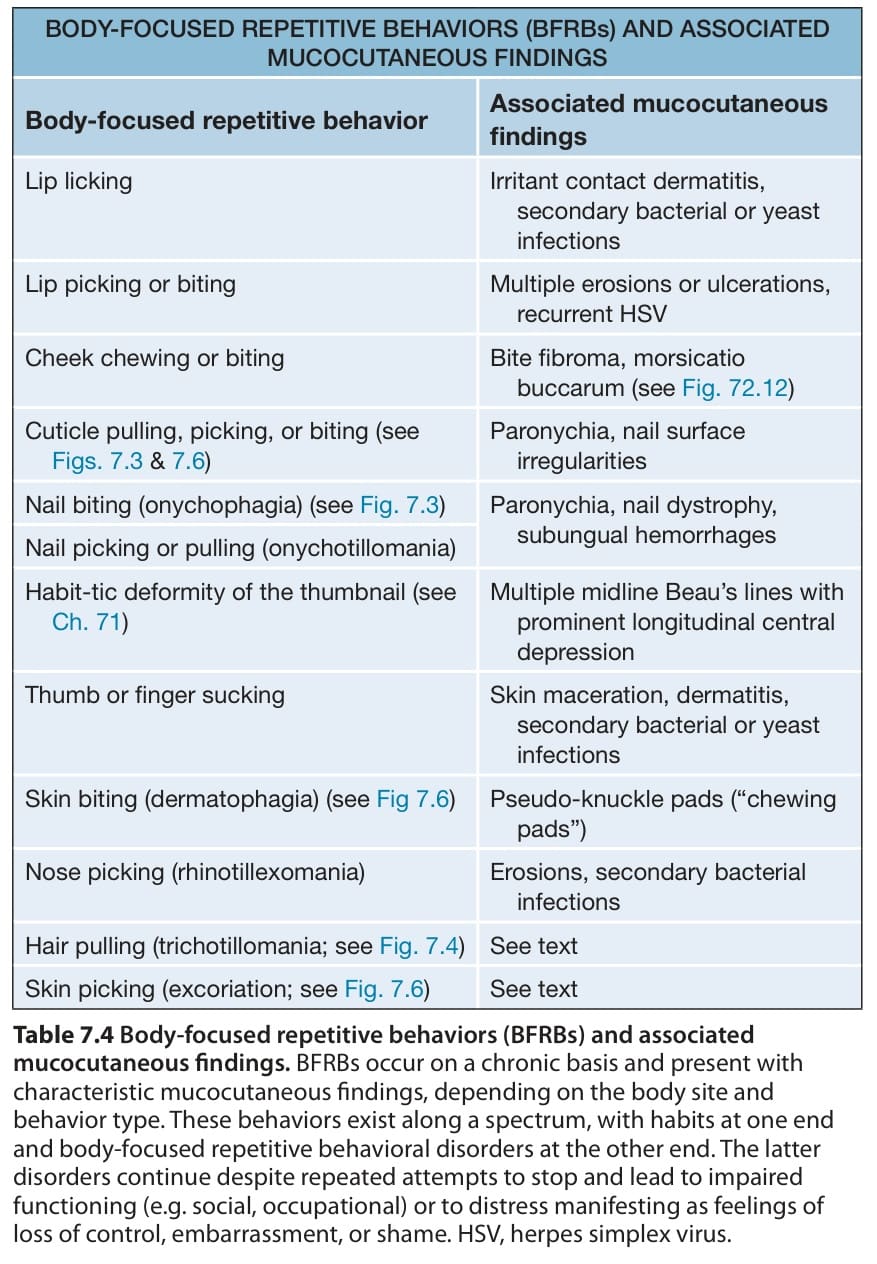
Table 7.4 Body-focused repetitive behaviors (BFRBs) and associated mucocutaneous findings. BFRBs occur on a chronic basis and present with characteristic mucocutaneous findings, depending on the body site and behavior type. These behaviors exist along a spectrum, with habits at one end and body-focused repetitive behavioral disorders at the other end. The latter disorders continue despite repeated attempts to stop and lead to impaired functioning (e.g. social, occupational) or to distress manifesting as feelings of loss of control, embarrassment, or shame. HSV, herpes simplex virus.