SECONDARY PSYCHODERMATOLOGIC DISORDERS
Patients often experience concern and suffering due to skin conditions that are life-threatening (e.g. melanoma), disfiguring (e.g. alopecia areata, vitiligo), intensely pruritic or painful (e.g. atopic dermatitis, hidradenitis suppurativa), or even relatively minor but troublesome. When the magnitude of the distress exceeds that which would be expected and/ or there is impairment in life functioning, then a secondary psychodermatologic condition such as anxiety, depression, and/or adjustment disorder should be considered.
Adjustment Disorder
Adjustment disorders are common in medical practice and may occur in response to a dermatologic condition. DSM-5™ defines an adjustment disorder as the development of emotional or behavioral symptoms in response to an identifiable stressor that results in either marked distress out of proportion to the severity of the stressor or significant impairment in life functioning. The stress-related reaction does not meet criteria for another psychiatric disorder (e.g. depression), arises within 3 months of the onset of the stressor, and does not persist for more than 6 months after the stressor has ended. If the stressor or its consequences persist, the adjustment disorder may continue and become chronic. Adjustment disorders have been associated with an increased risk of suicidal behavior and substance abuse as well as with interference in medical treatment and worsening of the medical condition.
By asking open-ended questions about patients’ experiences with their skin conditions, dermatologists can recognize and address their concerns, identify pathologic psychological responses, and make appropriate referrals to mental health providers. Adjustment disorder is best managed with psychotherapy, which can often be brief and solutionoriented, focusing on coping skills and managing problems associated with the dermatologic condition. Pharmacotherapy to address anxiety and/or depression, if present, may also be helpful (see Table 7.1).
Additional figures and tables, Abnormal involuntary movement scale (AIMS), The effect of psychotropics on QTc, available in our eBook (see inside front cover for access code).
- Beck KM, Bhutani T, Koo J. Psychotropic agents. In:
morbidity in dermatological outpatients: an issue to be recognized. Br J Dermatol. 2000;143:983–991.2. American Psychiatric Association. Diagnostic and
- Wilson JW, Miller HE. Delusions of parasitosis. Arch
Wolverton SE, Wu JJ, eds. Comprehensive Dermatologic Drug Therapy. 4th ed. Elsevier; 2020. p. 382–396.4. Kuhn H, Mennella C, Magid M, et al. Psychocutaneous
Statistical Manual of Mental Disorders (DSM-5™). 5th ed. Arlington: American Psychiatric Association; 2013.
Dermatol Syphilol. 1946;54:39.6. Pearson ML, Selby JV, Katz KA, et al; for the Unexplained
Dermopathy Study Team. Clinical, epidemiologic, histopathologic and molecular features of an unexplained dermopathy. PLoS ONE. 2012;7:e29908.
disease: clinical perspectives. J Am Acad Dermatol. 2017;76:779–791.
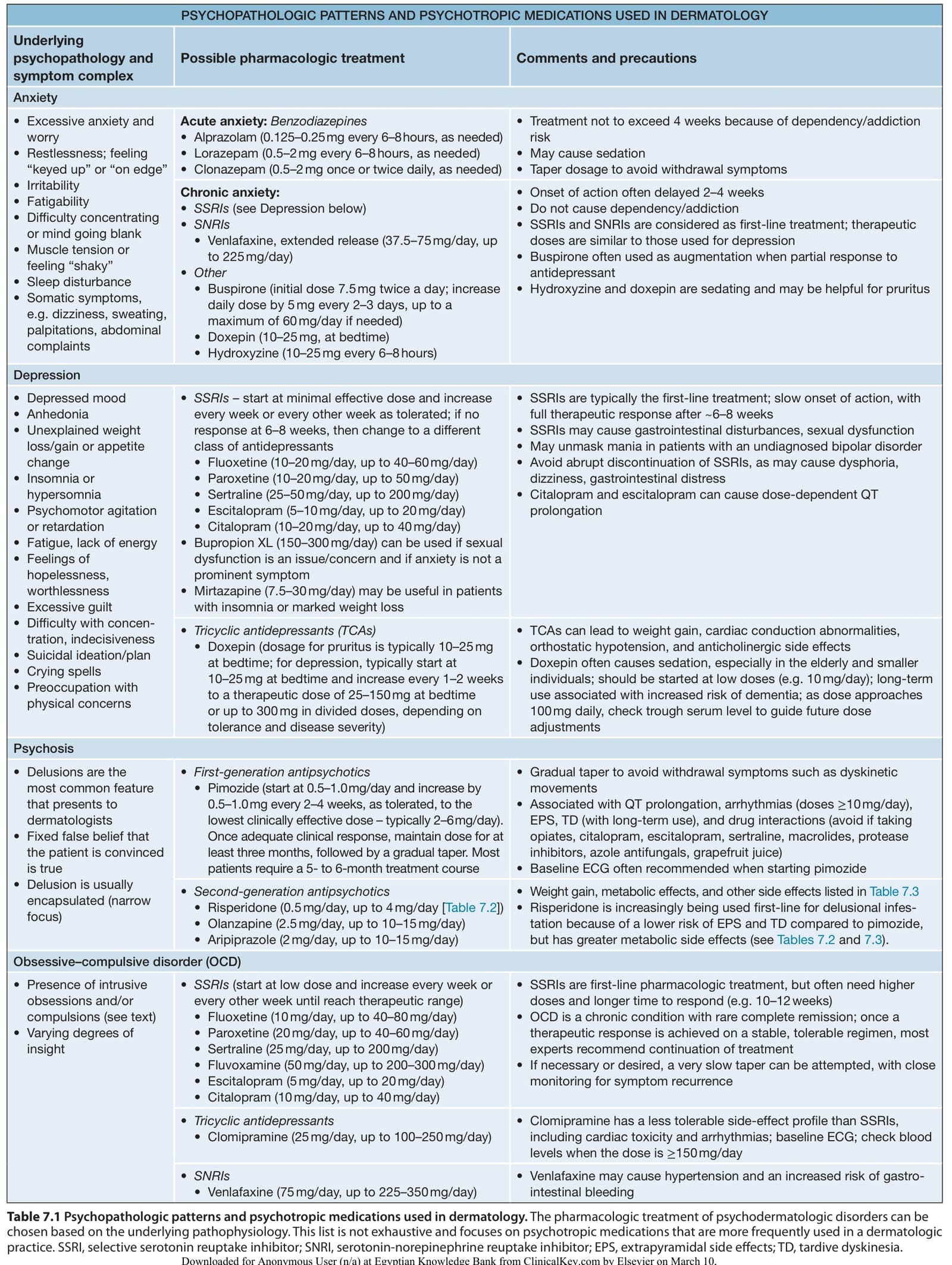
Table 7.1 Psychopathologic patterns and psychotropic medications used in dermatology. The pharmacologic treatment of psychodermatologic disorders can be chosen based on the underlying pathophysiology. This list is not exhaustive and focuses on psychotropic medications that are more frequently used in a dermatologic practice. SSRI, selective serotonin reuptake inhibitor; SNRI, serotonin-norepinephrine reuptake inhibitor; EPS, extrapyramidal side effects; TD, tardive dyskinesia.
despite potentially serious or fatal consequences, e.g. following the diagnosis of cutaneous melanoma.
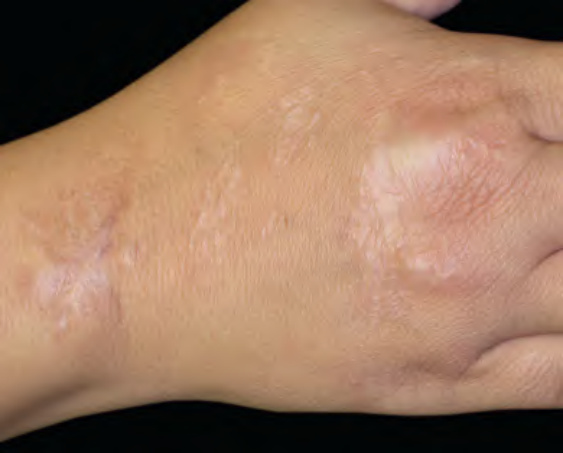
Fig. 7.9 Nonsuicidal self-injury. Repeated episodes of self-cutting with a razor blade caused these hypopigmented scars on the dorsal hand and forearm of this young woman.