EPIDEMIOLOGY AND GENETICS
In most reviews, the prevalence of psoriasis is said to be 2% of the world’s population. However, in the US and Canada, prevalences as high as 4.6% and 4.7% have been reported, respectively. This contrasts with frequencies in Africans, African-Americans, Norwegian Lapps, or Asians of between 0.4% and 0.7%. A worldwide systematic literature review was performed by the Global Psoriasis Atlas (www.globalpsoriasisatlas.org) focusing on the epidemiology of psoriasis. The incidence varied from 30 per 100 000 person-years in Taiwan to 321 per 100 000 person-years in Italy. Psoriasis proved to be more frequent in high-income countries and in regions with older populations.
One population-based study noted that 73% of affected individuals had mild to moderate psoriasis, while 27% suffered from more severe involvement. In one large group of patients with psoriasis (n = 1728), 79% had nail changes. Psoriatic arthritis has been found to affect 5%–30% of patients with cutaneous psoriasis, depending upon the series.
Psoriasis can first appear at any age, from infancy to the eighth decade of life. Two peaks in age of onset have been reported: one at 20–30 years of age and a second peak at 50–60 years. In ~75% of patients, the onset is before the age of 40 years, and in 35%–50%, it is before the age of 20 years. Although the age of onset is earlier in women than in men, the natural history is similar – chronic with intermittent remissions. In one epidemiologic study, 39% of the patients stated they had experienced remissions of 1–54 years.
In Europe, the overall prevalence rate for juvenile psoriasis was found to be ~0.7%, with an increase from 0.37%–0.55% in those 0 to 9 years of age to 1.01%–1.37% in those 10–19 years of age. Plaque psoriasis is the most frequent form of the disease in children, followed by guttate psoriasis.
Genetic Factors
Depending upon the series, a positive family history has been reported by 35% to 90% of patients with psoriasis. Based on a large survey-based study in Germany, if both parents had psoriasis, the risk of their child developing psoriasis was 41%, whereas if only one parent were affected, the risk was 14%; the risk was 6% if just one sibling had psoriasis.
Analysis of concordance rates among monozygotic and dizygotic twins is another method for examining the influence of genetic factors on a disease. One literature review found that of 141 monozygotic twin pairs, 82 were concordant for psoriasis and 59 were discordant; of 155 dizygotic twin pairs, only 31 were concordant and 124 were discordant for psoriasis. Thus, there is a two- to threefold increased risk of psoriasis in monozygotic twins as compared to dizygotic twins, implying that genetic factors are important. The distribution of the lesions, the severity, and the age of onset were similar in the monozygotic twin pairs, whereas these features differed in the dizygotic twin pairs. This observation suggested that genetic factors also play a role in the clinical course of psoriasis.
HLA studies
Histocompatibility antigens (HLA) are surface antigens on human cells, and the corresponding chromosomal region is called the major histocompatibility complex (MHC). It is situated on the short arm (p) of chromosome 6. Psoriasis is associated with HLA-Cw6, with the presence of HLA-Cw6 conferring a relative risk of 13 for developing psoriasis in the White population and 25 in the Japanese.
HLA-Cw6 is strongly linked to the age of onset of psoriasis. In one series, HLA-Cw6 was expressed in 90% of the patients with early-onset psoriasis, in 50% of those with late-onset psoriasis, and only in 7% of a control population. A specific MHC class II antigen (DRB10701/2) also appeared to be associated with early-onset psoriasis, and the psoriasis-associated HLA alleles were often in an extended haplotype: Cw6-B57-DRB10701-DQA10201-DQB10303. Individuals carrying this haplotype were found to have a 26-fold increased risk of developing early-onset psoriasis.
As a result, some clinicians have designated patients with earlyonset psoriasis, a positive family history of psoriasis, and expression of HLA-Cw6 as having type I psoriasis and those with late-onset disease, no family history, and a lack of expression of HLA-Cw6 as having type II psoriasis. While HLA-Cw6 may serve as a biomarker for clinical and therapeutic stratification, to date there are no treatments that specifically target HLA-Cw6. Other HLA alleles can be associated with different psoriasis variants and related conditions, e.g. the HLA-B27 allele is a marker for sacroiliitis-associated psoriasis and reactive arthritis (see below).
Genome-wide association studies
Classic genome-wide linkage analysis identified at least nine psoriasis susceptibility regions (PSORS1–9) in different chromosomal locations. By far the most important genetic region was PSORS1 (on chromosome 6p), which is estimated to account for up to 50% of psoriasis risk. PSORS1 contains genes such as HLA-C (with the HLA-Cw6 risk allele; see above) and corneodesmosin (CDSN). Due to high linkage disequilibrium in PSORS1 (i.e. genes within this region are inherited as a block), it has been challenging to determine which gene(s) within PSORS1 contribute to psoriasis pathogenesis.
In genome-wide association studies (GWASs), in which hundreds of thousands of single nucleotide polymorphisms (SNPs) across the entire human genome are examined in thousands of patients (see Ch. 54), at least 80 risk loci have been identified. It has been estimated that these loci explain ~28% of genetic heritability. GWASs have led to several conclusions regarding the genetic factors in psoriasis (Table 8.1). First, most of the genes that have been implicated have immune-related functions, underscoring the importance of the innate and adaptive immune systems in the pathogenesis of psoriasis; in contrast, relatively few genes that encode skin-specific proteins have been associated with psoriasis. Second, thus far surprisingly few interactions among the genetic variants have been identified (with the exception of HLA-Cw6 and ERAP-1; see below). Third, associated genes encode proteins with roles in particular immunologic and signaling pathways, especially those involving tumor necrosis factor (TNF), NF-κB, interferons (IFNs), and interleukin (IL)-23/Th17 cells (see Table 8.1). Lastly, ERAP1, which encodes an aminopeptidase involved in MHC class I antigen processing, interacts synergistically with the HLA-Cw6 risk allele, providing another argument for the role of an MHC-restricted antigen and its presentation through HLA-C in the pathogenesis of psoriasis.
More recently, greater insights into the genetics of pustular psoriasis have been made. In patients with generalized pustular psoriasis, several groups identified homozygous or compound heterozygous loss-offunction mutations in IL36RN, which encodes the IL-36 receptor antagonist. Patients with the autoinflammatory disorder DITRA (deficiency of IL-36 receptor antagonist) present with widespread psoriasiform plaques whose edges contain sterile pustules (see Figs. 45.11B & 45.12). Based upon susceptibility loci and transcriptomics, a significant IL-36 signature was also observed in patients with plaque psoriasis.
Functional genomic studies
Microarray technology has been utilized to obtain a comprehensive picture of the genes expressed in psoriatic skin. More than 1300 genes were found to be differentially expressed when compared to normal human skin. This group of genes included known markers of psoriasis in the skin, but it also contained numerous genes not known to be expressed in the skin. These analyses confirmed (on a genomic scale) the involvement of T cells and dendritic cells (DCs) and also implicated a role for comorbidity-associated genes involved in atherosclerosis signaling and fatty acid metabolism.
Another important gene family differentially expressed in psoriatic epidermis encodes antimicrobial peptides. These peptides are expressed at high levels in psoriatic skin but at low levels in skin affected by atopic dermatitis. Additionally, complete functional impairment of the IL-36 receptor antagonist secondary to null mutations in IL36RN has highlighted the importance of repressing IL-36-dependent activation of the NF-κB pathway. Such insights led to the recent introduction of an interleukin-36 receptor inhibitor for the treatment of generalized pustular psoriasis.
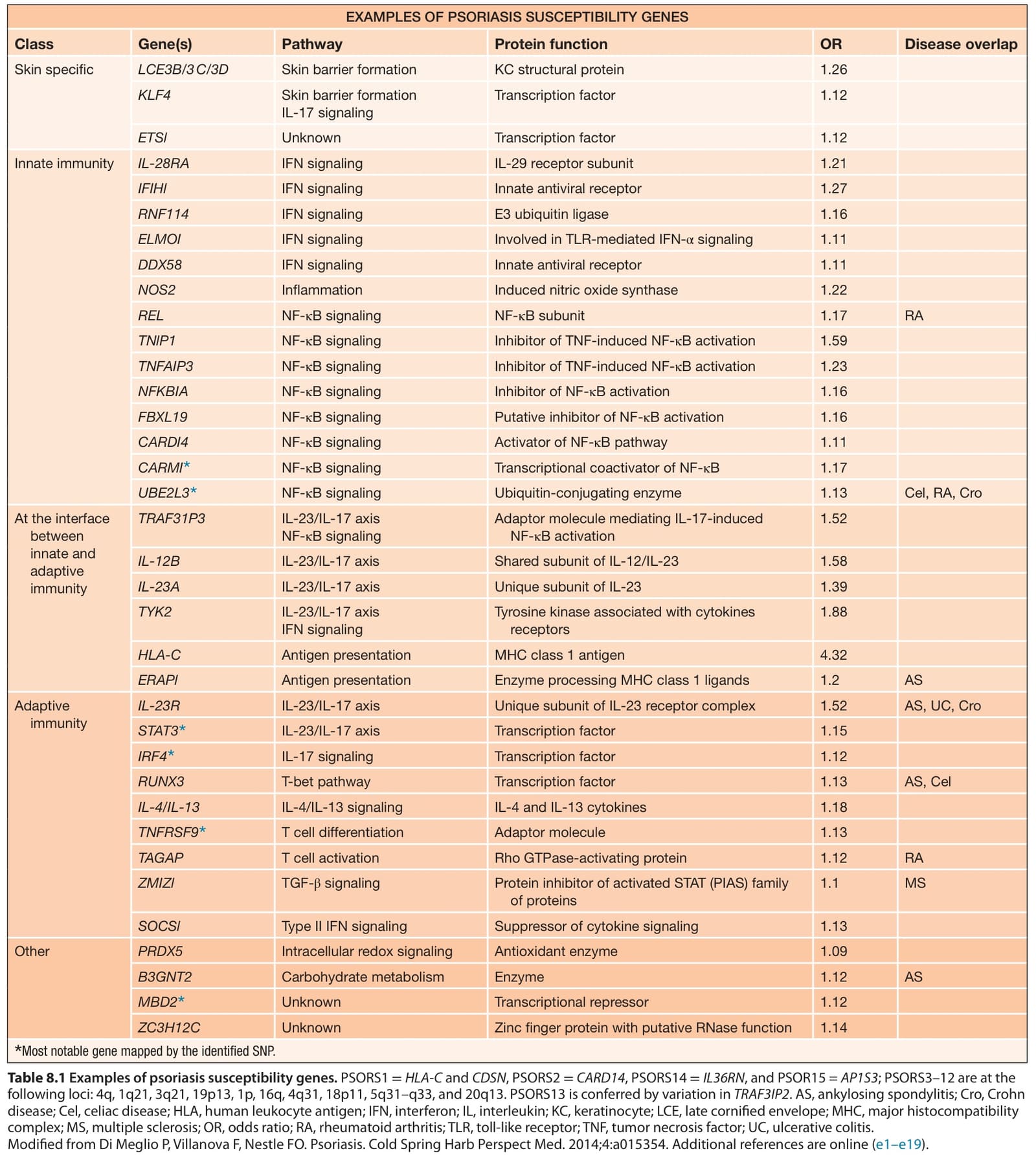
Table 8.1 Examples of psoriasis susceptibility genes. PSORS1 =HLA-C and CDSN, PSORS2 =CARD14, PSORS14 =IL36RN, and PSOR15 = AP1S3; PSORS3–12 are at the following loci: 4q, 1q21, 3q21, 19p13, 1p, 16q, 4q31, 18p11, 5q31–q33, and 20q13. PSORS13 is conferred by variation in TRAF3IP2. AS, ankylosing spondylitis; Cro, Crohn disease; Cel, celiac disease; HLA, human leukocyte antigen; IFN, interferon; IL, interleukin; KC, keratinocyte; LCE, late cornified envelope; MHC, major histocompatibility complex; MS, multiple sclerosis; OR, odds ratio; RA, rheumatoid arthritis; TLR, toll-like receptor; TNF, tumor necrosis factor; UC, ulcerative colitis. Modified from Di Meglio P, Villanova F, Nestle FO. Psoriasis. Cold Spring Harb Perspect Med. 2014;4:a015354. Additional references are online (e1–e19).