ANTIANGIOGENIC THERAPIES
Because induction of angiogenesis is essential for tumor progression, inhibition of tumor angiogenesis has become a target for cancer therapy. Despite the identification of several distinct tumor angiogenesis factors, including interleukin-8 and bFGF, the majority of approved anti-tumor angiogenesis therapies rely on targeting VEGF-A. The latter is generally considered to represent the major angiogenic factor in the majority of solid tumors.
The anti-VEGF-A humanized monoclonal antibody bevacizumab was the first FDA-approved angiogenesis inhibitor (Fig. 102.16). Beneficial effects were observed in patients with metastatic colon cancer when bevacizumab was combined with chemotherapy. Subsequently, bevacizumab has been approved for the treatment of other solid tumors including metastatic breast cancer, non-small-cell lung cancer (NSCLC), ovarian cancer, and cervical cancer as well as glioblastoma and renal cell carcinoma. Ramucirumab, a monoclonal antibody that targets human VEGFR-2, has been approved for advanced gastric cancer, hepatocellular carcinoma, and metastatic forms of NSCLC and colorectal cancer. Afilbercept, a soluble VEGF receptor fusion protein (“VEGF trap”), is approved for both colorectal cancer and wet macular degeneration. In
addition, several tyrosine kinase inhibitors (e.g. cabozantinib, lenvatinib, pazopanib, regorafenib, sorafenib, sunitinib) have been approved, primarily for renal cell carcinoma, but also for thyroid, hepatocellular, and colorectal carcinomas (see Fig. 102.16). However, these inhibitors are not specific for VEGFR tyrosine kinases but also inhibit other tyrosine kinases (see Table 21.16). In addition, the mTOR inhibitor everolimus, a moderate angiogenesis inhibitor, is approved for several solid organ carcinomas.
Although anti-VEGF-A therapies have been beneficial in a range of carcinomas, as a monotherapy they have been ineffective due to the development of resistance. However, combined inhibition of VEGF-A plus other pro-angiogenic signaling pathways has resulted in improved
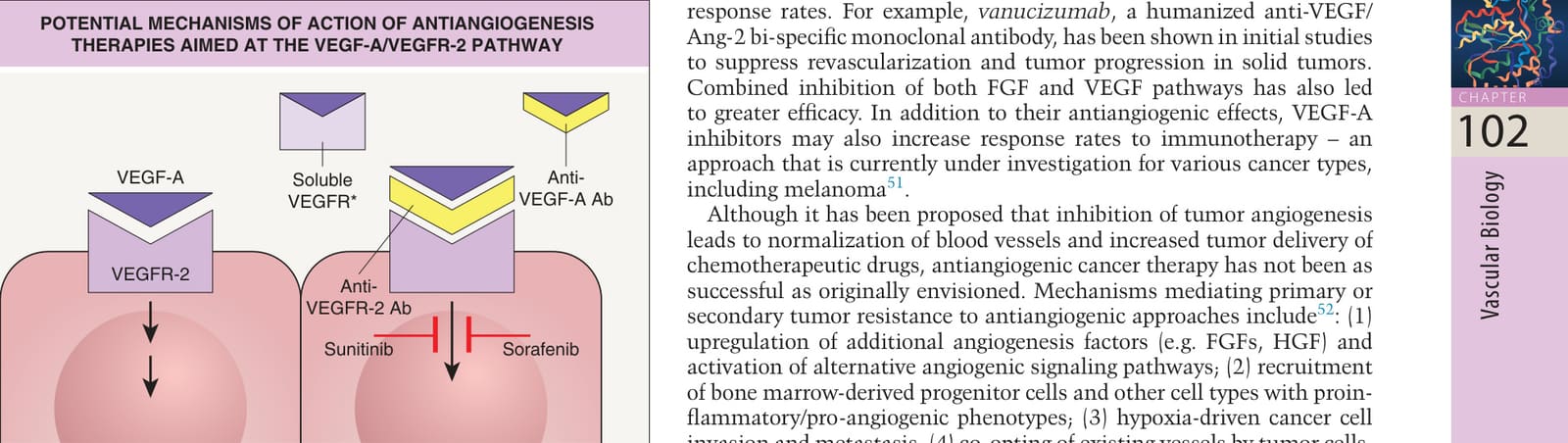
Fig. 102.16 Mechanisms of action of antiangiogenesis therapies aimed at the VEGF-A/VEGFR-2 pathway. Examples of anti-VEGF-A antibodies are bevacizumab and ranibizumab and an example of an anti-VEGFR-2 antibody is ramucirumab. Aflibercept acts as a soluble VEGF receptor fusion protein (“VEGF trap”). Tyrosine kinase inhibitors that block the VEGFR signaling pathway include cabozantinib, lenvatinib, pazopanib, and regorafenib as well as sorafenib and sunitinib.
response rates. For example, vanucizumab, a humanized anti-VEGF/ Ang-2 bi-specific monoclonal antibody, has been shown in initial studies to suppress revascularization and tumor progression in solid tumors. Combined inhibition of both FGF and VEGF pathways has also led to greater efficacy. In addition to their antiangiogenic effects, VEGF-A inhibitors may also increase response rates to immunotherapy – an approach that is currently under investigation for various cancer types, including melanoma.
Although it has been proposed that inhibition of tumor angiogenesis leads to normalization of blood vessels and increased tumor delivery of chemotherapeutic drugs, antiangiogenic cancer therapy has not been as successful as originally envisioned. Mechanisms mediating primary or secondary tumor resistance to antiangiogenic approaches include: (1) upregulation of additional angiogenesis factors (e.g. FGFs, HGF) and activation of alternative angiogenic signaling pathways; (2) recruitment of bone marrow-derived progenitor cells and other cell types with proinflammatory/pro-angiogenic phenotypes; (3) hypoxia-driven cancer cell invasion and metastasis; (4) co-opting of existing vessels by tumor cells; and (5) the formation of perfused vessels by tumor cells themselves, called “vascular mimicry”.
Non-malignant skin diseases have also emerged as potential targets for treatments aimed at vascular endothelium. The mechanisms by which propranolol, a non-selective β-adrenergic receptor blocker, induces regression of hemangiomas are not fully understood, but it may induce endothelial cell apoptosis and interfere with the VEGF-A/ VEGFR signaling pathway as well as reduce plasma renin levels (see Ch. 103). Sirolimus (rapamycin), an mTOR inhibitor, has been successfully used to treat patients with tufted angiomas/kaposiform hemangioendotheliomas who develop Kasabach–Merritt phenomenon as well as lymphatic malformations and kaposiform lymphangiomatosis.
In addition to these potential dermatologic applications, antiangiogenesis has become a promising new therapeutic approach in ophthalmology. Diabetes mellitus is frequently associated with intraocular neovascularization, and new blood vessel growth is the principal cause of visual loss in the wet form of age-related macular degeneration, the most common cause of blindness in Western countries. Nowadays, intra-vitreal injection of VEGF-A inhibitors (e.g. ranibizumab, aflibercept) are used to prevent progression of this disease and can even improve vision.
Biochemistry and Physiology of the Skin. New York: Oxford University Press; 1983. p. 817–877.2. Yano K, Brown LF, Detmar M. Control of hair growth and