EPIDEMIOLOGY
Cutaneous melanoma develops primarily in individuals with lightly pigmented skin. While melanoma is relatively uncommon amongst more darkly pigmented individuals of African, Asian, or Hispanic origin, its incidence has been slowly rising in some of these populations.
In 2015, over 350 000 new cases of melanoma were diagnosed worldwide, corresponding to an age-standardized incidence rate of 5 per 100 000 individuals, and nearly 60 000 deaths were attributable to melanoma. Globally, Australia, New Zealand, North America, and Europe bear the greatest burden of disease, with the highest incidence rates in Australia/New Zealand (~54/100 000) and Northern Europe (~25–26/100 000). Based upon the Surveillance Epidemiology and End Results (SEER) database, an estimated 99 780 men and women in the US are expected to be diagnosed with invasive cutaneous melanoma in 2022, with a projected 7650 melanoma-associated deaths.
Over the past several decades, the incidence rates of cutaneous melanoma have increased significantly (Fig. 113.3A). Whereas the annual increase in melanoma incidence varies depending upon the population, in general it has been estimated to be between 3% and 7%. These estimates predict a doubling of rates every 10–20 years, making cutaneous melanoma the most rapidly increasing cancer in White populations. However, an increase in skin screening, biopsy rates, and histopathologic diagnosis likely also contribute to this rise. The trend of increasing incidence rates is predicted to continue for at least the next decade, although several countries have begun to observe stabilizing or declining rates in recent years.
Since 2006, the overall incidence of melanoma in the US has risen at a slower rate of ~1% per year. Although melanoma incidence rates have
IL, interleukin; MHC, major histocompatibility complex; TGF, transforming growth factor.
decreased in younger populations, they have significantly increased among older individuals, specifically non-Hispanic White men >55 years of age and White women >45 years of age. Invasive melanomas, particularly thick melanomas, have also increased significantly over the past two decades among Hispanics in regions of high UVR exposure (e.g. California, Florida).
Despite the continued increase in melanoma incidence worldwide, melanoma mortality has generally stabilized and in some countries declined in recent years. After increasing during the 1980s in most European countries as well as in North America (Fig. 113.3B),
Australia, and New Zealand, mortality rates from melanoma peaked in the early 1990s. Subsequently, trends have been less uniform, with mortality rates still rising in several European countries but stabilizing or decreasing in others as well as in Australia and the US. Worldwide, there has been a widening sex disparity over the past three decades, with male death rates continuing to rise in contrast to stable or decreasing female death rates. Several countries have also observed increasing mortality rates among older adults, but stable or decreasing rates among younger adults. Similar trends have been noted in the US, where mortality rates for non-Hispanic White individuals have decreased in women and younger age groups but continue to increase in men over age 65 years. However, with the advent of effective therapies, notable reductions in mortality have been observed since 2013 in non-Hispanic White individuals, including older men. Melanoma survival among non-White populations continues to significantly lag behind White populations, and in several countries lower socioeconomic status has also been associated with higher mortality rates.
Vertical tumor thickness (Breslow depth) is the most important prognostic factor in primary cutaneous melanoma. Tumor thickness at initial diagnosis is somewhat age-dependent, with the percentage of thick melanomas increasing significantly with age, reaching 20% by age 80 years in both sexes. In the US, populations with the greatest mortality rates – older men, non-White individuals, and those in lower socioeconomic groups – have experienced a disproportionate increase in the incidence of thicker, more advanced melanomas at diagnosis.
Over the past several decades, a progressive reduction in mean tumor thickness has occurred as a result of more effective detection of melanoma at an earlier stage. In Germany, for example, there has been a trend towards diagnosing thinner melanomas since the 1980s, with the median tumor thickness decreasing from 1.81 mm (1980s) to 0.53 mm (2000). The percentages of in situ and thin (T1; ≤1 mm) melanomas also increased. Diagnosing thinner tumors should translate into stable or decreasing mortality rates, despite the rise in incidence rates. However, US data indicate that incidence rates among all tumor thickness categories have significantly increased over the past few decades (although most prominently for thin melanomas), suggesting that enhanced detection of thin melanomas cannot entirely account for the continued rise in overall melanoma incidence.
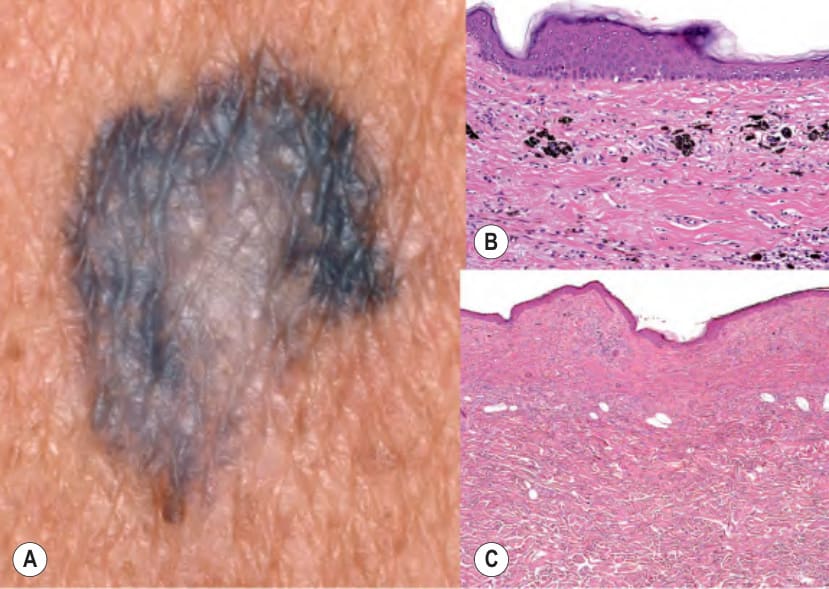
Fig. 113.2 Completely regressed cutaneous melanoma.A, B The gray-black arciform area had only melanophages in the upper dermis; although there were no remaining cells of melanoma, the patient already had nodal metastases. C The central hypopigmented area had fibrosis with sparse inflammation. Complexes of a pre-existing melanocytic nevus were present focally below the zone of regression. Courtesy, Department of Dermatology, Medical University of Graz.
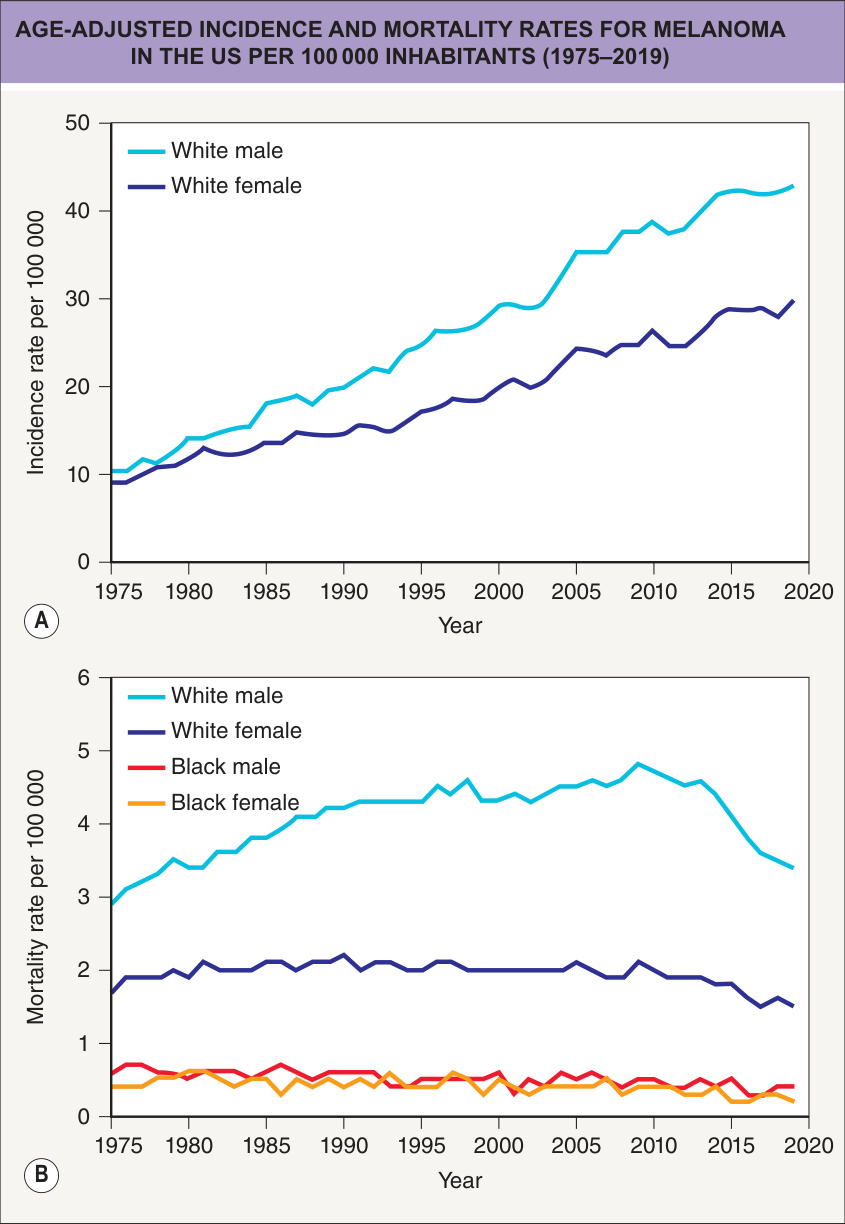
Fig. 113.3 Age-adjusted incidence rates and mortality rates for melanoma in the US per 100 000 inhabitants (1975–2019).A, B While the incidence of melanoma has increased significantly in White men and women over the past four decades, there has been a modest increase in mortality, primarily in middleaged to older White men and individuals of lower socioeconomic status, across all racial and ethnic groups. Data from https://seer.cancer.gov/statistics-network/explorer.
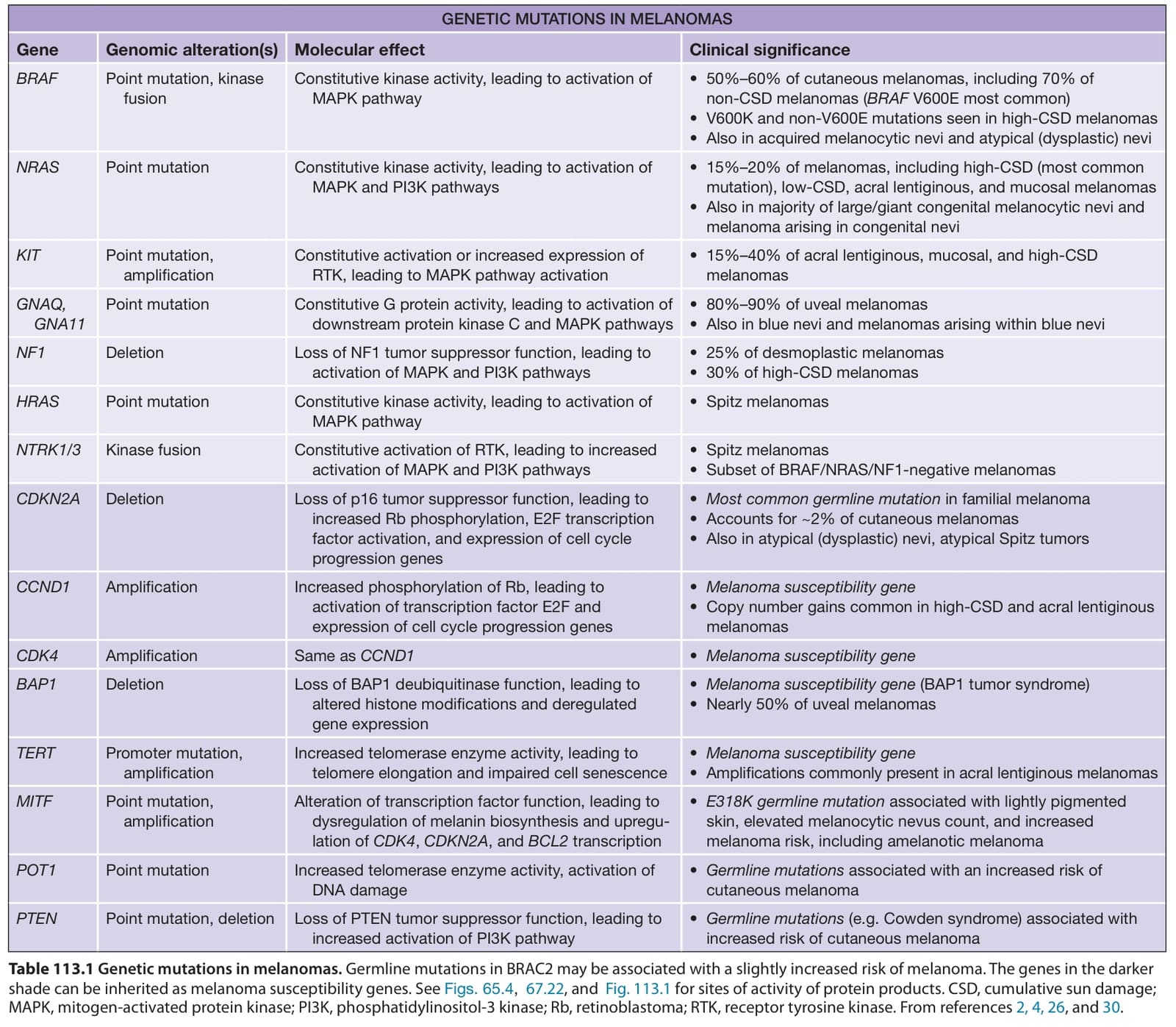
Table 113.1 Genetic mutations in melanomas. Germline mutations in BRAC2 may be associated with a slightly increased risk of melanoma. The genes in the darker shade can be inherited as melanoma susceptibility genes. See Figs. 65.4, 67.22, and Fig. 113.1 for sites of activity of protein products. CSD, cumulative sun damage; MAPK, mitogen-activated protein kinase; PI3K, phosphatidylinositol-3 kinase; Rb, retinoblastoma; RTK, receptor tyrosine kinase. From references 2, 4, 26, and 30.
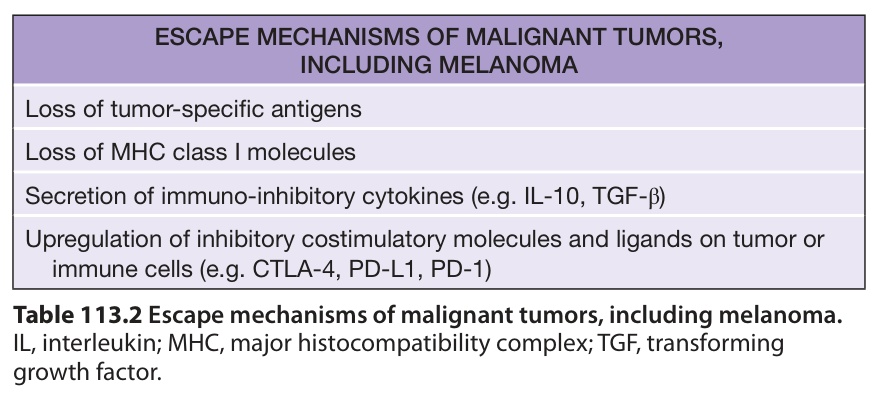
Table 113.2 Escape mechanisms of malignant tumors, including melanoma.
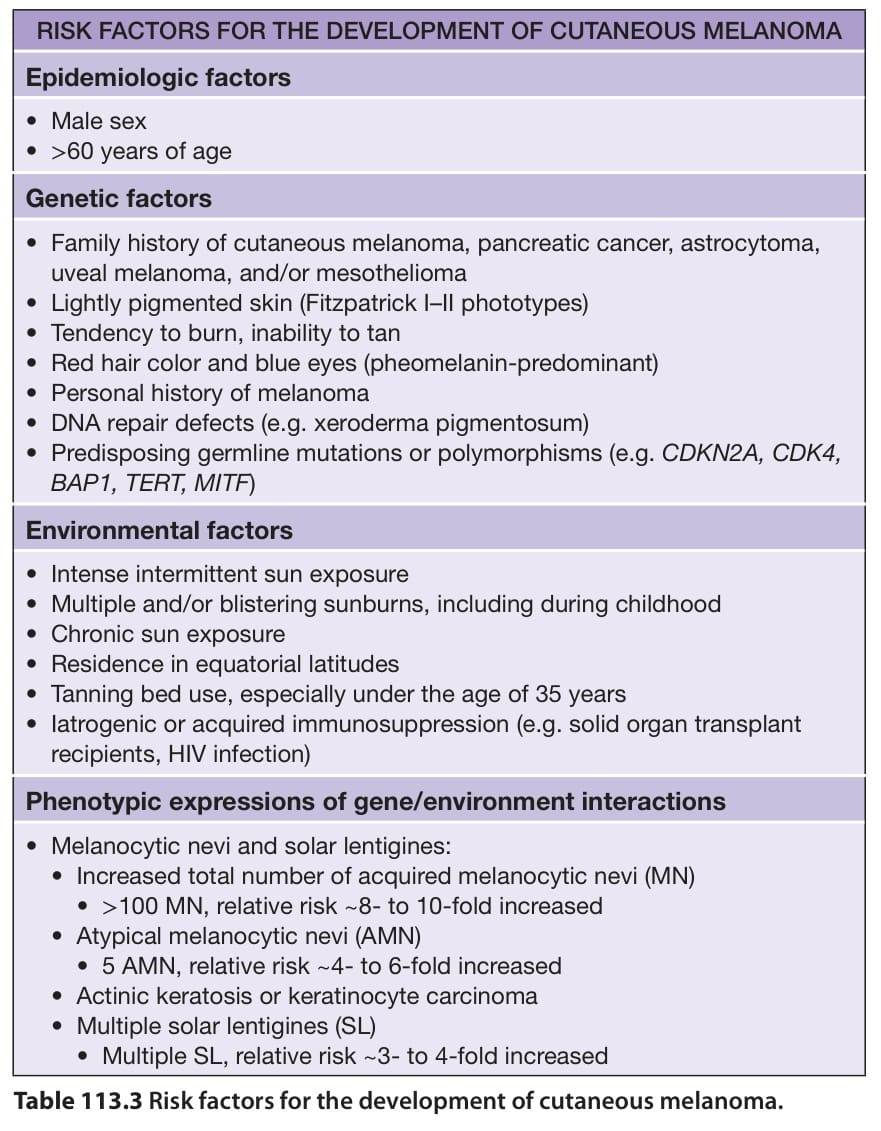
Table 113.3 Risk factors for the development of cutaneous melanoma.