PATHOGENESIS
Mast cells are derived from pluripotent CD34+ precursors in the bone marrow that then circulate in the peripheral blood as agranular, monocytic-appearing cells. After migrating into tissues, these immature mast cells assume their typical granular morphology (see Ch. 18). Circulating mast cell precursors express CD34, the tyrosine kinase receptor KIT (CD117), and IgG receptors (FcγRII), but not high-affinity IgE receptors (FcεRI). The KIT receptor is expressed on mast cells, melanocytes, primitive hematopoietic stem cells, primordial germ cells, and interstitial cells of Cajal. Activation of KIT by its ligand (stem cell factor [SCF]) induces mast cell growth and maturation, and it extends cell survival by preventing apoptosis. Membrane-bound and soluble forms of SCF exist, and both induce KIT activation. SCF is produced by bone marrow stromal cells, fibroblasts, keratinocytes, endothelial cells, and reproductive Sertoli and granulosa cells. Peripheral blood mast cell precursors cultured in the presence of SCF and other cytokines (e.g. interleukin [IL]-3, -4, -6, -9) become KIT+/CD34−/FcγRII−/FcεRI+ and develop characteristic cytoplasmic mast cell granules, as seen in mature tissue mast cells.
Alterations in KIT structure and activity are central to the pathogenesis of mastocytosis. Somatic activating mutations in KIT involving codon 816 represent the most common genetic abnormality in patients with sporadic mastocytosis. The result is a substitution of the amino acid aspartic acid (D) with valine (V), i.e. D816V, or less commonly another amino acid (Fig. 118.2). These mutations lead to constitutive, ligand-independent activation of the receptor. Less common activating mutations and a rare dominant inactivating mutation have also been identified in children and adults with mastocytosis (see Fig. 118.2). In addition, rare germline mutations have been reported.
In a study in which the entire KIT sequence was analyzed in skin biopsy specimens from 50 children (ages 0–16 years) with primarily maculopapular mastocytosis, codon 816 mutations were found in 42% and other activating mutations in 44% of the patients. However, the mechanism by which childhood disease often resolves spontaneously, despite the presence of underlying somatic KIT mutations, remains unknown.
In a transgenic mouse model of mastocytosis in which human activated KIT (D816V) was expressed, only 8 of 28 genetically identical animals developed clinical features of mastocytosis, ranging from indolent mast cell hyperplasia to an invasive mast cell tumor. In another model utilizing the homologous mouse Kit D814V, results ranged from advanced mast cell disease when this mutation appeared in undifferentiated bone marrow progenitors to variable mast cell tumors/skin disease when Kit D814V was only expressed in committed mast cell progenitors or mature mast cells. The diverse phenotypic expression of gain-of-function KIT mutations, along with the lack of KIT mutations in some patients and families with mastocytosis, points to
additional pathogenic factors in mastocytosis. Indeed, in adult patients with advanced systemic mastocytosis, somatic mutations have been identified in KIT plus a variety of other genes such as TET2, ASXL1, JAK2, SRSF2, RUNX1, and CBL, which encode Tet methylcytosine dioxygenase 2, additional sex combs like 1, transcriptional regulator, Janus kinase 2, serine and arginine rich splicing factor 2, runt related transcription factor 1, and Cbl proto-oncogene, respectively.
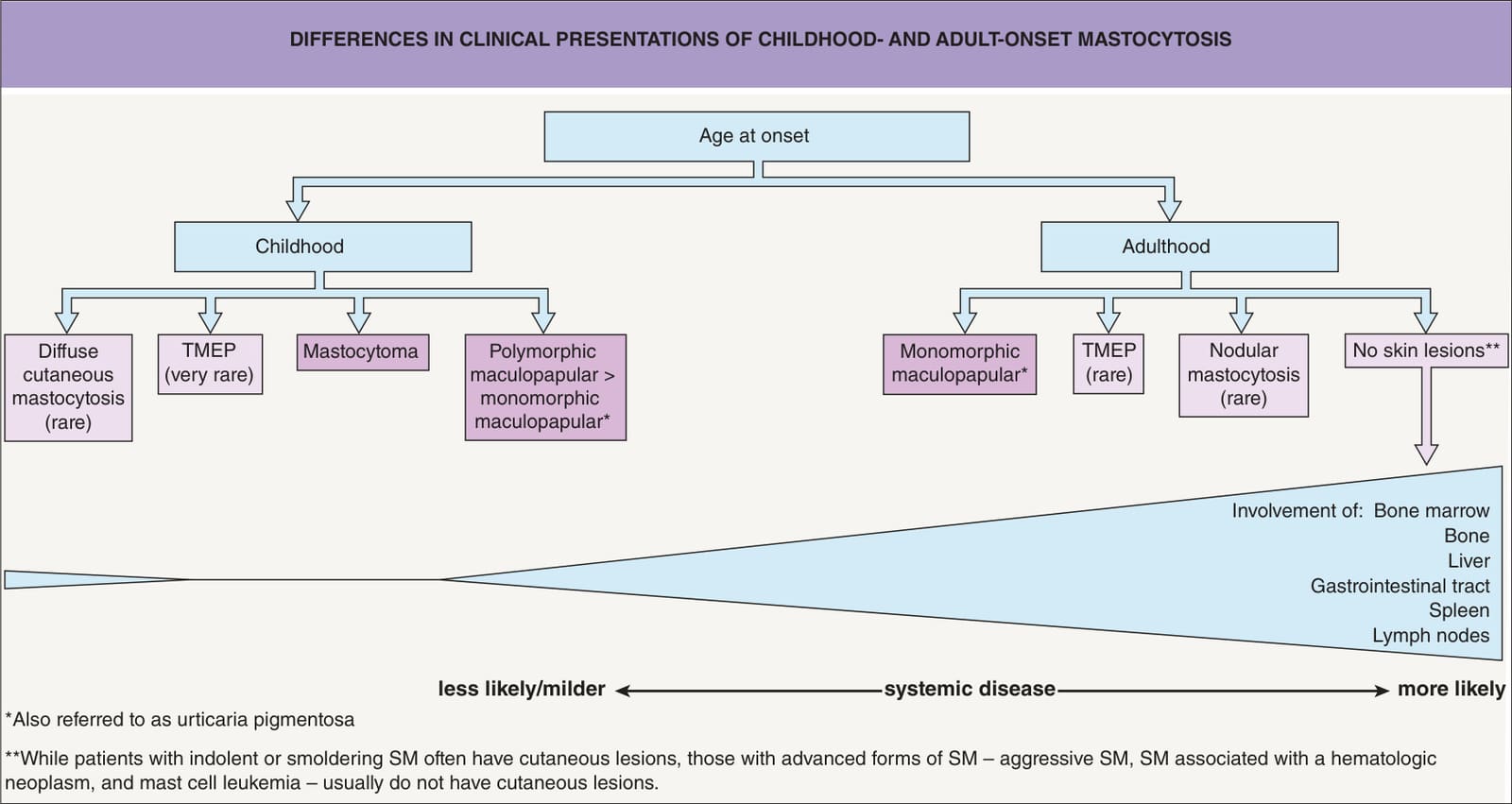
Fig. 118.1 Clinical presentations of childhood and adult-onset mastocytosis. The darker boxes represent the most common forms. Based upon the WHO classification scheme (see Tables 118.1 & 118.2), most children and a small proportion of adults have isolated cutaneous mastocytosis. Most adults with skin lesions have indolent systemic mastocytosis (SM), while those with advanced forms of SM usually do not have cutaneous involvement. In general, children have a benign course with a tendency for spontaneous remission. SM, systemic mastocytosis; TMEP, telangiectasis macularis eruptive perstans.
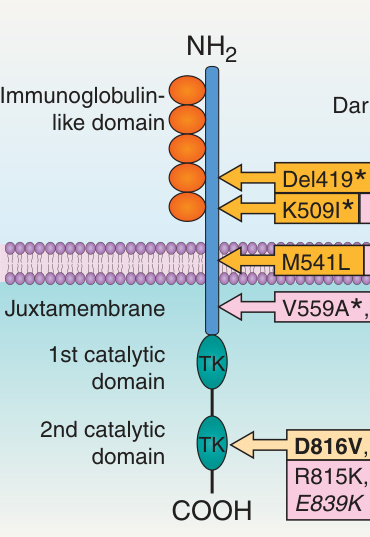
Fig. 118.2 KIT receptor and location of amino acid changes (due to KIT mutations) in pediatric and adult patients with mastocytosis. For example, D816V means that a mutation in codon 816 resulted from valine (V) being replaced by aspartic acid (D). The plasma membrane-bound KIT receptor is composed of three distinct regions: (1) the extracellular region (five immunoglobulin-like repeats [orange]); (2) the transmembrane region; and (3) the intracellular region (two tyrosine kinase domains [green]). The most common site for activating mutations is exon 17, which contains codon 816. The result is constitutive ligand-independent activation of the receptor. TK, tyrosine kinase domain (one binds ATP and the other has phosphotransferase activity).