INTRODUCTION
Although B cell lymphomas represent the majority of non-Hodgkin lymphomas (NHLs) arising within lymph nodes, they represent a minority of the NHLs whose primary site is the skin. In the classification of cutaneous lymphomas published by the World Health Organization (WHO) and the European Organization for Research and Treatment of Cancer (EORTC) Cutaneous Lymphoma Project Group (Table 119.1), B cell lymphomas represented ~25% of all cutaneous lymphomas. The WHO-EORTC classifications of 2005 and 2018 have been integrated with only minor changes into the International Consensus Classification (ICC) of Mature Lymphoid Neoplasms published in 2022 (see Table 119.1).
Primary cutaneous lymphomas are defined as malignant lymphomas confined to the skin at presentation after complete staging procedures. In general, most patients with primary cutaneous B cell lymphoma (pCBCL) are diagnosed by dermatologists, as extracutaneous symptoms and signs are observed only very rarely at the onset of the disease. Consequently, dermatologists should be conversant with the clinicopathologic features of this group of diseases, in order to be able to establish the diagnosis in its early stages. Additionally, as aggressive treatment modalities are needed only in selected cases, these patients should be managed primarily by dermatologists with special expertise in cutaneous lymphomas.
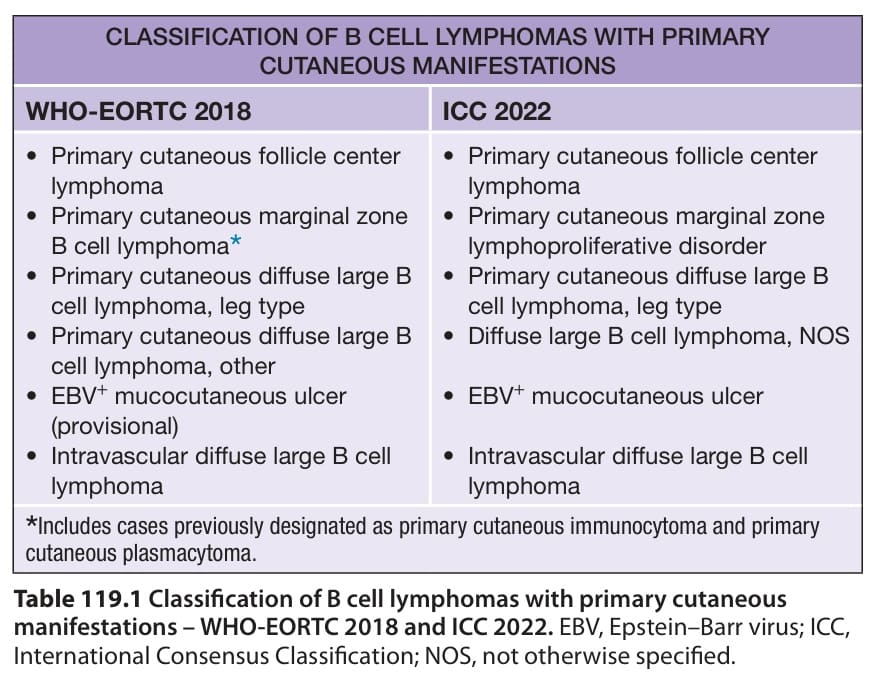
Table 119.1 Classification of B cell lymphomas with primary cutaneous manifestations – WHO-EORTC 2018 and ICC 2022. EBV, Epstein–Barr virus; ICC, International Consensus Classification; NOS, not otherwise specified.