HISTORY
In 1806, a French physician, Jean Louis Alibert, was the first to describe a patient with MF. This case was designated pian fungoïde in his atlas, but in 1835 it was renamed mycosis fungoïde because of the resemblance of some skin tumors to mushrooms. In 1870, Bazin described the natural progression from a nonspecific premycotic phase to plaque lesions and finally to tumors, which probably represents one of the first descriptions of the “multistep model” in the development of a malignancy. In 1885, Vidal and Brocq used the term “mycosis fungoides d’emblée” for patients presenting with skin tumors not preceded by patches or plaques. It has now become clear that such cases mostly represent another type of CTCL. The erythrodermic form of MF was described in 1892 by Besnier and Hallopeau. These early descriptions of the major clinical forms of MF were followed by descriptions of Sézary syndrome by Sézary and Bouvrain in 1938, pagetoid reticulosis by Woringer and Kolopp in 1939, and lymphomatoid papulosis (LyP) by Macaulay in 1968.
Thus, in the early 1970s, MF and some related conditions were the only types of cutaneous lymphoma that had been rather well described. Reports on cutaneous lymphomas other than MF/SS, commonly designated in the past as malignant reticulosis or reticulum cell sarcoma, were few. Moreover, they were firmly believed to represent skin manifestations of a systemic lymphoma and treated as such.
The CTCL Concept
In 1968, Lutzner and Jordan described the ultrastructural features of the circulating atypical cells in SS. Characteristically, the nuclei of these cells had deep and narrow indentations, giving them a cerebriform appearance. Three years later, similar cells were found in the skin and lymph nodes of patients with MF. In 1975, based on the observation that the neoplastic cells in MF, SS, and related conditions not only had the same morphology but also a common T cell phenotype, the term “CTCL” was suggested for this group of diseases. Within a short time, this term gained wide acceptance, particularly in the US. The introduction of the CTCL concept can be considered as a landmark in the history of this group of diseases. However, a major disadvantage has been that in many subsequent studies, distinction was no longer made between MF, SS, and other T cell neoplasms, entities which may vary considerably in clinical presentation and clinical behavior.
The Concept of Primary Cutaneous Lymphomas
At about the same time that the CTCL concept was introduced, several European groups started to classify cutaneous lymphomas according to the criteria of the Kiel classification, a system used by hematopathologists for the categorization of nodal lymphomas. It was then determined that many types of CBCL and CTCL (other than classic MF and SS) can present in the skin without any evidence of extracutaneous disease at the time of diagnosis. It appeared that these primary cutaneous lymphomas often have a completely different clinical behavior and prognosis when compared to morphologically similar lymphomas arising within lymph nodes, and therefore require different types of treatment. In addition, differences in the presence of specific chromosomal translocations and in the expression of oncogenes, viral sequences or antigens (e.g. EBV), and adhesion receptors involved in tissue-related lymphocyte homing were found.
Such differences underscored that primary cutaneous lymphomas represent a distinct group and may explain, at least in part, their different clinical behavior. For instance, the observation that the neoplastic T cells in most CTCLs express cutaneous lymphocyte antigen (CLA) and the CC-chemokine receptors 4 (CCR4) and 10 (CCR10) indicates that they are the neoplastic counterparts of normal skin-homing T cells, and this explains why these CTCLs present in the skin. Perhaps most importantly, it appeared that different types of CTCL and CBCL with different clinical behaviors and different therapeutic requirements may have an identical histologic appearance. This implies that histologic features should always be combined with clinical and immunophenotypic data before a definite diagnosis (classification) is made.
Such an approach resulted in the delineation of several new types of CTCL and CBCL, and it formed the basis of the European Organization for Research and Treatment of Cancer (EORTC) classification for primary cutaneous lymphomas.
EORTC, WHO, and WHO-EORTC Classification Schemes
The EORTC classification scheme was the first one that was specifically designed for the group of primary cutaneous lymphomas. It contained
2018 update. NDA, no data available; NOS, not otherwise specified.
a limited number of well-defined types of CTCL and CBCL, and a distinction was made between cutaneous lymphomas with indolent, intermediate, or aggressive clinical behavior. By including well-defined and recognizable disease entities, this classification provided the clinician with detailed information on staging, preferred mode of treatment, clinical behavior and prognosis, serving as a useful guide for optimal management and treatment.
Collaboration between the EORTC and the World Health Organization (WHO) groups resulted in the publication of the WHO-EORTC consensus classification for primary cutaneous lymphomas in 2005 and its update in 2018. In this 2018 update, the terminology and definitions of the different types of CTCL are identical to those in the 2016 revision of the WHO classification. In the 2023 WHO classification (5th revision) as well as in the 2022 International Consensus Classification (ICC) of mature lymphoid neoplasms, only minor changes have been introduced, namely, primary cutaneous acral CD8-positive T cell lymphoma has been listed as a lymphoproliferative disorder rather than a lymphoma3a,3b. The frequency and survival of patients with the different types of CTCL recognized in the updated 2018 WHO-EORTC classification are presented in Table 120.1. Following a description of practical guidelines for diagnosis, classification, and staging, relevant features of the different types of CTCL included in this classification are presented.
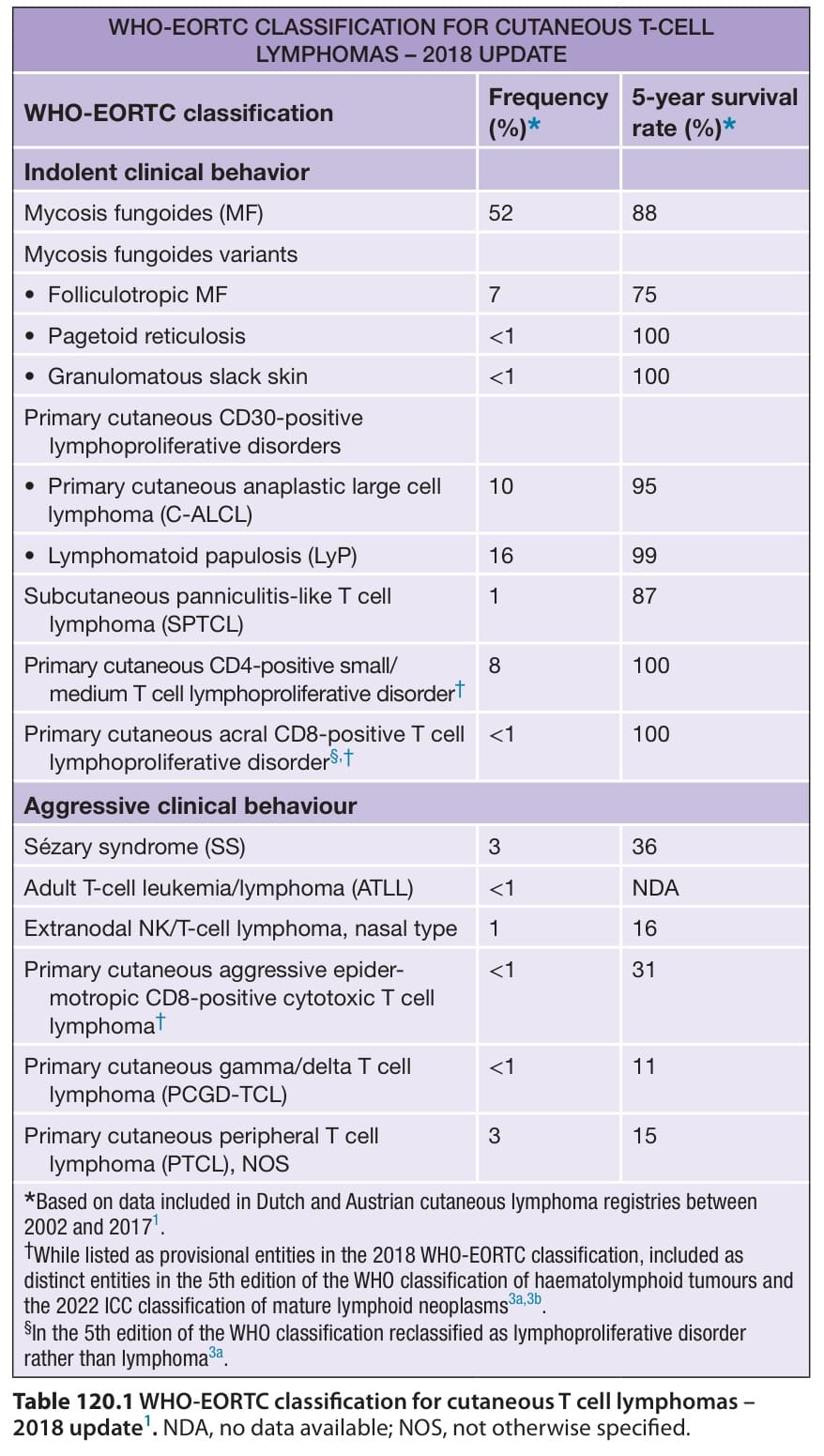
Table 120.1 WHO-EORTC classification for cutaneous T cell lymphomas –