PARAMETERS AFFECTING SKIN PERMEABILITY
The skin is an attractive site for drug delivery, whether for topical delivery to locally treat cutaneous conditions or for transdermal delivery into the systemic circulation via absorption through the skin for other indications. However, normal skin provides a significant barrier to drug absorption, whereas diseased skin can provide a lesser or greater barrier, depending on its associated epidermal changes. While the most straightforward method of circumventing the stratum corneum barrier is an intradermal needle injection (e.g. the Mantoux technique), this is often not practical for patients to perform on a routine basis.
Understanding the parameters that affect the permeability of this barrier is essential for achieving successful drug therapy via the skin without intradermal or subcutaneous injections. While local cutaneous effects are generally achieved by dissolving or suspending the drug in a vehicle that is applied topically as a semi-solid formulation (e.g. cream or ointment), administration of systemic therapy via the skin is typically accomplished through the use of a patch. In either situation, drug is supplied at the surface of the skin for diffusion across the stratum corneum, with the goal of reaching therapeutic targets within the skin and/or systemic uptake via superficial dermal capillaries.
Mark R. Prausnitz
Parameters Controlling Absorption
Conventional transdermal drug delivery is a passive process governed by Fick’s law, that is, the rate of absorption or flux (J) of any substance across a barrier is proportional to its concentration difference across that barrier. For topically applied drugs, the concentration difference can be simplified as the concentration of drug in the vehicle, Cv, and the proportionality constant relating flux to concentration is the permeability coefficient, Kp (Eq. 1). Kp is composed of factors that relate to both drug and barrier, as well as their interaction. These factors are: D, the drug diffusion coefficient; Km, the drug partition coefficient; and L, the length of the diffusion pathway across stratum corneum (Eq. 2). Thus, four factors control the kinetics of percutaneous drug absorption (Eq. 2); however, it is of great practical importance that two of the four (Cv, Km) are highly dependent on one additional factor, the vehicle in which the drug is supplied to the skin.
J KC p v
(1)
J DK
L C m
(2)
v
Role of the Vehicle
The vehicle is an important link between drug potency and therapeutic effectiveness, since extensive pharmaceutical research has shown that the composition of the vehicle can profoundly influence the rate and extent of absorption (bioavailability). As illustrated by the potency ranking scale for topical corticosteroids, the same drug appears
in different potency classes when formulated in different vehicles (Table 124.3). It was once axiomatic that ointments were more potent than creams. Though true for the early corticosteroid products, it is no longer generally applicable. Greater understanding of the science underlying topical formulations has allowed creams, gels, solutions, and foams to be specifically formulated equipotent to ointments (see Table 124.3).
In the rational design of dermatologic vehicles that maximize bioavailability, two factors are of critical importance: (1) solubilizing the drug in the vehicle (Cv); and (2) maximizing movement (partitioning) of drug from vehicle to stratum corneum (Km). The partition coefficient describes the ability of a drug to escape from the vehicle and move into the outermost layer of the stratum corneum. It is defined as the equilibrium solubility of drug in the stratum corneum (sc) relative to its solubility in the vehicle (Km=Csc/Cv).
Drug Concentration
The driving force for percutaneous absorption is the concentration of soluble drug in the vehicle. Many older topical drug products were marketed with the expectation that higher concentrations were more potent. Although true for some products such as tretinoin gels and creams (0.01%–0.1%), in which the drug is completely solubilized at all concentrations, for others it is not the case. Hydrocortisone 1% and 2.5% in a cream formulation have been shown to be of equal potency, as have triamcinolone acetonide 0.025%, 0.1% and 0.5% creams. One of the major advances in formulating glucocorticoids, as first shown with fluocinonide, came when it was discovered that the addition of propylene glycol to the vehicle could completely solubilize the drug, leading to corticosteroid products with greater potency.
Newer products are now tested during the development process to ensure that increased drug concentration results in increased bioavailability. However, excess non-dissolved drug can sometimes be advantageous, especially in transdermal patches worn for prolonged periods of time (e.g. up to a week). In this situation, as dissolved drug is absorbed into the body, non-dissolved drug can then become dissolved in order
to maintain an equilibrium, thereby maintaining a constant dissolved drug concentration over time and providing a constant rate of delivery.
Partition Coefficient
In general, topically applied drugs are poorly absorbed because only a small fraction partitions into the stratum corneum. Most of the drug remains on the skin surface, subject to loss from a multitude of factors (exfoliation, sweating, wash-off, rub-off, adsorption onto clothing, and chemical or photochemical degradation). Even 10–12 hours following application, a drug that has not been lost by exfoliation or rub-off remains largely on the skin surface, and it is easily removed by a simple soap and water wash. In the case of patches worn for several days, as much as half of the original amount of drug may still be present in the patch when it is removed, and this can pose a safety hazard upon disposal, especially with potentially dangerous drugs such as fentanyl.
A number of physical and chemical factors can improve partitioning. Hydration of the skin due to occlusion, either from a topical formulation or a patch, expands the reservoir volume available to drugs within the stratum corneum; this can increase absorption by as much as five- to ten-fold. Common excipients such as ethanol and propylene glycol can also alter barrier structure so as to increase partitioning. In addition, many excipients have good solvent properties and, as a result, positively affect Cv as well as Km. The use of high concentrations of propylene glycol to maximize bioavailability has become pervasive among the super- and high-potency corticosteroids, but at a price. Adverse events such as burning and stinging are common when such preparations are applied to fissured or eroded skin, and contact dermatitis may occur.
A number of other compounds have been identified as enhancers. Dimethylsulfoxide (DMSO), the archetypical enhancer, exemplifies the effects that can be achieved (Fig. 124.6). As with ethanol and propylene glycol, both Cv and Km are affected. Because DMSO is a superb solvent, higher drug concentrations can be achieved than with other solvents. In addition, DMSO expands the stratum corneum barrier, permitting increased drug uptake and possibly an increased rate of diffusion (D) through the barrier. However, the use of powerful enhancers such as DMSO is constrained by excessive skin irritation or toxicity.
Regional Variation
All body sites are not equally permeable. Variations in stratum corneum thickness and lipid composition, the number of sebaceous glands, and hydration status can all affect absorption. Current data and clinical experience suggest that one can crudely rank regional permeability as follows: scrotum >> face/scalp > trunk/extremities > palm/ sole >> nail.
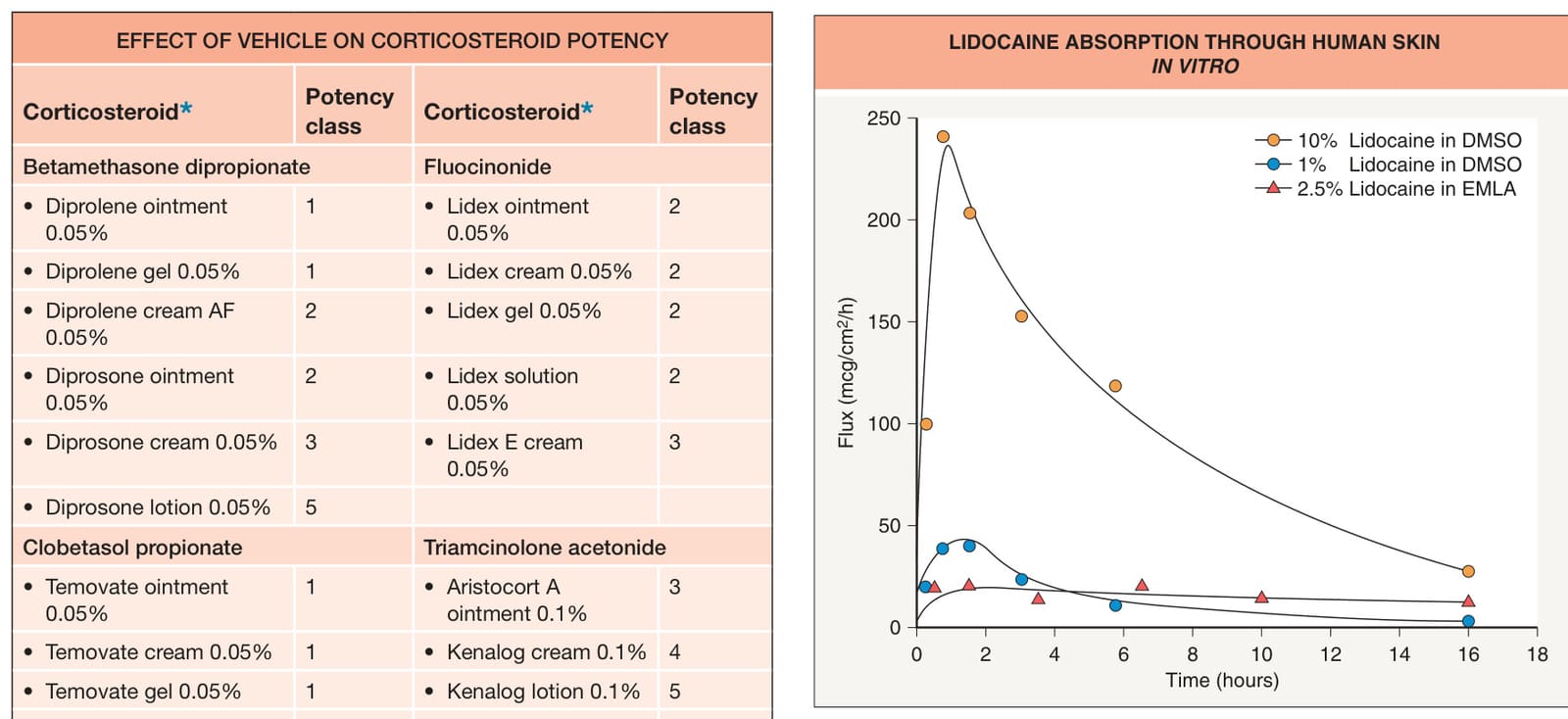
Fig. 124.6 Lidocaine absorption through human skin in vitro. Incorporation of DMSO as a co-solvent with ethanol results in both increased drug solubility (Cv) and partitioning (Km). At 10% drug concentration, the maximum flux in the presence of DMSO is 10-fold greater than that achieved in an emulsion formulation without DMSO (eutectic mixture of lidocaine 2.5% and prilocaine
2.5% [EMLA]). At 1% drug concentration in DMSO, the maximum flux is two-fold greater than 2.5% drug in EMLA. Reproduced from Mallory SB, et al. Topical lidocaine for anesthesia in patients undergoing pulsed dye laser treatment for vascular malformations. Pediatr Dermatol 1993;10:370–5.
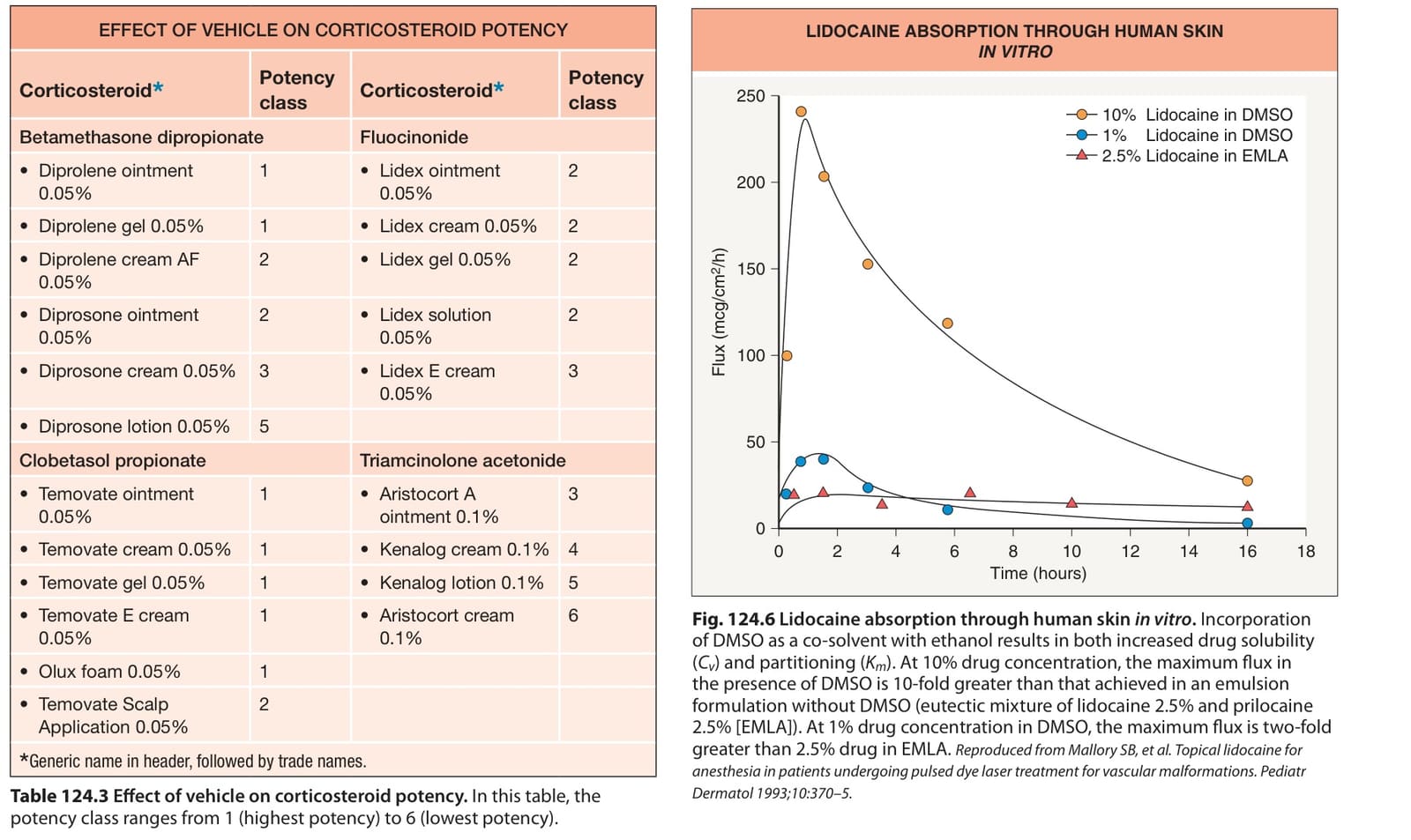
Table 124.3 Effect of vehicle on corticosteroid potency. In this table, the potency class ranges from 1 (highest potency) to 6 (lowest potency).