HISTORY AND DEFINITIONS
The association of AD with allergic rhinitis and asthma was recognized by Besnier in 1892. The term “atopy” originates from the Greek word atopos meaning strange or unusual; it was first applied to this triad in the 1920s, including the use of “atopic eczema”. A decade later, Hill and Sulzberger proposed the name “atopic dermatitis”. The list of characteristic features proposed by Hanifin and Rajka in 1980 helped to unify the clinical concept of AD. In 1994, Williams and co-workers simplified Hanifin and Rajka’s criteria to establish the UK Working Party’s Diagnostic Criteria for AD, which were validated for the purpose of clinical studies; these criteria were modified slightly by Williams in
2005. In 2003, a consensus conference, spearheaded by the American Academy of Dermatology, suggested revised Hanifin and Rajka criteria that are more streamlined and applicable to the full range of patient ages (Table 12.1).
According to the consensus nomenclature by the World Allergy Organization (WAO), the term “atopy” is tightly linked to the presence of allergen-specific IgE antibodies in the serum, as documented by positive fluorescence enzyme immunoassays (previously radioallergosorbent [RAST] tests) or skin prick tests. Thus, an IgE-associated or allergic form of dermatitis, formerly known as extrinsic AD, corresponds to AD in the strict sense. The remaining 20%–30% of patients with the clinical phenotype of AD who have no evidence of IgE-sensitization are categorized as having a non-IgE-associated or non-allergic form of dermatitis, formerly known as intrinsic AD. However, IgE-associated/ allergic “true” AD and non-IgE-associated/non-allergic dermatitis have substantial overlap and cannot be considered as two separate diseases; for example, the latter often represents an early transitional form of IgE-associated AD.
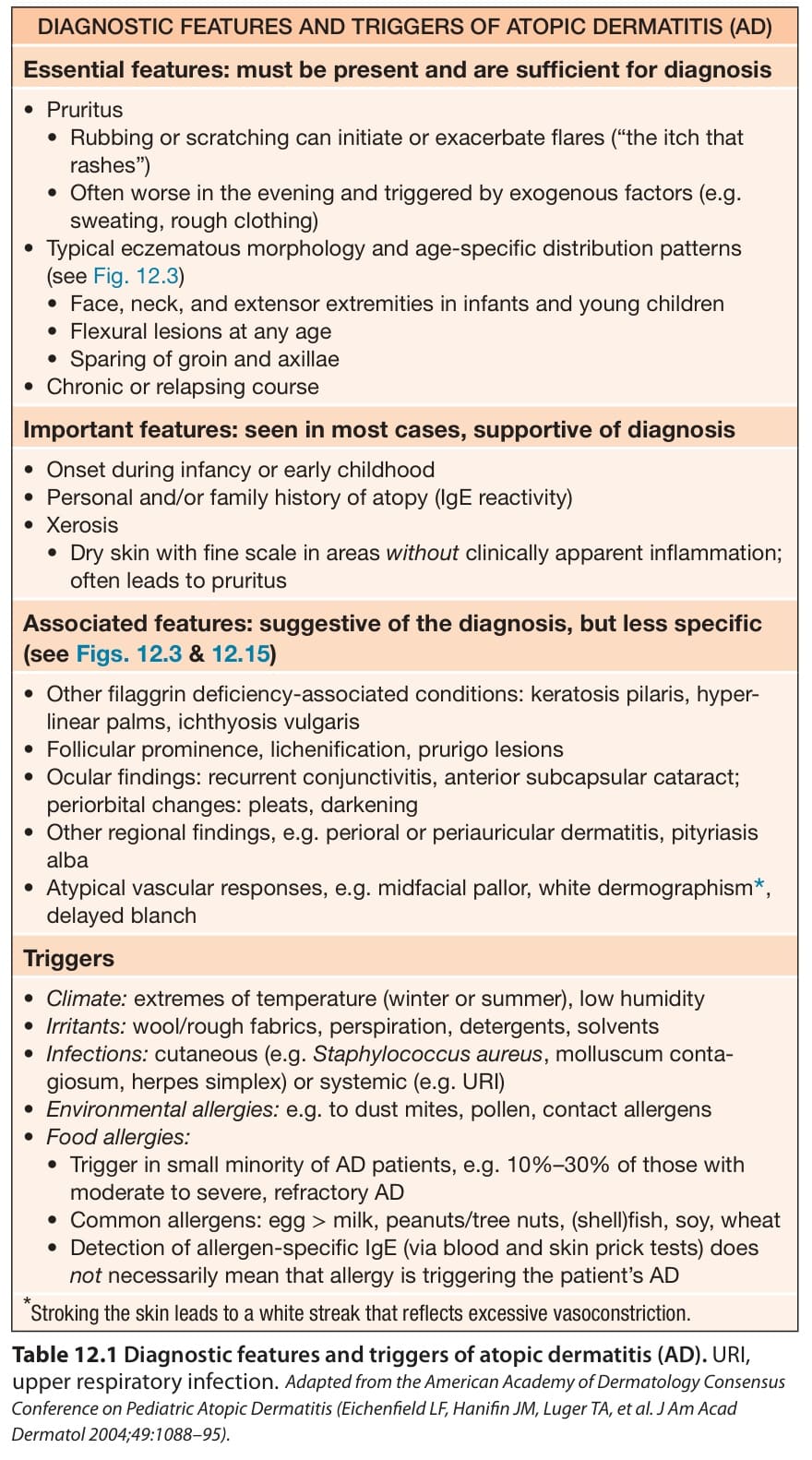
Table 12.1 Diagnostic features and triggers of atopic dermatitis (AD). URI, upper respiratory infection.Adapted from the American Academy of Dermatology Consensus Conference on Pediatric Atopic Dermatitis (Eichenfield LF, Hanifin JM, Luger TA, et al. J Am Acad Dermatol 2004;49:1088–95).