APREMILAST
A novel, small-molecule inhibitor of phosphodiesterase 4, apremilast (Otezla®) works intracellularly to reduce the production of proinflammatory mediators and increase those that are anti-inflammatory (see below). When administered orally, apremilast is 70%–75% bioavailable, with peak plasma concentrations observed at ~2.5 hours. Nearly 70% of the drug is bound to plasma proteins, and it is metabolized by cytochrome P450 (CYP) enzymes, predominately CYP3A4 (see Ch. 131); this is followed by glucuronidation and non-CYP-mediated hydrolysis. Apremilast has a terminal elimination half-life of 6–9 hours and is excreted in the urine and feces.
Mechanism of Action
Apremilast inhibits phosphodiesterase 4, which is an intracellular enzyme that degrades cAMP and represents the predominant phosphodiesterase in keratinocytes, dendritic cells, monocytes, and neutrophils. Increasing intracellular cAMP levels activates protein kinase A, leading to enhanced expression of several transcription factors including cAMP-response element binding protein (CREB), while inhibiting others such as nuclear factor kappa B (NF-κB). By inhibiting phosphodiesterase 4 and increasing intracellular cAMP levels, apremilast has multiple downstream effects: it decreases the production of inflammatory mediators such as TNF, IFN-γ, and interleukins (IL)-2, -12, and -23; it increases the production of anti-inflammatory mediators including IL-10; and it inhibits natural killer responses (Fig. 130.4).
Dosages
The recommended dosage for psoriatic arthritis and psoriasis is 30 mg twice daily. In order to reduce gastrointestinal symptoms, an upward titration of the dose by 10 mg/day is recommended, starting with an initial dose of 10 mg/day. Apremilast is available in 10, 20, and 30 mg tablets. For individuals with severe renal impairment, the recommended maximum daily dose is 30 mg; there is no dosing adjustment for hepatic impairment.
Major Side Effects
The most common side effects are gastrointestinal, especially nausea and diarrhea, which are most evident during the first 15 days of administration and gradually resolve over several weeks. Headache and nasopharyngitis are additional potential side effects. Because depression, including suicidal ideation, can be observed in up to 1% of patients, patients with a history of depression should be monitored closely. Loss of ~5%–10% of body weight occurs in ~10% of patients. No laboratory monitoring is recommended, but serial measurements of weight can be considered.
Indications
Apremilast is FDA-approved for adult patients with active psoriatic arthritis and moderate to severe plaque psoriasis. The ESTEEM trial reported that a significantly greater proportion of patients receiving apremilast (30 mg BID) achieved Psoriasis Area and Severity Index (PASI)-75 (33.1%) and PASI-50 (58.7%) at week 16 compared with placebo (5.3% and 17.0%); quality of life measures and nail and scalp psoriasis were similarly improved. It is also approved for the treatment of oral ulcers associated with Behçet disease and is currently being investigated for other inflammatory skin diseases including lichen planus, hidradenitis suppurativa, granulomatous dermatoses, discoid LE, and atopic dermatitis.
Contraindications
Apremilast is contraindicated in patients with known hypersensitivity to the drug or its components. Dosing should be adjusted for renal failure (see above). Relative contraindications include a history of depression or suicidal ideation.
Use in Pregnancy and Lactation
Because well-controlled studies of pregnant women receiving apremilast have not been conducted, incidences of malformations and fetal loss are currently not known. In studies in monkeys, administration of apremilast during organogenesis resulted in dose-related increases in abortion/embryo-fetal death at dose exposures of 2.1× MRHD (maximum recommended human therapeutic dose) and no adverse effects at exposure of 1.4×. Although it is not known whether apremilast or its metabolites are present in human milk, the drug was detected in the milk of lactating mice. Fertility studies in male mice detected no adverse effects; in female mice, estrous cycles were prolonged (at higher doses) and those mice that became pregnant had an increased incidence of early postimplantation loss.
Drug Interactions
Coadministration of apremilast with potent CYP450 inducers including rifampin, phenobarbital, carbamazepine, and phenytoin may significantly diminish apremilast levels and should be avoided (see Ch. 131).
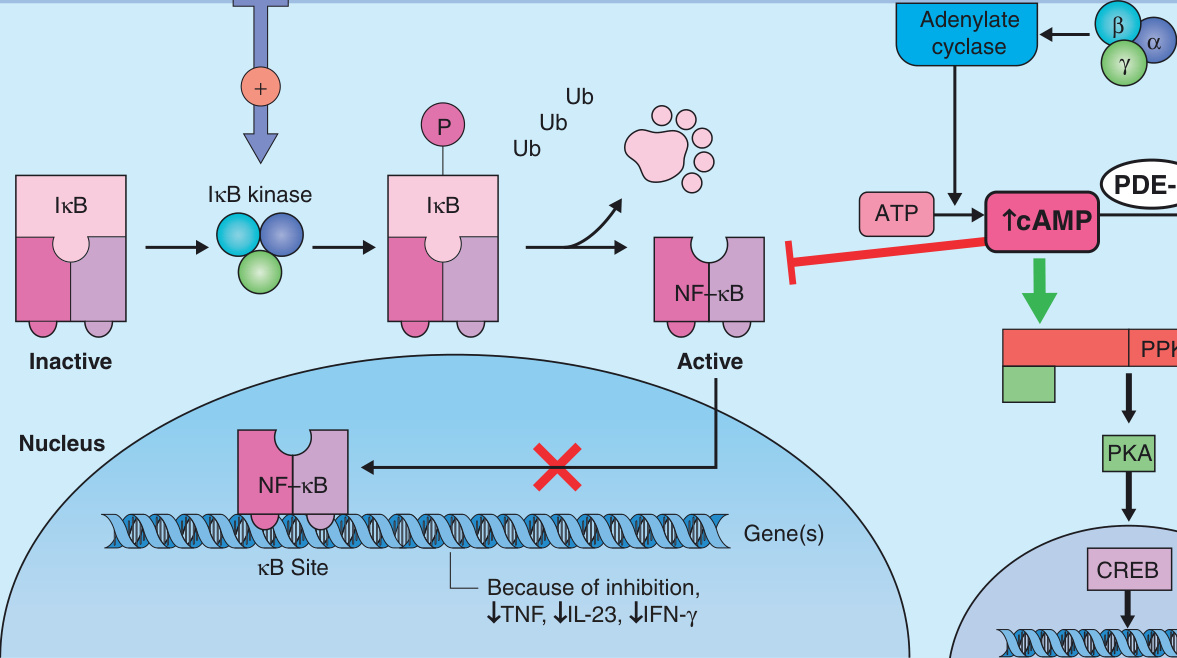
Fig. 130.4 Mechanism of action of apremilast and other phosphodiesterase 4 (PDE-4) inhibitors. Inhibition of phosphodiesterase 4 (PDE-4) results in increased intracellular cAMP levels. This leads to activation of protein kinase A (PKA), which in turn phosphorylates the transcription factor cAMP response element binding protein (CREB). Binding of CREB acts to increase the expression of anti-inflammatory mediators, e.g. interleukin (IL)-10. Increased intracellular cAMP levels also inhibit nuclear factor kappa B (NF-κB) leading to decreased expression of inflammatory mediators, e.g. tumor necrosis factor-alpha (TNF-α), IL-23, interferon-γ (IFN-γ). NEMO is another name for the gamma subunit of IκB kinase. ATP, adenosine triphosphate; α, α subunit of the stimulatory G protein; Ub, ubiquitin. Adapted from Schafer P. Apremilast – mechanism of action and application to psoriasis and psoriatic arthritis. Biochem Pharmacol 2012;83:1583–90.