CYCLOSPORINE
Cyclosporine, a cyclic peptide of 11 amino acids, was isolated from the soil fungus Tolypocladium inflatum in 1970 and was found to have clinical immunosuppressive effects in 1976. In 1979, during a rheumatoid arthritis trial, it was discovered that cyclosporine improved cutaneous psoriasis in patients with psoriatic arthritis. Two forms are available, the original preparation (Sandimmune®) and a predigested microemulsion (Neoral®) that is more completely and consistently absorbed. The latter is available as capsules (25 and 100 mg) or as an oral solution (100 mg/ml). The solution can be mixed in orange juice or apple juice, but grapefruit juice should be avoided because it alters cyclosporine’s metabolism (see Fig. 131.4).
Bioavailability of the microemulsion is not known, but it yields 40%–106% higher peak blood levels than the original formulation. Cyclosporine is both metabolized by the CYP3A4 pathway and is a CYP3A4 inhibitor; primary excretion is via bile and feces. Only 6% of cyclosporine is excreted unchanged in the urine. Drug levels (11-hour trough level) can be measured but the therapeutic range is relatively wide; determinations are helpful when drug–drug interactions or non-compliance are a concern.
Mechanism of Action
T cell receptor activation causes release of intracellular calcium that in turn binds calmodulin and activates calcineurin (see Ch. 129). This calcineurin complex dephosphorylates the nuclear factor of activated T cells (NFATc) which is present within the cytoplasm, allowing it to migrate into the nucleus and bind with its intranuclear counterpart NFATn. This complex is a transcription factor for inflammatory cytokines such as IL-2. IL-2 receptors are also upregulated as a result of this process.
Cyclosporine binds to cyclophilin, a member of the family of intra-cytoplasmic proteins called immunophilins. This complex blocks the dephosphorylation of NFATc and the subsequent upregulation of IL-2 and IL-2 receptors, resulting in a reduction of CD4+ and CD8+ (cytotoxic) T cells in the epidermis.
Dosages
Cyclosporine is best used on a short-term basis (<6–12 months) to control flares of psoriasis relatively quickly and to provide an alternative to the patient’s current regimen (see Ch. 8). However, safety has been documented in psoriasis patients receiving therapy for up to 2 years. It is reasonable to use cyclosporine as sequential therapy with acitretin, methotrexate, or other systemic agents such as systemic immunomodulators (“biologics”). After psoriasis clearance has been initiated by cyclosporine, the alternative medicine may be started and advanced to the therapeutic dose. At the same time, cyclosporine may be weaned by 1 mg/kg/day each month until the patient is maintained on the alternate systemic agent. Historically, the maximum dermatologic dose for cyclosporine is 5 mg/kg/day, although a maximum dose of 4 mg/kg/ day of the microemulsion formulation should be considered, given its greater bioavailability. The dose for obese patients is based on ideal body weight.
For psoriasis patients with a severe flare or recalcitrant disease, cyclosporine may be initiated at the maximum dosage until significant disease resolution occurs. The dose is then tapered by 1 mg/kg/ day every 2 weeks until the minimum effective maintenance dose is determined. For most patients with more moderate disease, therapy should be initiated at 2.5 mg/kg/day and increased by 0.5 to 1 mg/kg/ day every other week until clinical improvement is seen or a maximum dose of 4–5 mg/kg/day (depending upon the formulation) is reached. If no improvement is observed after 3 months at maximum dose, therapy has failed and should be discontinued.
Patients must be adequately monitored for the development of hypertension and laboratory abnormalities as outlined in Table 130.3. If the serum creatinine rises by >25% over baseline, the value should be rechecked within 2 weeks. If it returns to <25% over baseline, therapy can be continued at the current dose. However, if the elevation persists at that level, the dose should be decreased by 25%–50% for 1 month and then the serum creatinine rechecked. If it is still >25% above baseline, therapy should be discontinued until the serum creatinine is within 10% of the baseline value. At that time, restarting therapy may be considered, but at a significantly lower dose.
Major Side Effects
Cyclosporine is associated with a wide variety of adverse effects, including hypertension, renal dysfunction, hyperlipidemia, hyperkalemia, hyperuricemia, hypomagnesemia, hypertrichosis, and gingival hyperplasia (see Table 130.5). Most of the side effects associated with short-term therapy are reversible upon discontinuation of the drug. A quarter of all psoriasis patients on cyclosporine will develop hypertension, which is usually mild and manageable; calcium channel blockers of the dihydropyridine class are the recommended first-line antihypertensive agents. A direct vasoconstrictive effect of cyclosporine on the kidney vasculature is responsible for the development of hypertension short-term. Hypertension due to cyclosporine is both timeand dose-related.
Modern, conservative dosing guidelines have prevented significant kidney damage in the vast majority of patients on short-term therapy. However, renal interstitial fibrosis has been demonstrated histologically even in the absence of abnormal laboratory tests in patients on appropriate dosing and monitoring regimens. Renal biopsy specimens from patients on long-term treatment demonstrate irreversible changes including renal tubular atrophy, arteriolar hyalinosis, glomerular obsolescence, and interstitial fibrosis. In fact, all patients on cyclosporine for >2 years were shown to have some of these abnormalities.
Although transplant recipients on high doses and prolonged courses of cyclosporine have an increased risk of certain malignancies (e.g. lymphoma, cutaneous squamous cell carcinoma), patients with skin diseases on cyclosporine for less than 2 years and on lower “dermatologic” doses have not been observed to have a similar risk.
Indications
Cyclosporine can be beneficial for patients with psoriasis who have failed or cannot tolerate other therapies and for those with widespread, inflammatory disease. In fact, cyclosporine has FDA approval for three “types” of psoriasis: (1) severe; (2) recalcitrant; and (3) disabling. Patients with plaque-type psoriasis may also benefit from cyclosporine in rotating or sequential regimens with other modalities.
The use of cyclosporine in atopic dermatitis has been examined, and a high percentage of patients improve with therapy; unfortunately, most relapse within 4 weeks of discontinuation. Cyclosporine efficacy has been established in patients with severe pyoderma gangrenosum; however, some clinicians prefer cyclosporine for idiopathic pyoderma gangrenosum only, arguing that when there is a known underlying cause, therapy is best aimed at the latter (e.g. inflammatory bowel disease, myelodysplasia). Very short-term cyclosporine has been used for Stevens–Johnson syndrome and toxic epidermal necrolysis as well as other severe cutaneous adverse reactions such as DRESS (drug reaction with eosinophilia and systemic symptoms) and AGEP (acute generalized exanthematous pustulosis) with promising results. Most other uses of cyclosporine are based upon anecdotal evidence.
Contraindications
Absolute contraindications include significant renal impairment, uncontrolled hypertension, and hypersensitivity to cyclosporine. Relative contraindications include age <18 years or >64 years, controlled hypertension, and medication usage that may interfere with cyclosporine metabolism or worsen renal function. Caution is necessary if used in patients with significant infections, recent live-virus vaccinations (see Table 128.9) or immunodeficiency syndromes, or in combination with methotrexate, phototherapy, or other immunosuppressive drugs.
Use in Pregnancy and Lactation
Cyclosporine is not associated with an increased risk of major fetal malformations when compared to the general population. Use during pregnancy should be considered only in exceptional patients for whom the potential benefits dramatically outweigh the risks, with close monitoring of maternal blood pressure and renal function. Cyclosporine is excreted into breast milk and should not be used during lactation, due to risks of immunosuppression and possible carcinogenesis in the breastfed infant. There is no recommendation for male patients to discontinue cyclosporine while trying to conceive with their partner and limited data are available regarding impact on female fertility.
Drug Interactions
Drugs that interact with cyclosporine are discussed in Chapter 131. The clinician should review the patient’s medication list for potential interactions using the following guidelines. In general, drugs that inhibit the CYP3A4 pathway will increase cyclosporine levels, while inducers of the 3A4 pathway will decrease the effectiveness of cyclosporine, due to lower serum levels. Some drugs will potentiate renal toxicity, such as nonsteroidal anti-inflammatory drugs (NSAIDs), aminoglycosides, amphotericin B, and miscellaneous antibiotics (vancomycin, trimeth oprim–sulfamethoxazole). Cyclosporine will reduce the renal clearance of digoxin, lovastatin, and prednisolone. Increased risk of hyperkalemia occurs with concurrent use of angiotensin-converting enzyme (ACE) inhibitors, potassium supplements, and potassium-sparing diuretics.

Table 130.3 Monitoring guidelines for systemic medications, as recommended by the authors.
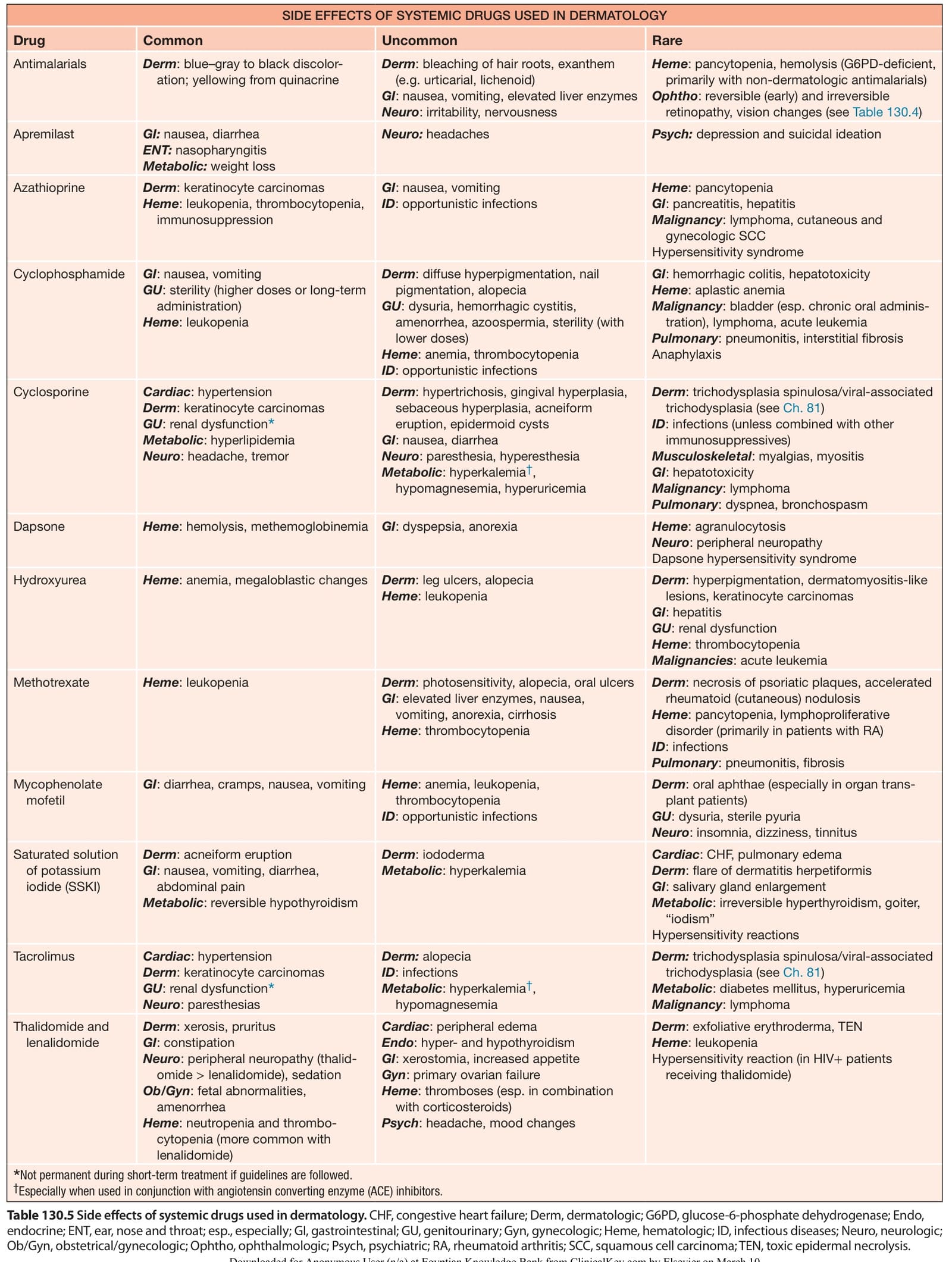
Table 130.5 Side effects of systemic drugs used in dermatology. CHF, congestive heart failure; Derm, dermatologic; G6PD, glucose-6-phosphate dehydrogenase; Endo, endocrine; ENT, ear, nose and throat; esp., especially; GI, gastrointestinal; GU, genitourinary; Gyn, gynecologic; Heme, hematologic; ID, infectious diseases; Neuro, neurologic; Ob/Gyn, obstetrical/gynecologic; Ophtho, ophthalmologic; Psych, psychiatric; RA, rheumatoid arthritis; SCC, squamous cell carcinoma; TEN, toxic epidermal necrolysis.