DAPSONE
Dapsone is a sulfone drug, and sulfones are related to the sulfonamide family. Sulfonamides were initially derived from coal tar in the early 1900s for use as fabric dyes. Medically, they were first demonstrated to be effective against streptococcal infections. Synthesized in 1908, dapsone was shown to be effective against tuberculosis and Hansen disease (leprosy). During the first half of the twentieth century, the related drugs sulfapyridine and sulfoxone were used to treat dermatitis herpetiformis (DH). However, since 1953, dapsone (the parent compound of sulfoxone) has been the mainstay of treatment for DH. Due to its activity in neutrophil-mediated dermatoses, dapsone has also proven useful in the treatment of several forms of autoimmune bullous diseases and vasculitis syndromes.
Dapsone is 80% orally bioavailable, peaks in the serum between 2 and 6 hours post-administration and has a half-life of 24–30 hours. Being highly lipophilic, it has excellent cell penetration. Dapsone and its major metabolite monoacetyldapsone are strongly protein-bound and undergo enterohepatic recirculation. Thus, dapsone may be found in the bloodstream up to 1 month following a single dose.
Dapsone is metabolized by N-acetylation and N-hydroxylation in the liver. Acetylation yields monoacetyldapsone, which is then de-acetylated to dapsone, yielding an equilibrium between dapsone and monoacetyldapsone. Hydroxylation via CYP enzymes produces N-hydroxy-dapsone, the metabolite which is believed to be responsible for the majority of dapsone side effects. Both dapsone and N-hydroxydapsone undergo glucuronidation in the liver, which results in more water-soluble compounds that are rapidly excreted in the urine.
Mechanism of Action
Dapsone is clinically most useful in the treatment of dermatologic diseases involving neutrophilic infiltrates. Researchers have demonstrated that dapsone inhibits neutrophil myeloperoxidase, thus reducing damage from the neutrophil respiratory burst mediated by this enzyme. Furthermore, dapsone has been shown to inhibit neutrophil chemotaxis to N-formyl-methionyl-leucyl-phenylalanine (fMLP) and to interfere with the CD11b/CD18-mediated neutrophil binding that induces chemoattractant signal transduction. IgA adherence is also inhibited. It is of clinical interest that dapsone also inhibits eosinophil myeloperoxidase activity, and thus may be efficacious in diseases in which eosinophils have a central role in pathogenesis, such as eosinophilic cellulitis.
Dosages
Dapsone is available in 25 and 100 mg tablets. The initial dose is often 50 mg/day in a single dose. Most conditions require 50–200 mg/day for adequate control of symptoms; rarely are dosages up to 300 mg/day required. In those with DH who respond to dapsone, rapid resolution of symptoms (within 48 hours) is usually noted; conversely, symptoms flare relatively rapidly after discontinuing therapy. Patients must be strictly warned against self-adjustment of the dosage, due to dosedependent side effects.
Because of potential adverse effects, any cardiopulmonary or neurologic symptoms should be assessed prior to therapy. Documentation of peripheral motor nerve function may occasionally be necessary before or during therapy. Table 130.3 outlines monitoring guidelines for therapy. The clinician must be aware of all signs and symptoms associated with methemoglobinemia and peripheral neuropathy to ensure proper monitoring.
Major Side Effects
Serious systemic side effects of dapsone may be idiosyncratic or pharmacologic. The pharmacologic and dose-dependent adverse effects include methemoglobinemia and hemolytic anemia (see Table 130.5). Agranulocytosis, peripheral motor neuropathy, and dapsone hypersensitivity are idiosyncratic reactions; however, patients on higher daily doses or long-term therapy may be more likely to develop a peripheral motor neuropathy. Although rare, dapsone hypersensitivity syndrome may be fatal. Patients present with fever, hepatitis, and a generalized cutaneous eruption. Cutaneous reactions range from an exanthematous eruption to toxic epidermal necrolysis (TEN). Liver failure has occurred in patients with the dapsone hypersensitivity syndrome, and hypothyroidism may develop following resolution of the acute eruption. Thus, there is significant overlap with DRESS/DIHS (drug reaction with eosinophilia and systemic symptoms/drug-induced hypersensitivity syndrome). In particular, HLA-B*13:01 has been associated with dapsone-related DRESS in Chinese populations and its incidence can be reduced via screening prior to therapy.
Indications
Dapsone works well in a number of neutrophilic dermatoses and immunobullous diseases. Although only FDA-approved for DH, dapsone is very useful in linear IgA bullous dermatosis, bullous eruption of SLE, erythema elevatum diutinum, mucous membrane (cicatricial) pemphigoid, and perhaps cutaneous small vessel vasculitis. It is also a key component of combination therapy for Hansen disease.
Contraindications
The absolute contraindication to dapsone therapy is prior hypersensitivity to dapsone. Relative contraindications include a low glucose- 6-phosphate dehydrogenase (G6PD) level, significant cardiopulmonary disease, and allergy to sulfonamide antibiotics (because of possible cross-reactivity). In patients with low G6PD levels, there is an increased risk for oxidative stress of the dapsone metabolites on RBCs. Those with significant cardiopulmonary disease may not tolerate the methemoglobinemia and hemolysis induced by dapsone.
Use in Pregnancy and Lactation
Dapsone does not appear to present a major risk to the fetus; however, it should only be used during pregnancy if the benefits clearly outweigh the risks. There have been publications reporting its use in pregnant patients with Hansen disease. Dapsone is found in breast milk and can cause hemolytic anemia in breastfed infants; however, it is approved by the American Academy of Pediatrics for use during lactation when required, as in patients with Hansen disease.
Drug Interactions
Drugs that may increase dapsone levels (and side effects) are probenecid (via decreased renal clearance), trimethoprim, and other folate antagonists such as methotrexate. Sulfonamides and hydroxychloroquine increase the oxidative stress on RBCs and may worsen hemolysis. Dapsone levels may be reduced by activated charcoal, para-aminobenzoic acid (PABA), and rifampin. Although cimetidine can increase absolute levels of dapsone, the former leads to a reduction in the more toxic hydroxylamine metabolite, and thus the end result is a lower level of methemoglobin.

Table 130.3 Monitoring guidelines for systemic medications, as recommended by the authors.
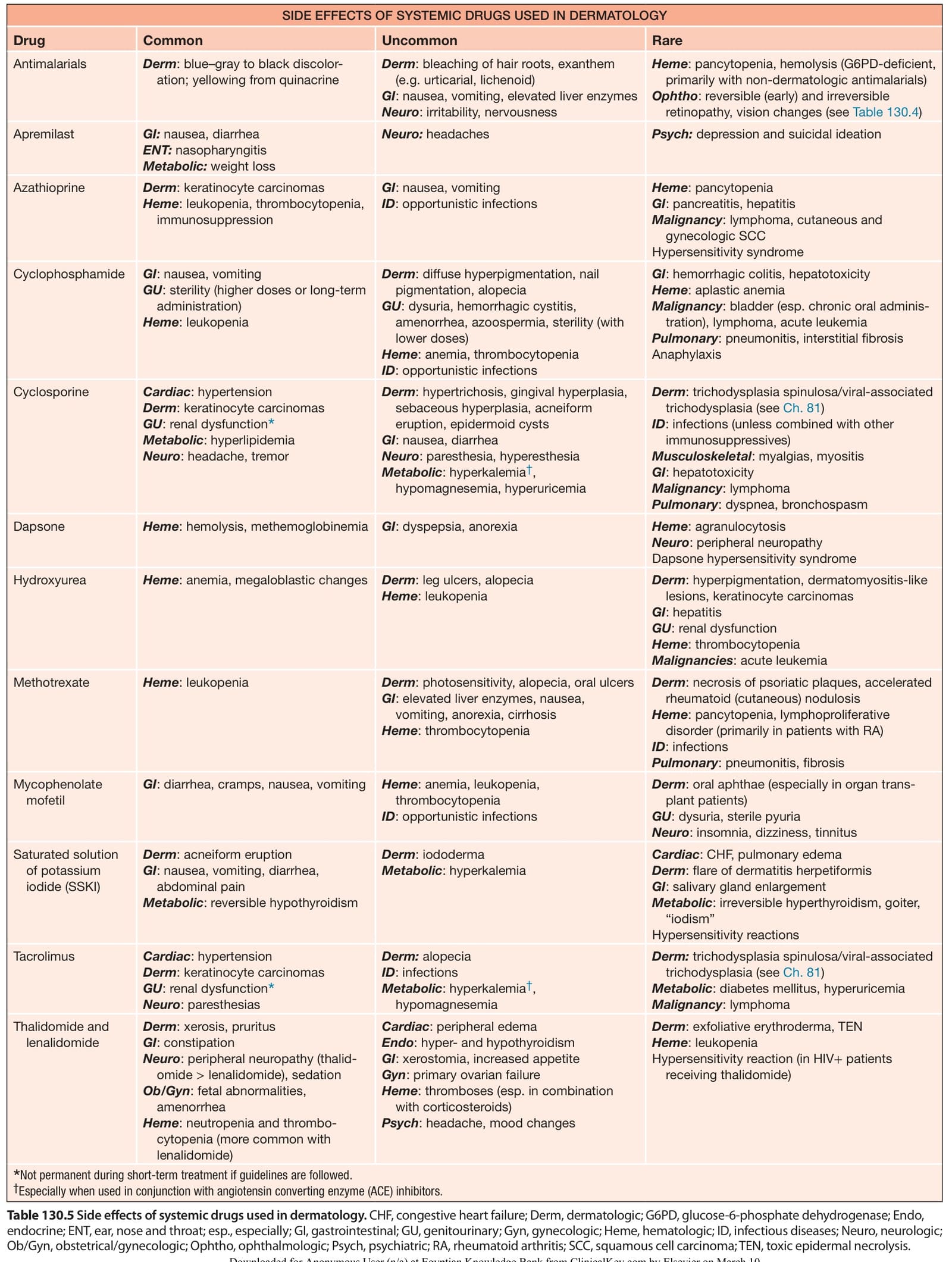
Table 130.5 Side effects of systemic drugs used in dermatology. CHF, congestive heart failure; Derm, dermatologic; G6PD, glucose-6-phosphate dehydrogenase; Endo, endocrine; ENT, ear, nose and throat; esp., especially; GI, gastrointestinal; GU, genitourinary; Gyn, gynecologic; Heme, hematologic; ID, infectious diseases; Neuro, neurologic; Ob/Gyn, obstetrical/gynecologic; Ophtho, ophthalmologic; Psych, psychiatric; RA, rheumatoid arthritis; SCC, squamous cell carcinoma; TEN, toxic epidermal necrolysis.