INTRODUCTION AND HISTORY
Sun Exposure
Evidence exists that even ancient civilizations sought protection from the damaging effects of the sun. The concept of excessive sun exposure as unhealthy or at least cosmetically unacceptable eventually spread to Northern Europe, especially among the aristocracy, and continued into the nineteenth century until the period of the Industrial Revolution. In 1890, Palm noted that children in urban slums of England had rickets whereas those in similar housing conditions in sunny India did not, and linked the lack of sun to the development of rickets. Physicians then began to treat such children with artificial UV radiation. At the same time, Finsen began to treat a number of other diseases, including cutaneous tuberculosis and, interestingly, lupus erythematosus, with artificial light; he was awarded the Nobel Prize for this work in 1903. At the turn of the twentieth century, the image of tanned skin as aesthetically pleasing began to emerge. The French fashion designer Coco
Chanel is often credited with developing the concept of tanned skin as beautiful that still persists today. Indeed, for decades consumers applied various oils to the skin and used metal reflectors to enhance tanning. However, the twentieth century also saw the recognition of sunburn as an effect of UVB, the discovery of UVB-specific DNA mutations, and establishment of UVB as a complete carcinogen.
During the 1990s, dermatologists and other healthcare professionals made serious efforts to educate consumers regarding the damaging effects of excessive sun exposure as well as exposure to artificial tanning devices. Despite these efforts, recent studies show that while under-standing of the adverse effects of exposure has increased, there has been very little positive change in behavior. This is especially true for adolescents and young adults, who continue to suffer sunburns and who continue to seek tans through natural and artificial exposure. For example, a systematic review in 2014 reported the prevalence of exposure to indoor tanning in the US, Europe, and Australia to be 36% for adults, 55% for university students, and 19% for adolescents. Even in children and adolescents with a parental history of melanoma, sun protection was noted to be suboptimal, and some studies have found that sunscreen usage has actually been declining.
Sunscreens
Sunscreens attenuate UV wavelengths which would otherwise interact with molecules in the skin (chromophores) to generate photochemical reactions, leading to photobiologic change. These preparations are usually combinations of active filters that absorb or scatter incident radiation, and they are dispersed in a variety of topical vehicles. The active ingredients are not meant to be absorbed in any large quantity into the living epidermis, dermis, or general circulation.
In 1928, the first modern sunscreen, a product containing benzyl salicylate and benzyl cinnamate, was introduced in the US. However, widespread use of sunscreens did not occur until World War II, when the US military provided preparations containing red petrolatum to prevent sunburn in troops stationed in sunny areas. After the war, there was an increased interest in UV-absorbing chemicals, and para-aminobenzoic acid (PABA), patented in 1943, was the first of these to gain widespread usage. It was not until the mid-1970s that sunscreens gained a degree of consumer acceptance.
While solar radiation reaching the surface of the earth and human skin includes ultraviolet, visible, and infrared rays (see Fig. 134.1), the initial sunscreens were formulated primarily to prevent sunburn and therefore contained primarily UVB-absorbing agents (Fig. 132.1). As scientific evidence grew documenting the deleterious effects of longerwavelength UVA radiation and as manufacturers strove to develop higher levels of protection against burning, agents with absorption in the longer wavelengths (e.g. benzophenones) were combined with UVB absorbers. The inorganic sunscreens (e.g. titanium dioxide) were used from the early days of sunscreen manufacturing, but because of large particle size, were not cosmetically acceptable in high concentrations. Newer technology allowed for micronization of such particles, with an increase in transparency and therefore greater cosmetic acceptability. More recently, chemical agents with greater UVA absorption have been introduced (see below) and are gaining in popularity.
Today, a wide array of sunscreen-containing preparations, including foundations, moisturizers, and lipsticks, are commercially available. Another improvement in sunscreen products has been the development of agents with increased substantivity. Such agents, usually marketed as “sports” products, have bases which persist on the stratum corneum for longer than do the usual bases, allowing for vigorous outdoor activity, sweating, and even swimming with retained photoprotection.
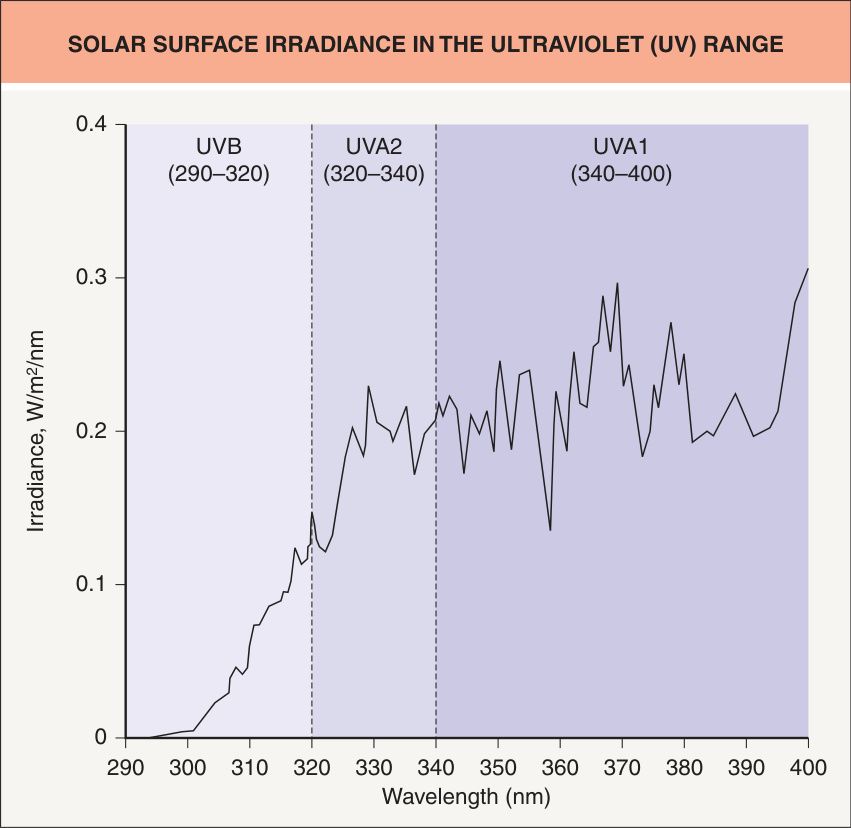
Fig. 132.1 Solar surface irradiance in the UV range. Note that the defined boundary between UVB and UVA differs between the International Commission on Illumination (315 nm) and the FDA (320 nm). Courtesy Mark Naylor, MD.