CONCLUSIONS
Increasingly, we are asking the question, “Lasers: what’s the truth?” This reality check is necessary so that we start to ask the right questions and are critically aware of the answers. Laser engineers are very insightful and they can provide us with semi-intelligent laser, light, and other energy systems that can more precisely target the correct structures and induce appropriate healing responses. We should celebrate the enormous energy that goes into newer and more sophisticated devices, just as we should criticize and reject devices which underperform and overpromise. Those of us who are involved in new technology devel opment know that, just around the corner, advances are going to bring us smarter, cheaper, more durable, more tunable devices. Total internal reflection of spontaneous emission of radiation (TRASER) devices, which are neither lasers nor IPL, are more efficient than lasers and are tunable. Our hope is that as new technologies come online, there will be a continued attempt to answer the ongoing tough questions pertaining to both surgical and medical dermatology.
Additional figures and video available in our eBook (see inside front cover for access code).
and sclerotherapy in leg telangiectasias treatment. Lasers Surg Med. 2004;34:273–276.4. Alster TS, Garg S. Treatment of facial rhytides with a high- precise microsurgery by selective absorption of pulsed radiation. Science. 1983;220:524–527.2. Alexiades-Armenakas MR, Dover JS, Arndt KA. The side-by-side comparison with carbon dioxide laser. Lasers Surg Med. 2000;26:208–214.7. Jacob CI, Dover JS, Kaminer MS. Acne scarring: a classi- energy pulsed carbon dioxide laser. Plast Reconstr Surg. 1996;98:791–794.5. Zachary CB. Modulating the Er: YAG laser. Lasers Surg Med.
spectrum of laser skin resurfacing: nonablative, fractional, and ablative laser resurfacing. J Am Acad Dermatol. 2008;58:719–737. quiz 738–40.3. Levy JL, Elbahr C, Jouve E, Mordon S. Comparison and fication system and review of treatment options. J Am Acad Dermatol. 2001;45:109–117.8. Johnson TM, Sebastien TS, Lowe L, Nelson BR. Carbon
2000;26:223–226.6. Newman JB, Lord JL, Ash K, McDaniel DH. Variable pulse sequential study of long pulsed Nd:YAG 1,064 nm laser dioxide laser treatment of actinic cheilitis: clinico histopathologic correlation to determine the optimal depth of destruction. J Am Acad Dermatol. 1992;27:737–740.
erbium: YAG laser skin resurfacing of perioral rhytides and
Nano-Pulse Stimulation™ (NPS™) technology (Pulse Biosciences, Inc.) utilizes non-thermal energy and has a unique mechanism of action that targets only cellular morphology while sparing the non-cellular stroma (Fig. 137.18). Ultrafast (nanosecond) electrical energy pulses are delivered via microneedle arrays. In clinical trials, NPS has been used to treat common warts, seborrheic keratoses, sebaceous hyperplasia, and superficial basal cell carcinomas, with a reportedly low incidence of hyper- or hypopigmentation and rarely scarring. Regulated cell death has also been observed in malignant tumor-bearing animals as has a secondary immune response that leads to rejection of re-intro duced malignant cells of the same lineage.
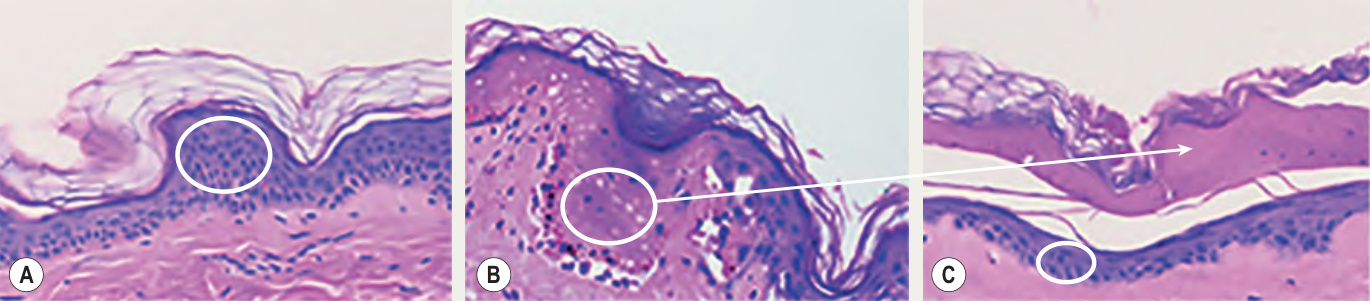
Fig. 137.18 Nanopulse stimulation (NPS). Cellular apoptotic death. A Abdominal skin, untreated. B Abdominal skin, 1 day after NPS treatment. C Abdominal skin, 5 days post NPS treatment. From Kaufman D, Martinez M, Jauregui L, et al. A dose-response study of a novel method of selective tissue modification of cellular structures in the skin with nanosecond pulsed electric fields. Lasers Surg Med 2020;52:315–22.