PALLIATION
Locally Advanced Tumors
Occasionally, elderly, debilitated, or mentally ill patients present with advanced and neglected skin cancers, which, though not curable, can be palliated. Such tumors are often painful, bleeding, and infected, causing problems for both the patient and the caregiver. With the addition of a bolus (see Fig. 139.2), single large fractions of 8–20 Gy can be given quickly (within minutes) using megavoltage photons. Uncooperative patients may require mild sedation prior to treatment. These large single fractions are well tolerated with minimal toxicity. Alternative regimens include multiple, medium-sized fractions given once or twice a week (e.g. 8 Gy × 3). In elderly patients who are otherwise well, higher total dose fractionation schedules such as 35 Gy in 5–7 fractions or 40 Gy in 10 fractions (Fig. 139.9) may be more appropriate and can be considered more aggressive in intent. These are often given as two or three fractions per week.
Metastases
Dermal-based metastases occur most frequently in patients with lung and breast cancer, and, in general, are associated with a poor prognosis (see Ch. 122). Both in-transit metastases and distant dermal metastases can develop in patients with cutaneous SCC, Merkel cell carcinoma, and melanoma. Cutaneous metastases may also present as rapidly enlarging subcutaneous masses with intact overlying skin.
Ulceration and bleeding are complications of cutaneous metastases that respond to palliative radiotherapy. Orthovoltage photons or megavoltage photons (with a bolus) administered as a single 8 Gy fraction or as 20 Gy in five fractions are effective regimens. Metastatic deposits elsewhere (e.g. skeletal) are also palliated with a similar dose fractionation schedule.
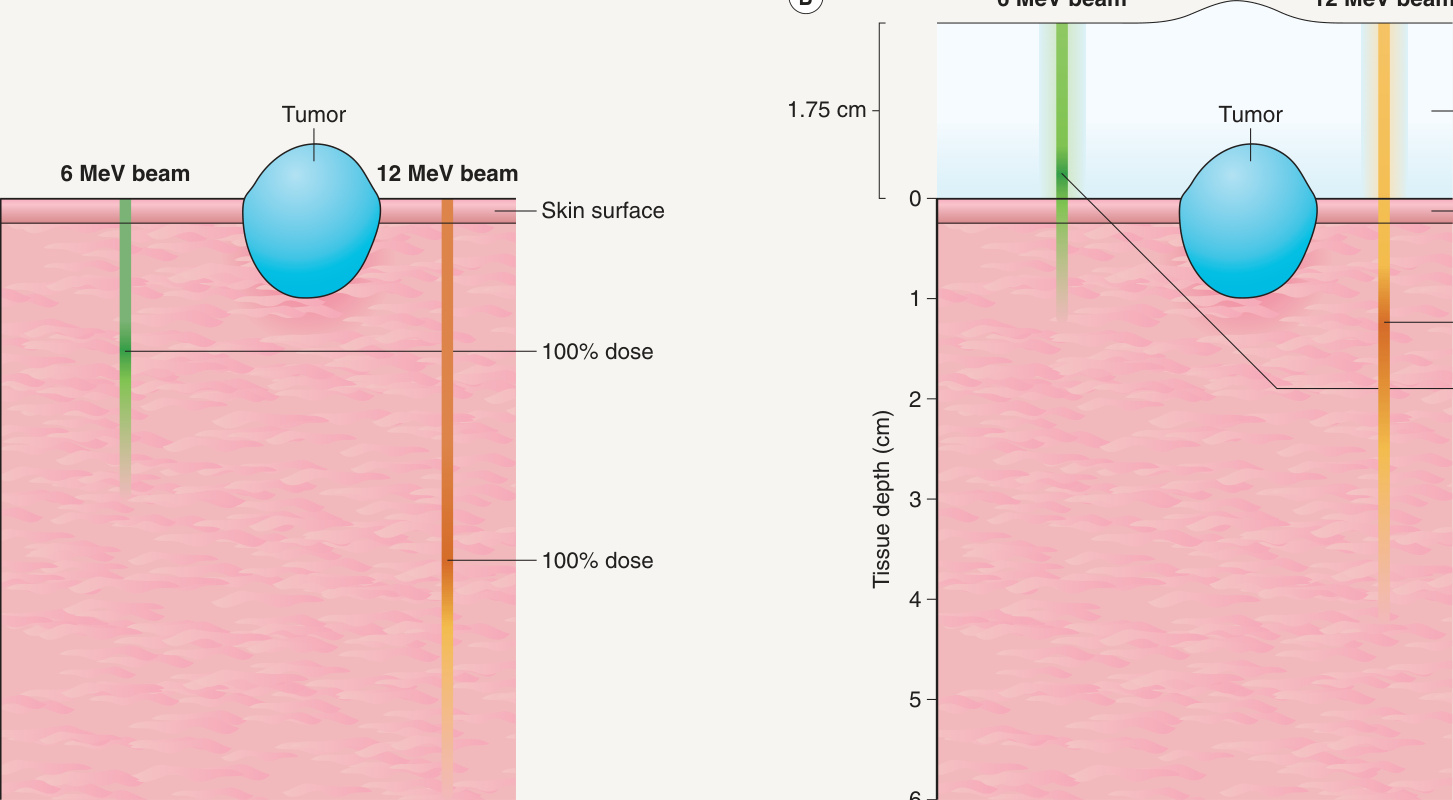
Fig. 139.2 Depth dose of electron beams – with and without a bolus.A Beams with a dose of 6 MeV and 12 MeV. B Demonstration of the bolus effect whereby a more appropriate dose of radiation is obtained at the skin surface. Bolus material needs to be tissue equivalent and maintain a constant thickness; its composition varies from paraffin wax to thermoplastics (e.g. Aquaplast®). Courtesy Lynn Wilson, MD.
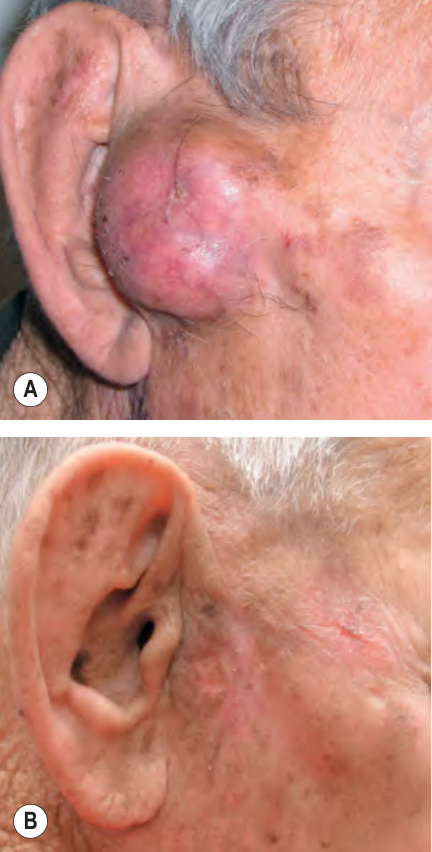
Fig. 139.9 Metastatic squamous cell carcinoma involving the parotid lymph nodes.A An 85-year-old man with advanced and inoperable SCC of his right parotid lymph nodes. B Following a two-week course of palliative radiotherapy (40 Gy in 10 daily fractions using 12 MeV electrons plus a tissue equivalent bolus), he experienced a complete clinical response.