VARIATIONS/UNUSUAL SITUATIONS
Cardiac Implantable Electronic Devices
The use of electrosurgery in patients with cardiac implantable electronic devices raises the question of whether the flow of electrical energy during electrosurgery might interfere with the function of these devices. Although modern permanent pacemakers and ICDs have improved shielding technology to guard them from the influence of
external electromagnetic currents, prudence requires that a modicum of precaution be taken. If used indiscriminately in these patients, electrosurgery can occasionally trigger skipped beats, reprogramming of a pacemaker, firing of an ICD, asystole, or bradycardia.
Routine precautions recommended when using electrosurgery in patients with cardiac implantable electronic devices include: (1) utilize short bursts of energy that are less than 5 seconds in duration; (2) keep power settings as low as possible; (3) avoid the use of cutting current; and (4) avoid use on the skin around the device. Although recommended in the literature, most dermatologists do not follow specific precautions such as intraoperative monitoring, preoperative cardiology consultation, or postoperative evaluation of the cardiac device by a cardiologist. This may be due to the fact that to date there have been no reported cases of interference with a pacemaker or ICD in a dermatologic setting. Also, at least one article suggests that practical experience of complications due to electrosurgical interference is rare among dermatologic surgeons.
There is less risk of potential side effects when the electrosurgical current is confined to a very small area, as is the case when bipolar forceps are used as electrodes. A way to virtually eliminate such risk in very unstable cardiac patients or those with ICDs is to use true electrocautery, rather than other forms of electrosurgery. Although use of this modality may cause more of a burn injury than is seen with true electrosurgery, there is no flow of current to cause electrical inter-ference. In a survey of Mohs surgeons, 34% used electrocautery and 19% used bipolar forceps in patients with pacemakers or ICDs. Among this group, there was only one reported case of interference in one of the electrocautery patients. However, since there is no current flow in true electrocautery, this was likely an error in reporting.
It is the author’s belief that the use of either electrocautery or bipolar forceps as electrodes in patients with cardiac implantable electronic devices will eliminate the need for intraoperative monitoring, preoperative cardiology consultation, or postoperative evaluation by a cardiologist in the majority of patients.
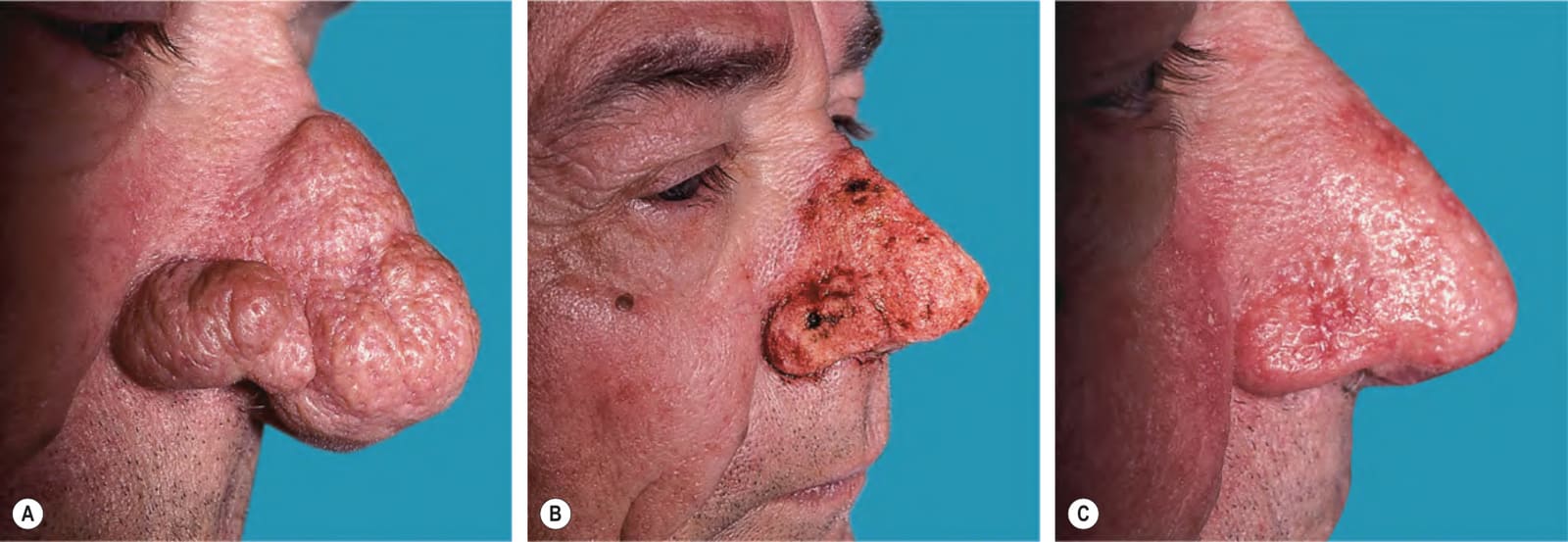
Fig. 140.7 Rhinophyma.A Moderately severe rhinophyma in a middle-aged man. B Immediately after electrosurgical planing of excess sebaceous glands. Care is taken to perform subtotal removal as very aggressive therapy can result in significant scarring and possible deformity caused by scar contracture. C Four weeks later, healing with good cosmetic outcome is noted. During healing, the wound is kept moist with an ointment (e.g. petrolatum) and semi-occlusive dressings.