FUTURE DIRECTIONS
Wound dressings are an essential component of wound care, compression therapy for venous leg ulcers, and pressure redistribution for pressure ulcers. Over the past century, dressings have moved from a passive to more active role with improvements in moisture-retentive products and delivery systems. However, incorporation of active ingredients into traditional dressings increases their cost and raises regulatory issues as to whether a dressing is a drug or a medical device. Advances based on growth factors, cellular therapy, and skin substitutes will continue, but selection of the most appropriate dressing for a given clinical scenario will remain the key decision for the physician.
Additional figures and references available in our eBook (see inside front cover for access code).
-
Smack DP, Harrington AC, Dunn C, et al. Infection and lization of superficial wounds in the skin of the young domestic pig. Nature. 1962;193:293–294.2. Bennett R. Dressings and miscellaneous surgical
-
Witkowski JA, Parish LC. Wound cleansers. Clin Dermatol.
allergy incidence in ambulatory surgery patients using white petrolatum vs bacitracin ointment. A randomized controlled trial. JAMA. 1996;26:972–977.10. Dixon AJ, Dixon MP, Dixon JP. Randomized clinical trial materials. In: Fundamentals of Cutaneous Surgery. St. Louis: Mosby; 1987.3. Cho CY, Lo JS. Dressing the part. Dermatol Clin.
1996;14:89–93.16. Fernandez R, Griffiths R. Water for wound cleansing.
Cochrane Database Syst Rev. 2012(2):CD003861.17. Scimeca CL, Bharara M, Fisher TK, et al. An update on of the effect of applying ointment to surgical wounds before occlusive dressing. B J Surg. 2006;93:937–943.11. Zitelli J. Wound healing by first and second intention.
1998;16:25–47.4. Gilje O. On taping (adhesive tape treatment) of leg ulcers.
pharmacological interventions for diabetic foot ulcers. Foot Ankle Spec. 2010;3:285–302.18. Sutherland R, Boon RJ, Griffin KE, et al. Antibacterial
In: Roenigk RK, Roenigk HH, eds. Roenigk & Roenigk’s Dermatologic Surgery: Principles and Practice. 2nd ed. New York: Marcel Dekker; 1996:101–130.12. Lipsky BA, Berendt AR, Cornia PB, et al. 2012 Infectious
Acta Derm Venereol. 1948;28:454–467.5. Eaglstein WH, Mertz PM. New methods for assessing epidermal wound healing: the effects of triamcinolone acetonide and polyethelene film occlusion. J Invest Dermatol. 1978:71:382–4.6. Cunningham B, Berstein L, Woodley DT. Wound dressings.
activity of mupirocin (pseudomonic acid), a new antibiotic for topical use. Antimicrob Agents Chemother. 1985;27:495–498.19. Lipsky BA, Hoey C. Topical antimicrobial therapy
Diseases Society of America clinical practice guideline for the diagnosis and treatment of diabetic foot infections. Clin Infect Dis. 2012;54:e132–e173.13. Beasley WD, Hirst G. Making a meal of MRSA-the role of
In: Roenigk RK, Roenigk HH, eds. Roenigk & Roenigk’s Dermatologic Surgery: Principles and Practice. 2nd ed. New York: Marcel Dekker; 1996:131–148.7. Matthews D. Dressing of open wounds and burns with for treating chronic wounds. Clin Infect Dis. 2009;49:1541–1549.20. Frank C, Bayoumi I, Westendorp C. Approach to infected skin ulcers. Can Fam Physician. 2005;51:1352–1359.21. Harding KG, Jones V, Price P. Topical treatment:
biosurgery in hospital-acquired infection. J Hosp Infect. 2004;56:6–9.14. Dumville JC, Worthy G, Soares MO, et al. VenUS II: a tulle gras. Lancet. 1941;1:43.8. Ersek RA. Ischemic necrosis and elastic net bandages. Tex which dressing to choose. Diabetes Metab Res Rev. 2000;16(Suppl. 1):S47–50.22. Woo KY, Ayello EA, Sibbald RG. Silver versus other randomised controlled trial of larval therapy in the management of leg ulcers. Health Technol Assess. 2009;13:1–182, iii–iv.
Med. 1982;78:47–49.
antimicrobial dressings: best practices! Surg Technol Int. 2008;17:50–71.
oxide products are commercially available as are combinations of zinc oxide with each of the above components or calamine plus clioquinol.
Elastic bandages provide both easy stretchability and a sustained squeeze on tissue (see Table 145.7). This is because these bandages recoil back to their original length due to the presence of elastomeric fibers. In contrast, inelastic bandages such as the Unna boot and short stretch bandage (more commonly used in Europe) form a rigid covering that resists lateral expansion of the calf muscle during active contractions. Of note, contractions of the calf muscle act as a pump that generates a propelling force to promote venous return (see Fig. 105.2).
Compression bandages may be composed of a single component or multiple combined components. In a meta-analysis, short stretch bandages were found to be as efficacious in promoting healing of venous leg ulcers as more complex multi-component bandaging systems, in both ambulatory and non-ambulatory patients. However, Cochrane reviews suggest that the evidence supports multi-component systems (over single-component systems) and systems with an elastic component (over those with an inelastic bandage). Lastly, tubular systems (Tubigrip®, EdemaWear®) provide low compression and can be used by patients with reduced ABIs (see above).
Intermittent pneumatic compression (IPC) devices deliver sequential pressure to the limb. IPC is a beneficial adjunct to other forms of compression in the treatment of venous leg ulcers, especially for non-ambulatory patients. When the calf muscle pump is not active, the use of a dynamic compression system is more beneficial than a passive system. Portable IPC devices that are relatively easy to operate are available for home use. In a randomized controlled trial, patients with lymphedema and venous leg ulcers healed faster and with less pain when a 4-layer compression system was combined with daily home-based IPC as compared to 4-layer compression alone. Both self-adjustable Velcro® devices and hybrid systems are alternative compression therapy choices that may increase compliance.
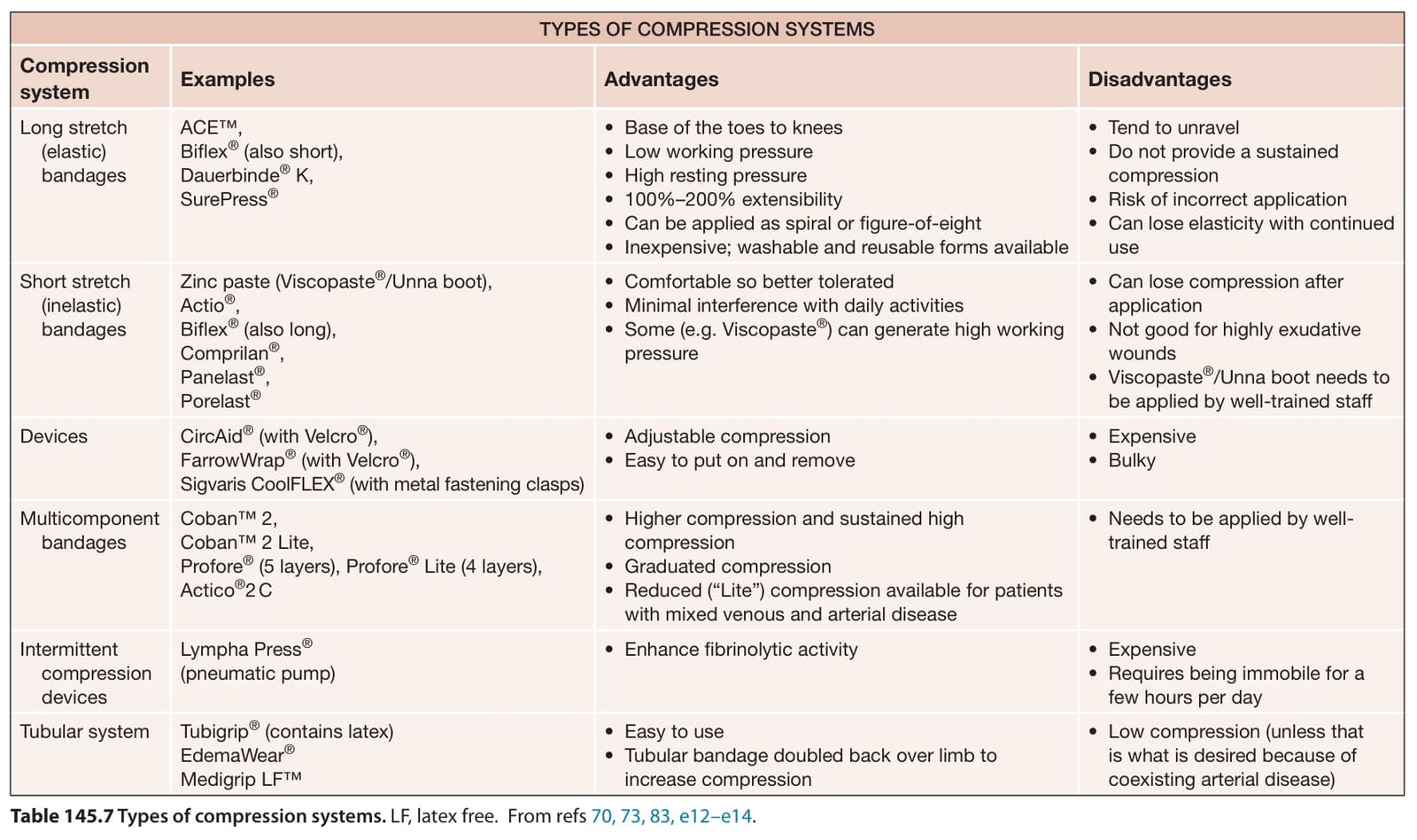
Table 145.7 Types of compression systems. LF, latex free.From refs 70, 73, 83, e12–e14.