未來方向(FUTURE DIRECTIONS)
傷口敷料是傷口照護、靜脈性腿部潰瘍壓迫治療,以及壓瘡壓力重新分布的必要組成。過去一個世紀以來,隨著保濕型產品與遞送系統的改良,敷料已從被動角色轉向更主動的角色。然而,將活性成分納入傳統敷料會增加其成本,並引發敷料究竟是藥品或醫療器材的法規議題。以生長因子、細胞療法與皮膚代用品為基礎的進展將會持續,但為特定臨床情境選擇最適當的敷料,仍將是醫師的關鍵決策。
更多圖片與參考文獻可見於我們的 eBook(存取碼請見封面內頁)。
-
Smack DP, Harrington AC, Dunn C, et al. Infection and lization of superficial wounds in the skin of the young domestic pig. Nature. 1962;193:293–294.2. Bennett R. Dressings and miscellaneous surgical
-
Witkowski JA, Parish LC. Wound cleansers. Clin Dermatol.
allergy incidence in ambulatory surgery patients using white petrolatum vs bacitracin ointment. A randomized controlled trial. JAMA. 1996;26:972–977.10. Dixon AJ, Dixon MP, Dixon JP. Randomized clinical trial materials. In: Fundamentals of Cutaneous Surgery. St. Louis: Mosby; 1987.3. Cho CY, Lo JS. Dressing the part. Dermatol Clin.
1996;14:89–93.16. Fernandez R, Griffiths R. Water for wound cleansing.
Cochrane Database Syst Rev. 2012(2):CD003861.17. Scimeca CL, Bharara M, Fisher TK, et al. An update on of the effect of applying ointment to surgical wounds before occlusive dressing. B J Surg. 2006;93:937–943.11. Zitelli J. Wound healing by first and second intention.
1998;16:25–47.4. Gilje O. On taping (adhesive tape treatment) of leg ulcers.
pharmacological interventions for diabetic foot ulcers. Foot Ankle Spec. 2010;3:285–302.18. Sutherland R, Boon RJ, Griffin KE, et al. Antibacterial
In: Roenigk RK, Roenigk HH, eds. Roenigk & Roenigk’s Dermatologic Surgery: Principles and Practice. 2nd ed. New York: Marcel Dekker; 1996:101–130.12. Lipsky BA, Berendt AR, Cornia PB, et al. 2012 Infectious
Acta Derm Venereol. 1948;28:454–467.5. Eaglstein WH, Mertz PM. New methods for assessing epidermal wound healing: the effects of triamcinolone acetonide and polyethelene film occlusion. J Invest Dermatol. 1978:71:382–4.6. Cunningham B, Berstein L, Woodley DT. Wound dressings.
activity of mupirocin (pseudomonic acid), a new antibiotic for topical use. Antimicrob Agents Chemother. 1985;27:495–498.19. Lipsky BA, Hoey C. Topical antimicrobial therapy
Diseases Society of America clinical practice guideline for the diagnosis and treatment of diabetic foot infections. Clin Infect Dis. 2012;54:e132–e173.13. Beasley WD, Hirst G. Making a meal of MRSA-the role of
In: Roenigk RK, Roenigk HH, eds. Roenigk & Roenigk’s Dermatologic Surgery: Principles and Practice. 2nd ed. New York: Marcel Dekker; 1996:131–148.7. Matthews D. Dressing of open wounds and burns with for treating chronic wounds. Clin Infect Dis. 2009;49:1541–1549.20. Frank C, Bayoumi I, Westendorp C. Approach to infected skin ulcers. Can Fam Physician. 2005;51:1352–1359.21. Harding KG, Jones V, Price P. Topical treatment:
biosurgery in hospital-acquired infection. J Hosp Infect. 2004;56:6–9.14. Dumville JC, Worthy G, Soares MO, et al. VenUS II: a tulle gras. Lancet. 1941;1:43.8. Ersek RA. Ischemic necrosis and elastic net bandages. Tex which dressing to choose. Diabetes Metab Res Rev. 2000;16(Suppl. 1):S47–50.22. Woo KY, Ayello EA, Sibbald RG. Silver versus other randomised controlled trial of larval therapy in the management of leg ulcers. Health Technol Assess. 2009;13:1–182, iii–iv.
Med. 1982;78:47–49.
antimicrobial dressings: best practices! Surg Technol Int. 2008;17:50–71.
oxide 產品有市售品,zinc oxide 與上述各成分的組合,或 calamine 加 clioquinol 的組合亦有市售。
彈性繃帶同時提供容易的延展性與對組織持續的擠壓(見表 145.7)。這是因為這些繃帶由於彈性體纖維的存在而會回彈至其原本長度。相對地,非彈性繃帶如 Unna boot 與 short stretch 繃帶(在歐洲較常使用)形成剛性覆蓋,可抵抗小腿肌肉在主動收縮期間的橫向擴張。值得注意的是,小腿肌肉的收縮作用如同幫浦,產生推進力以促進靜脈回流(見圖 105.2)。
壓迫繃帶可由單一成分或多種組合成分構成。在一項統合分析中發現,在可行走與不可行走的病人中,short stretch 繃帶在促進靜脈性腿部潰瘍癒合上與更複雜的多成分繃帶系統同樣有效。然而,Cochrane 回顧顯示證據支持多成分系統(優於單一成分系統),以及含彈性成分的系統(優於含非彈性繃帶者)。最後,管狀系統(Tubigrip®、EdemaWear®)提供低度壓迫,可供 ABI 降低的病人使用(見前述)。
間歇性氣動壓迫(Intermittent pneumatic compression, IPC)裝置對肢體施予依序的壓力。IPC 在治療靜脈性腿部潰瘍時是其他壓迫形式的有益輔助,尤其對不可行走的病人。當小腿肌肉幫浦未在運作時,使用動態壓迫系統比被動系統更有益處。市面上有相對容易操作的可攜式 IPC 裝置可供居家使用。在一項隨機對照試驗中,患有淋巴水腫與靜脈性腿部潰瘍的病人,在 4 層壓迫系統合併每日居家 IPC 時,相較於單獨 4 層壓迫,癒合較快且疼痛較少。可自行調整的 Velcro® 裝置與混合式系統,都是可能提高順從性的替代壓迫治療選擇。
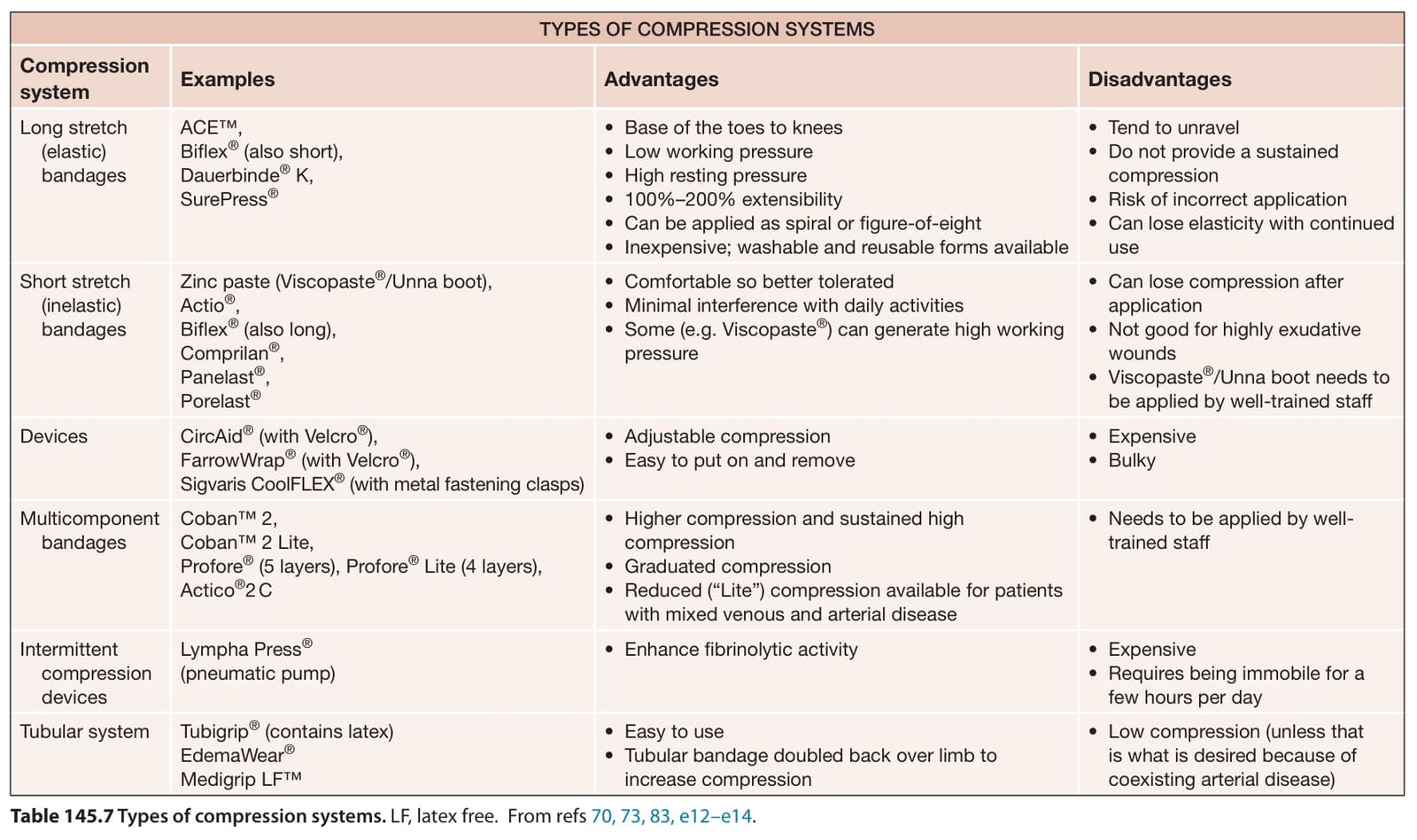
表 145-7:壓迫系統的類型。LF, latex free。取自參考文獻 70、73、83、e12–e14。