INTRODUCTION
When the skin comes in contact with external agents, many adverse events can occur including contact dermatitis, which can be either allergic or irritant. Irritant contact dermatitis (ICD) accounts for ~80% of all contact dermatitis (see Ch. 15), with allergic contact dermatitis (ACD) accounting for the remainder. ACD is a delayed-type hypersensitivity reaction that is elicited when the skin comes in contact with a chemical to which an individual has previously been sensitized.
The cutaneous responses of ACD are dependent on the particular chemical, the duration and nature of the contact, and individual host susceptibility. The chemicals that cause contact dermatitis may be found in jewelry, personal care products, plants, topical medications (prescription, over-the-counter or herbal), clothing, and home remedies, as well as chemicals the individual comes in contact with at work, during avocations, or via contact with another individual (e.g. consort contact dermatitis).
ICD and ACD, especially the chronic forms, can take on similar clinical appearances. The classic picture of contact dermatitis is a well-demarcated, erythematous, vesicular, and/or scaly patch or plaque with well-defined margins corresponding to the area of contact (Fig. 14.1A). The distribution can be linear, when an object such as a leaf or branch is rubbed against the skin (Fig. 14.1B), or localized to the site where there has been contact with the offending chemical or product, e.g. hand dermatitis caused by ACD to epoxy resin or foot dermatitis due to ACD to the components of shoes (Figs. 14.2–14.4). Because ICD and ACD are not always discernible clinically, patch testing is required to help identify an allergen or exclude an allergy to a suspected allergen. While patch testing remains the gold standard for diagnosing ACD, it is important to note that ICD and ACD may coexist.
Patients with the most common clinical presentations of ACD often do not seek medical attention. Those who have earring dermatitis or erythema and pruritus under a ring may simply diagnose themselves as having an allergy to jewelry. An individual who is gardening over the weekend may never present to a physician because the “poison ivy rash” is so familiar. Nickel (worldwide) and poison ivy (US; see Ch. 17) are among the most common etiologies of ACD and are often not further investigated because the cause is obvious. However, oftentimes, the clinical picture and history are not sufficiently specific to identify the causative allergen, and patch testing is then necessary. For example, the patient with chronic hand dermatitis or eyelid dermatitis who comes to the office for treatment is often unaware that a personal care product could be the cause of the problem. These are the patients who can be most helped by a thorough history and cutaneous examination, as well as the diagnostic procedure of patch testing.
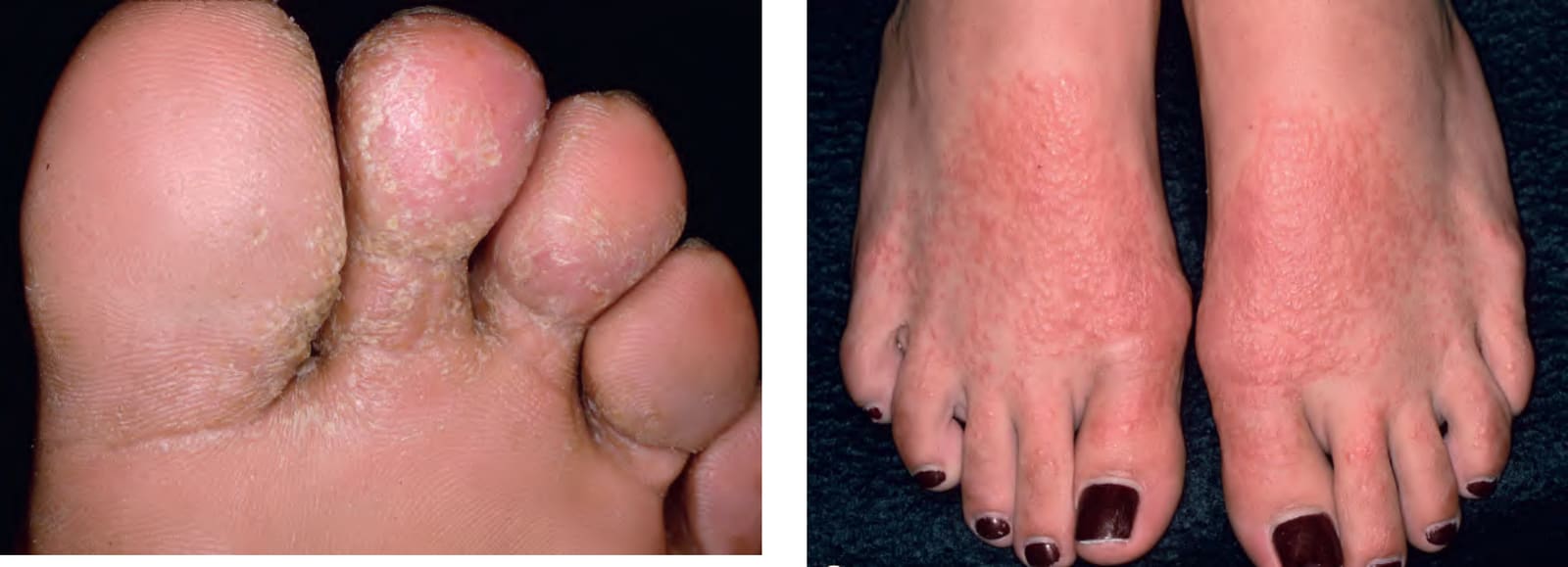
Fig. 14.2 Chronic allergic contact dermatitis (ACD). Chronic foot dermatitis due to ACD to rubber (mercaptobenzothiazole). Courtesy Louis A. Fragola, Jr, MD.