COMPLICATIONS
Complications and adverse events from MMS are uncommon and the procedure has an undetectable mortality rate. A large, multi-center, prospective cohort study of adverse events in MMS found that the rate of adverse events was <1%, with the majority being minor.
Intraoperative considerations include anxiety, pain (with local anesthesia injection), bleeding, nerve damage, and allergic reactions. If warranted, oral midazolam can be given in the range of 5–15 mg for healthy adults. Knowledge of vascular, muscular, and neural anatomy, especially within the “danger zones” of the face (see Ch. 142), helps to avoid and anticipate specific complications. Hemorrhage is a potential risk during surgery and is minimized with meticulous hemostasis and pressure bandaging. The superficial temporal artery is the most common major artery that may be transected,
and its transection usually requires suture ligation. Epinephrine (adrenaline) included in the local anesthetic temporarily improves hemostasis. To date, there is no evidence that patients taking aspirin or warfarin for serious medical problems experience increased risks of serious hemorrhage or bleeding complications following MMS. In addition, while there is a significantly increased risk of bleeding complications in patients on thienopyridines (e.g. clopidogrel, ticlopidine) undergoing dermatologic surgery, these medications are typically continued due to the possible risk of internal thrombotic complications.
Injury to cutaneous sensory nerves occurs during all cutaneous surgery. Transection of significant motor nerves is occasionally necessary for removal of deeply invasive tumors, especially in the temporal region. Whenever possible, the surgeon should inform the patient before surgery of any possible loss of function or sensation.
Additional postoperative complications include infection, dehiscence, partial- or full-thickness necrosis, and seroma formation (see Ch. 151). Based upon several studies, the infection rate post MMS is very low (0.7%).
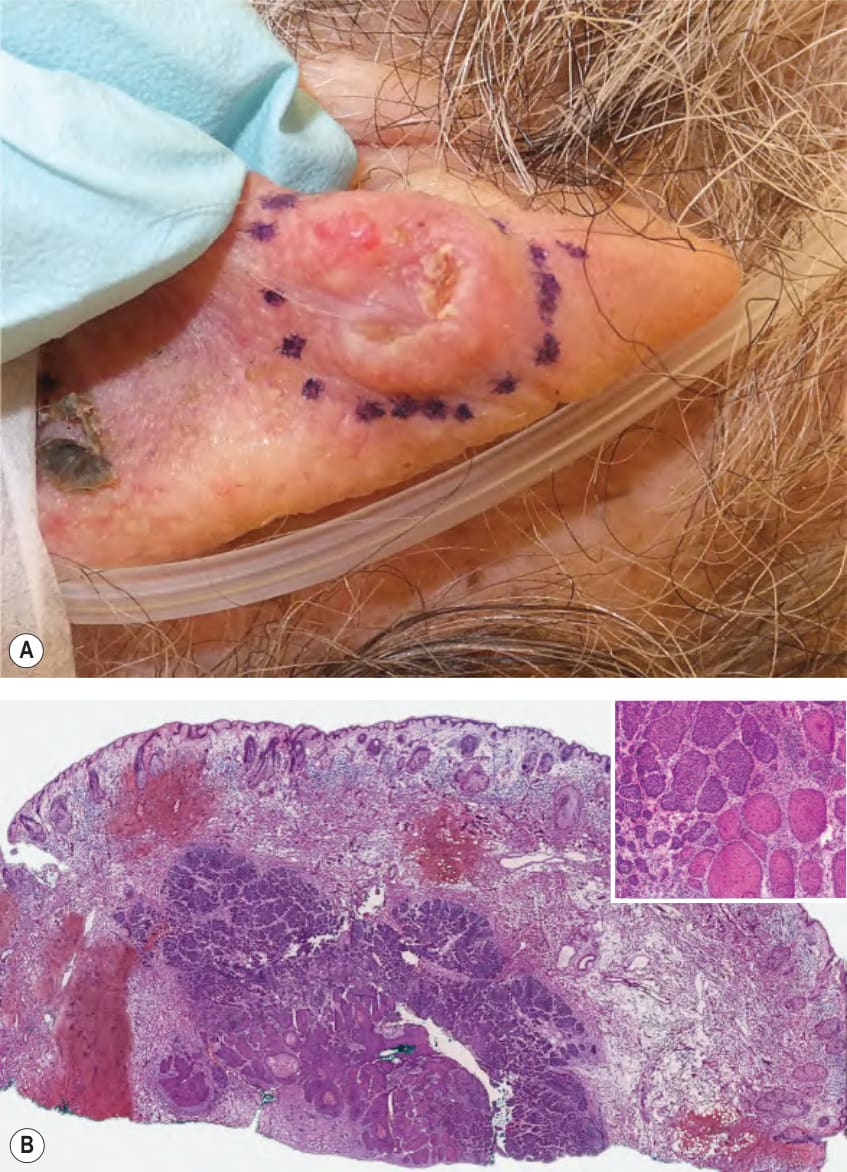
Fig. 150.9 Collision tumor – basal cell carcinoma (BCC) and squamous cell carcinoma (SCC).A A biopsy-proven micronodular/nodular BCC on the ear. B Frozen sections demonstrated distinct aggregates of uniform basaloid cells as well as variably large, irregular complexes of polygonal cells with eosinophilic cytoplasm and enlarged, partly pleomorphic nuclei (inset).