COMPLICATIONS
Complications may occur following any method of skin resurfacing involving injury to any depth but are more common after mediumdepth and deep procedures. It is far simpler to prevent the development of a complication than to manage it once it has occurred. Complications may be prevented by proper selection of suitable patients and appropriate resurfacing modalities, precise intraoperative technique, and proper patient management before and after the procedure (see Table 154.3). The dissatisfied patient represents a complication even when the cosmetic result is favorable. An explanation of realistic results and review of photographs of “average” rather than best results during the pre-treatment consultation is recommended. Any information provided at this time is included within informed consent.
Improper wound care, trauma to healing areas resulting from overzealous debridement, compulsive picking or scratching, and premature use of irritating substances such as depilatories or wax for the removal of hair can each cause the depth of injury to extend beyond the threshold of safety. As discussed below, the development of infection in the postoperative period can also extend the depth of injury and increase the risk of permanent sequelae.
With specific regard to chemical peeling, excessive injury to the skin can result from poor technique during application or problems with the chemical agents utilized. The degree of frosting is monitored closely to assure that the agent has been applied evenly and that the injury extends to the proper depth (Table 154.10). Although it does not always correlate completely with the depth of injury, the level of frosting is a very valuable guide for determining the appropriate endpoint of treatment
(see Fig. 154.3). Injuring the skin too deeply during a chemical peel, as suggested by an excessive degree of frosting, may result not only from over-application but also from the use of excessively concentrated peeling solutions. The latter error can be caused by the surgeon’s choice of an improper peeling agent, such as 50% TCA, or it can be related to unexpected disturbances in a solution’s pharmacologic mixture. For Baker–Gordon peels, a new batch should be mixed by the surgeon prior to each procedure to be certain that the preparation is made correctly; the other peeling solutions are available in various formulations and strengths for purchase directly from medical supply dealers. Reputable dealers mix and label these solutions properly according to standard weight-to-volume formulas. It should be noted that the latter accurately reflect the TCA percentages cited in the medical literature, while volume-to-volume and weight-to-weight preparations of TCA do not.
Storage of peeling solutions in proper containers away from sunlight and immediate replacement of expired solutions are important measures to ensure chemical stability of the agents being used. Immediately prior to peeling, an ample volume of the solution should be poured from the primary storage container into a smaller, secondary cup. The peeling agent is applied directly to the skin surface from this cup and the excess subsequently discarded to avoid contamination of the storage container and to avoid the accidental transfer of concentrated crystals from the neck of the storage container to the patient’s skin.
Errors during mechanical resurfacing procedures may also lead to an injury of excessive depth and a higher risk of adverse sequelae. This problem can result from poor technique in the handling of the instruments or from failure to recognize the appropriate treatment endpoint. The beginner should first start by conservatively dermasanding small areas to get a comfortable feel for the skin’s response to this type of injury. As knowledge and experience is gained, one can then progress on to diamond fraise dermabrasion and later to the use of the wire brush. Observation of experienced surgeons and hands-on training are invaluable. The beginner should always err on the side of conservatism, while still yielding favorable results, to avoid excessively deep tissue injury that could produce long-term complications.
During chemical peeling or mechanical resurfacing, intraoperative exposure of vital structures to the resurfacing agent may occur and can have serious adverse consequences. Extreme care must be exercised when dermabrading with a power-driven, rotating instrument, assuring that the dominant hand maintains complete control continuously and free skin edges (e.g. eyelid, lip) are not caught up in the wire brush or diamond fraise, as the latter may result in tearing of the skin. During chemical peeling, the moistened applicator should never be passed over the central face, in order to avoid inadvertent exposure of a vulnerable surface such as the eye to the solution. There should always be appropriate fluids readily available to rinse the area in case such an exposure does occur. In particular, saline is used to dilute TCA, mineral oil is used to dilute phenol solutions, and sodium bicarbonate is used to neutralize glycolic acid.
Adverse systemic effects related to a resurfacing procedure are very uncommon but can usually be traced to an identifiable causative factor in the perioperative period. Peeling with phenol solutions has been associated with systemic toxicities, so these procedures must be performed slowly and only on properly selected, healthy patients in an appropriate clinical setting. The use of Jessner’s solution poses a theoretical risk of systemic salicylate or resorcinol toxicity, but this is probably not clinically significant when application is limited to the face and neck. Undoubtedly, the most common cause of systemic problems related to resurfacing procedures is an adverse allergic or physiologic reaction to a medication used for anesthesia. It is imperative that the surgeon knows all the physiologic effects and the potential adverse consequences of each drug administered systemically, unless there is an attending anesthesiologist who assumes this responsibility. Fortunately, the chemical and mechanical resurfacing procedures utilized most often can be performed with little or no sedation.
It is important to make a distinction between a true complication and an expected side effect of a resurfacing procedure. With medium-depth and deep resurfacing, transient erythema, flushing, increased skin temperature, pruritus, edema, and milia formation are typical occurrences, so they should not be classified as true complications. Patient reassurance may be all that is necessary, since these problems usually resolve spontaneously. True complications that may develop within a treated area include infection, delayed wound healing, persistent erythema, scarring, and pigmentary or textural abnormalities. Any of these true complications can occur despite proper patient and procedure selection, perfect surgical technique, and appropriate management before and after the operation.
Infection is an uncommon complication that develops during the postoperative period and may be caused by bacterial, viral, or fungal organisms. An important preventive measure is the repeated use of soaks for adequate wound debridement. Frequent postoperative visits are also helpful to assure early recognition and treatment of any infection so that scarring does not result. An infection may present with delayed wound healing, ulcerations, excessive necrotic material and crusting, purulent drainage, or odor. An acneiform eruption or pustular folliculitis can also be a manifestation of infection and should be treated as such. Infection with streptococcal and staphylococcal organisms can occur under biosynthetic membranes or thick, occlusive ointments, so these are best avoided, except in the immediate postoperative period. Other organisms, such as Escherichia coli or Pseudomonas spp., may infect the area if there is improper wound care. Candida infections can also occur and are sometimes related to the use of prophylactic antibiotics or occlusive wound care. Clinical suspicion of a wound infection necessitates immediate institution of empiric antimicrobial therapy, laboratory culture for identification of the organism(s), and wound debridement as necessary.
Herpes simplex viral infections can occur during the healing period following medium-depth or deep resurfacing and have the potential for devastating sequelae. An outbreak can even occur in patients on the recommended 10- to 14-day prophylactic antiviral regimen. The keys to avoiding scar formation are rapid recognition and aggressive therapy begun early in the course of the infection. The dosage of antiviral drug should be increased to the recommended maximum in cases of active herpetic infections.
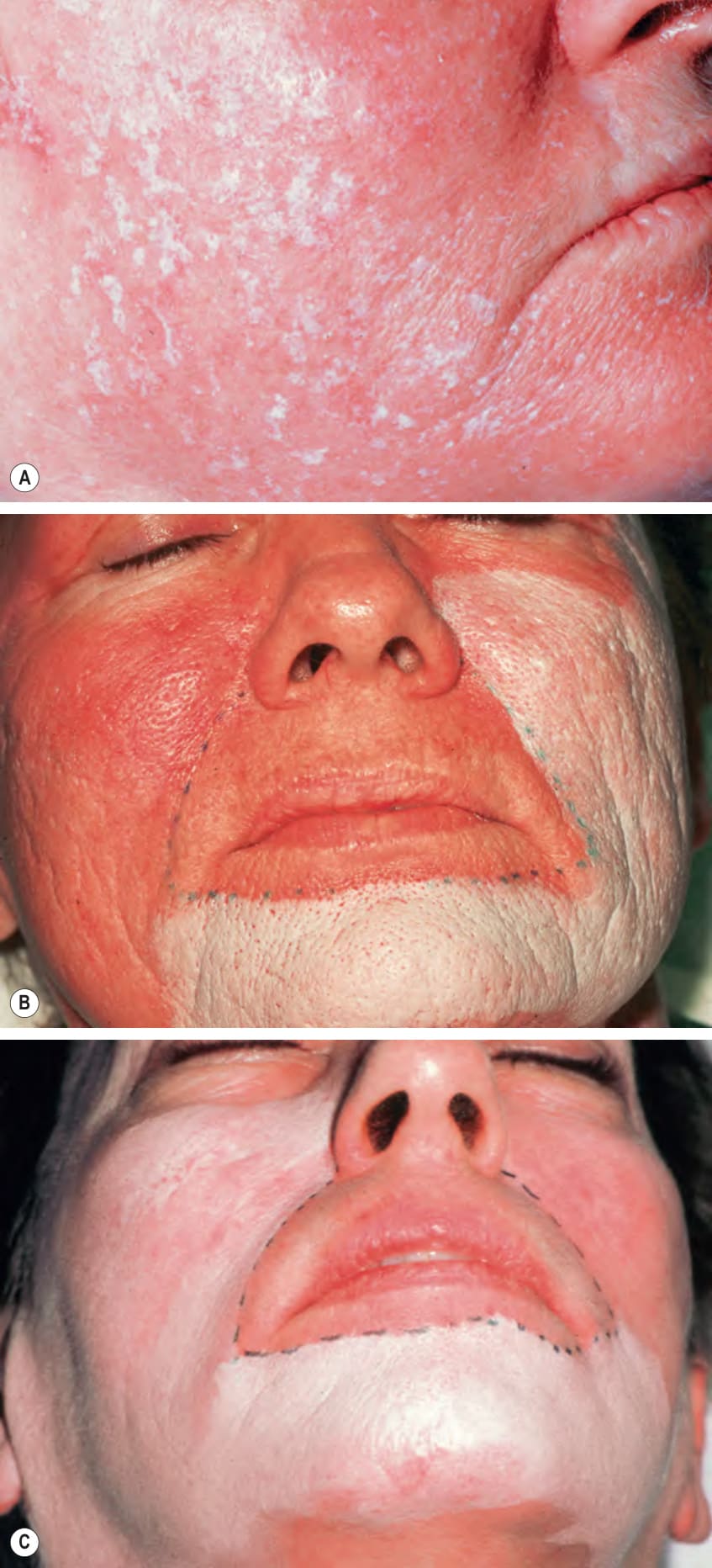
Fig. 154.3 Levels of frosting. A Level I frosting as found with light chemical peeling: erythema with streaky frosting. B Level II frosting: erythema with diffuse white frosting. C Level III frosting: solid white enamel frosting.
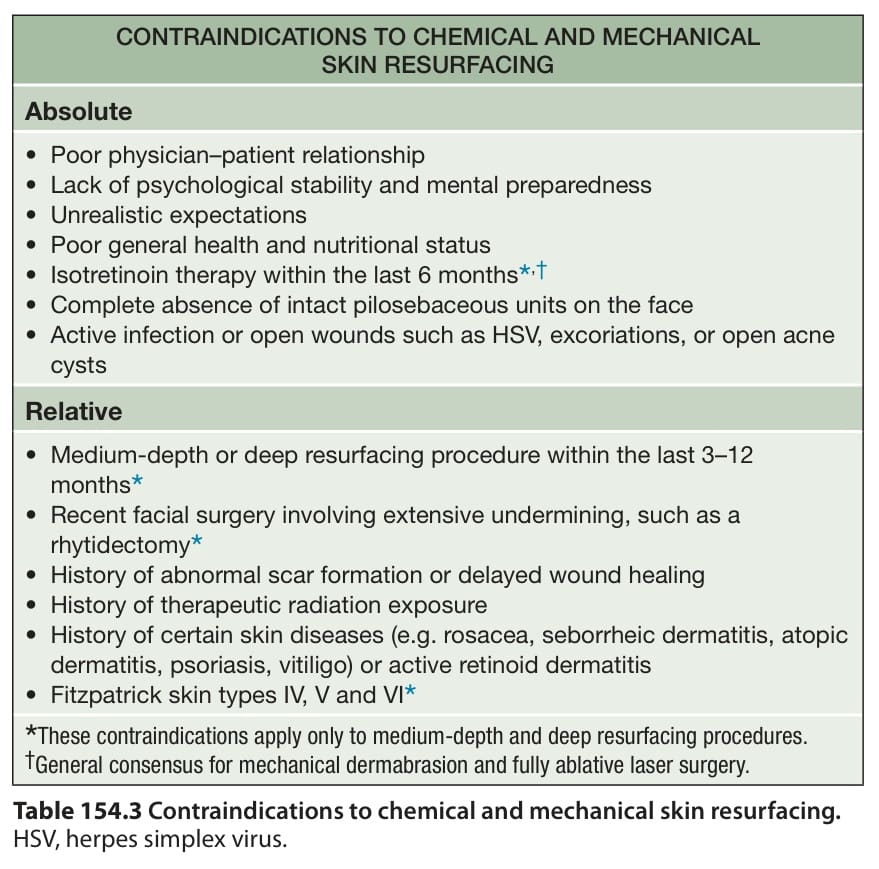
Table 154.3 Contraindications to chemical and mechanical skin resurfacing.
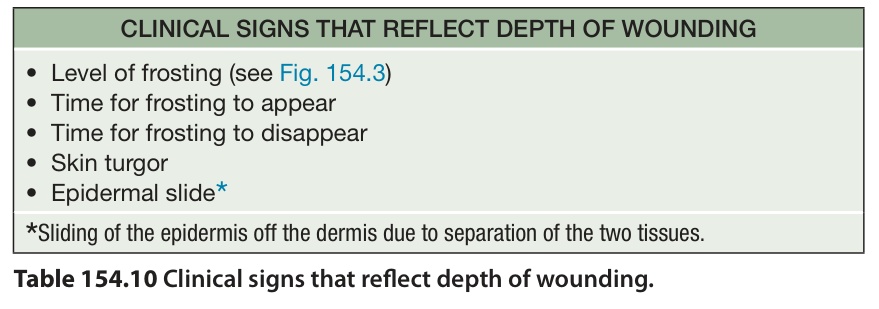
Table 154.10 Clinical signs that reflect depth of wounding.