PROPERTIES OF BOTULINUM TOXINS
Various strains of the bacterium Clostridium botulinum produce seven distinct serotypes of BoNT that affect neural function: A, B, C1, D, E, F and G. Although all serotypes produce chemodenervation and atrophy of skeletal muscles by blocking acetylcholine release from motor neurons at the neuromuscular junction (Fig. 159.1), they differ with regard to cellular mechanism of action and clinical profile.
Formulations
BoNT type A (BoNT-A), the first serotype developed for use in humans, is available in seven formulations worldwide (Table 159.1). Five have been approved by the U.S. Food and Drug Administration (FDA) for the treatment of glabellar rhytides and have been assigned specific drug names to avoid confusion and reduce the potential for dosing errors: onabotulinumtoxinA (onaA; BOTOX®/BOTOX® Cosmetic), abobotulinumtoxinA (aboA; Dysport®, Azzalure®), incobotulinumtoxinA (incoA; Xeomin®/ Bocouture®), prabotulinumtoxinA-xvfs (praboA; Jeuveau®), and daxibotulinumtoxinA-lanm (DAXI; DAXXIFY®). Outside of North America, BoNT-A formulations include Prosigne® and Neuronox®. One formulation of BoNT type B (BoNT-B; rimabotulinumtoxinB (rimaB; MYOBLOC®/ NeuroBloc®) is also available in North America (see Table 159.1). All preparations of BoNT differ in terms of purification procedures, potency, and clinical effect and may not be used interchangeably.
Clinical Differences
Clinical differences between onaA and aboA have been debated, in particular the possibility of greater diffusion and migration by aboA. However, digital image correlation at various time points utilizing speckle-tracking photogrammetry demonstrated no significant differences between aboA and onaA in the reduction of dynamic glabellar rhytides. Similar efficacy for onaA and aboA has also been observed for non-cosmetic indications, such as facial synkinesis. While suggested dosing ratios have ranged from 1 : 2 to 1 : 4 (onaA : aboA), a dosing ratio of 1 : 2.5 has been shown to increase the field of anhidrotic effect, and a higher dose ratio of 1 : 3 has been reported to result in greater longevity, as well as a faster onset of action. Although no clear consensus on a conversion factor between products has been reached, current guidelines recommend a dose ratio of 1 : 2.5 or less than 1 : 3.
The first BoNT formulation without complexing proteins, incoA, has been shown to be as safe and effective as onaA for the treatment of glabellar rhytides, with a rapid onset of effect and duration of effect of up to 5 months or more. In contrast to aboA (see above), incoA has similar dosing to onaA. Researchers had initially speculated that complexing proteins would limit diffusion of the active neurotoxin within the target muscle, but human and animal studies have suggested otherwise. For example, Kerscher and colleagues found no difference in the size of the anhidrotic area after injection with incoA or onaA.
In a multicenter, randomized, double-blind, controlled clinical trial that enrolled 540 patients with moderate to severe glabellar rhytides, a single treatment with praboA (20 U) was found to be as safe and effective as onaA; no serious side effects were observed with this more recently approved formulation of BoNT-A. One comparison study of the effectiveness of rimaB versus onaA reported similar findings. Of note, rimaB was FDA-approved in 2000 for cervical dystonia but is used off-label to treat facial rhytides.
When used for the treatment of hyperkinetic lines in the face, there are several key differences between rimaB and onaA: rimaB has a more rapid onset of action but a shorter duration of effect, diffuses more widely, and is associated with greater pain and other side effects when compared to onaA. That said, one study which examined seven doses of rimaB found all to be safe and effective for the treatment of hyperfunctional rhytides, with a dose-related duration of effect.
Topical BoNT-A
Percutaneous delivery of topical BoNT has been limited by its inability to cross the stratum corneum. As a result, it has been combined with mechanical, chemical, and thermal techniques in an attempt to enhance percutaneous delivery. Despite early promising reports of the treatment of lateral canthal rhytides (Fig. 159.2) and primary axillary hyperhidrosis with topical formulations of BoNT-A, to date, no such formulations have been approved by the FDA. For example, in contrast to the effectiveness of injectable daxibotulinumtoxinA, topical daxibotulinumtoxinA gel did not meet primary endpoints for efficacy in a phase III trial. Nonetheless, topical BoNT-A remains a potential approach for the treatment of anatomic areas that are difficult to manage or particularly painful to inject.
A Note About Dosing
Most of the published information regarding the cosmetic uses of BoNT pertains to the use of onaA, followed in recent years by aboA and incoA. Data are scarce regarding other formulations of BoNT-A. Since most of our experience pertains to the use of onaA, the following discussion (including units and description of techniques) focuses on this formulation specifically. However, a conversion rate of 1 : 1 U may be considered for all 100-U product vials (incoA, Prosigne®, and Neuronox®) and 1 : 2.5 U for aboA.
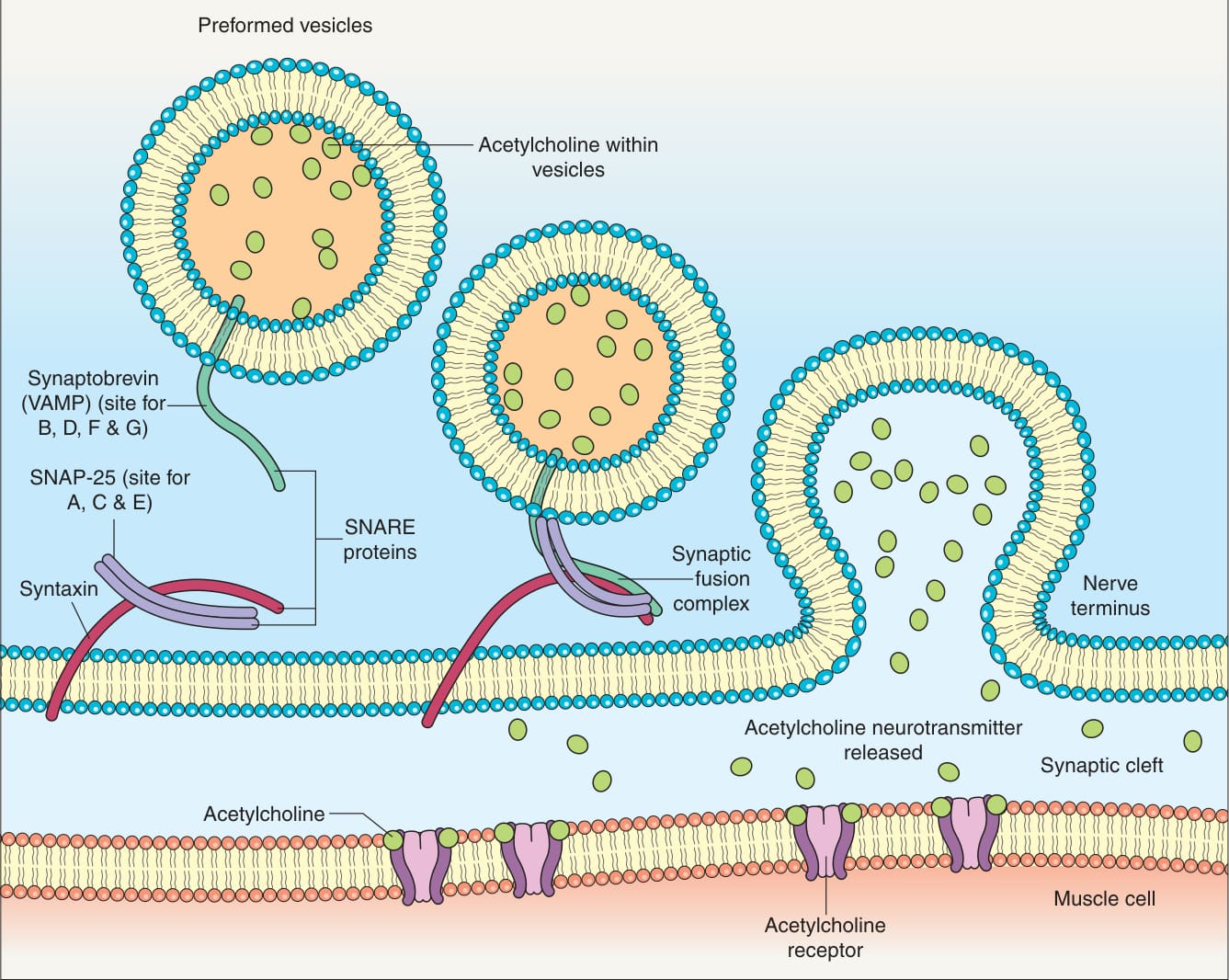
Fig. 159.1 Sites of interactions between botulinum toxins and the SNARE proteins in the synaptic fusion complex at the neuromuscular junction.
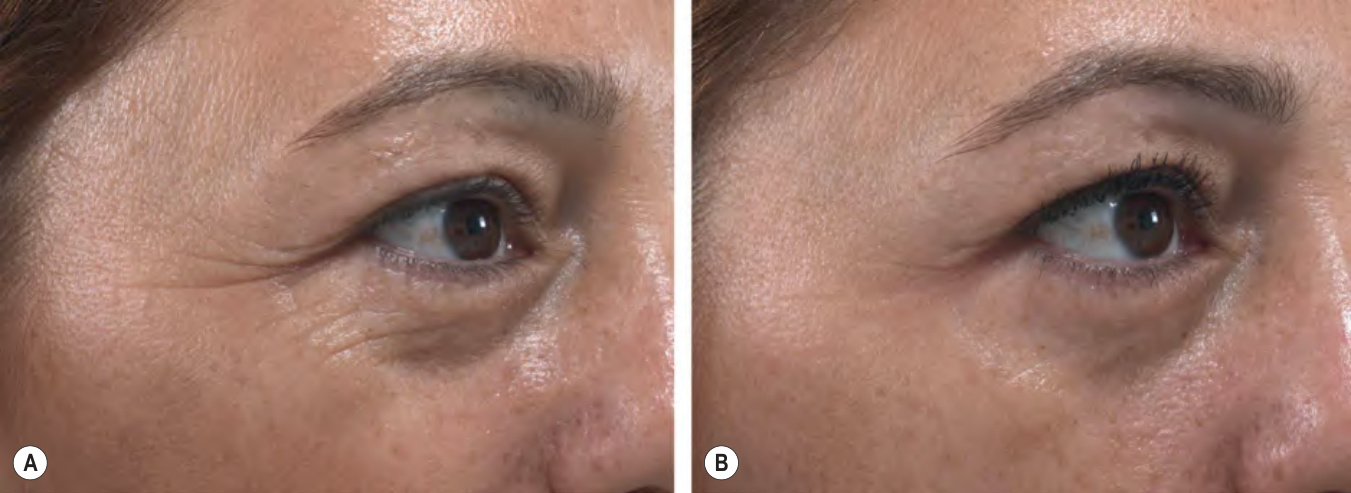
Fig. 159.2 Topical BoNT-A for lateral canthal rhytides (crow’s feet). Before (A) and after (B) treatment.
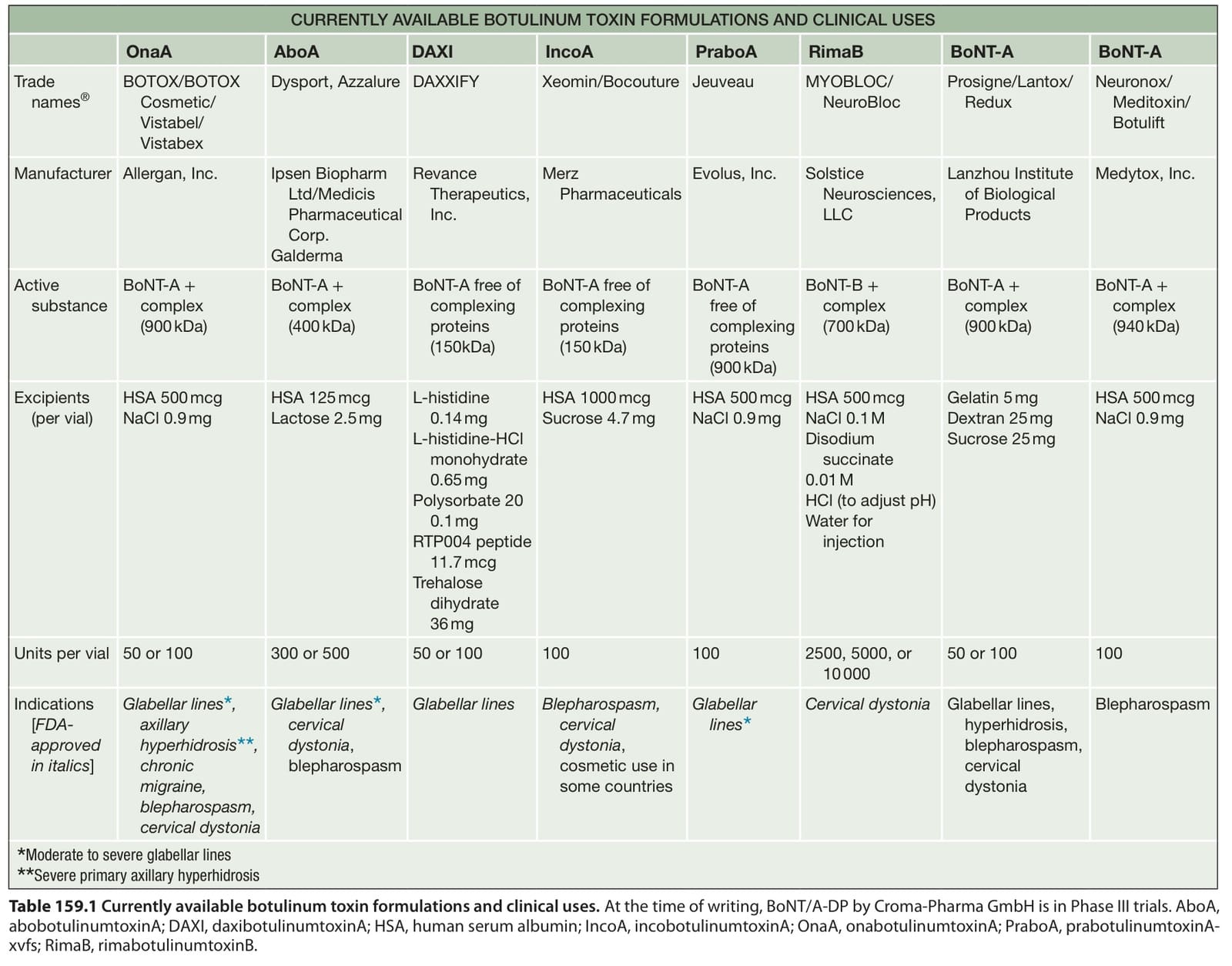
Table 159.1 Currently available botulinum toxin formulations and clinical uses. At the time of writing, BoNT/A-DP by Croma-Pharma GmbH is in Phase III trials. AboA, abobotulinumtoxinA; DAXI, daxibotulinumtoxinA; HSA, human serum albumin; IncoA, incobotulinumtoxinA; OnaA, onabotulinumtoxinA; PraboA, prabotulinumtoxinAxvfs; RimaB, rimabotulinumtoxinB.