EPIDEMIOLOGY
ICD is the most common form of occupational skin disease, estimated to constitute between 70% and 80% of all occupational skin disorders (Table 15.1). Data from the North American Contact Dermatitis Group indicate that in groups of patients with contact dermatitis, ICD (as a primary diagnosis) accounts for 9%–10% of those screened for allergic contact dermatitis via patch testing, and when hands are affected, ICD predominates over all other causes of contact dermatitis.
The US Bureau of Labor Statistics data show that occupational skin diseases accounted for a consistent 30%–45% of all patients with occupational illnesses from the 1970s through the mid-1980s. However, occupational skin disease rates have since fallen dramatically, e.g. from an average rate of 16.2 events/10 000 full-time workers in 1972 to 2.8 events in 2013.
Although skin disease accounted for only 17% of all recorded non-fatal occupational illnesses in 2007, it still ranks second and is only surpassed by musculoskeletal disorders. The incidence of occupational contact dermatitis in several other countries is similar to that in the US, with a range of 50 to 70 cases/100 000 workers/year. In Europe, the decreasing incidence of occupational contact dermatitis has been attributed to more recently enacted legislation that limits occupational exposure to chemical agents, though a causal relationship has not been confirmed. In 1996, the United Kingdom created a voluntary reporting system that combined information from the EPIDERM study with the occupational physicians’ reporting activity (OPRA). The annual incidence of occupational contact dermatitis reported by dermatologists was 0.9 per 10 000 workers, and for occupational physicians, it was 3.1 per 10 000 workers.
In 2010, the National Institutes of Occupational Safety and Health sponsored the National Health Interview Survey which utilized a sample cohort of 27 157 individuals (to represent 229 million US civilian adults), the majority of whom were employed or recently employed. The overall prevalence of dermatitis was 10.2%, ranging from 7.3% in those who never worked to 9.8% in currently employed workers to 11.8% in those recently, but not currently, employed. In addition to manufacturing, industries with the highest non-adjusted and adjusted rates of dermatitis include healthcare and social assistance; arts, entertainment, and recreation; and accommodations and food services. Rubber chemicals, soaps and cleansers, wet work, resins, acrylics, and nickel are some of the more common sources for irritant and allergic contact dermatitis. Additional high-risk occupations are discussed in Chapter 16.
Clinical manifestations of ICD are highly variable and determined by the properties of the irritating substance as well as host and environmental factors. These include concentration, pH, mechanical pressure, temperature, humidity, and duration of contact. Low ambient humidity and cold are important factors in decreasing the water content of the stratum corneum and, consequently, increasing the permeability to irritants such as soaps, detergents, acids, bases, and solvents. Cold alone may also reduce the plasticity of the horny layer, with consequent cracking of the stratum corneum. However, in one study, the application of cold had a protective effect on the development of ICD if applied during the provocative exposure, in this case to sodium lauryl sulfate. Occlusion, excessive humidity, and maceration increase the water content of the stratum corneum and compromise the stratum corneum’s protective lipid bilayers, with consequent enhanced percutaneous absorption of water-soluble substances (Fig. 15.1). In addition, irritated skin may become more susceptible to superimposed allergic sensitization.
Important predisposing characteristics of the individual include age, sex, pre-existing skin disease, anatomic region exposed, and sebaceous activity. There are age-associated changes in the skin that can alter the skin’s response to irritants. Both infants and the elderly are more often affected by ICD because of their less robust epidermal barrier, and they also develop more severe symptoms. While skin irritation may be seen more often on the upper extremities of women than men, this higher prevalence of ICD may be due to increased frequency of exposure rather than inherent sex differences. Genetic factors also play a role in the development of ICD, as shown in studies with monozygotic twins. Patients with a history of atopic dermatitis have a 13.5 times greater risk of developing occupational dermatitis, and a reduction in epidermal filaggrin can reduce the inflammatory threshold for irritants. Lastly, the most commonly affected sites are exposed areas such as the hands and the face, with hand involvement seen in ~80% of patients and facial involvement in 10%. Excessive exposure to water, soaps and detergents, common causes of ICD, play a critical role given that wet work (immersion in water for >2 hours, occlusive protective gear, and/ or hand washing >20 times/day) represents one of the most important risk factors for developing irritant dermatitis.
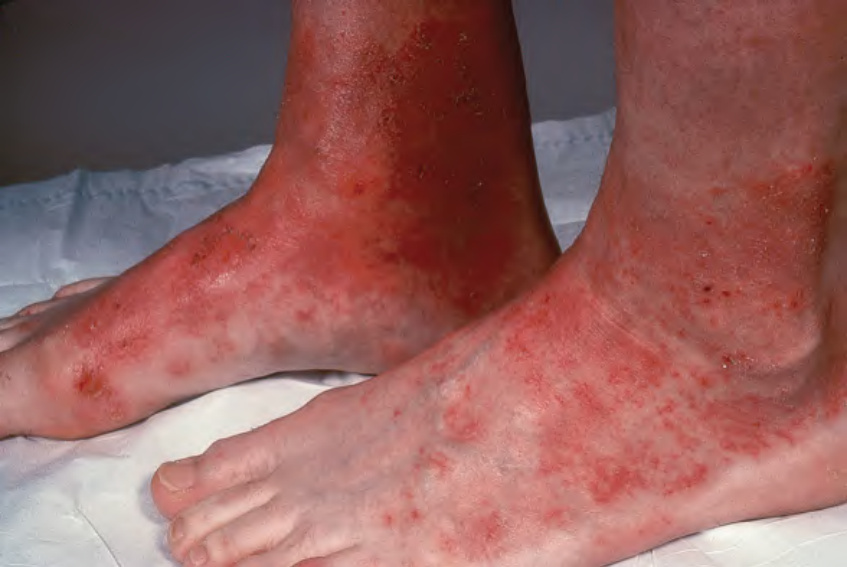
Fig. 15.1 Bilateral irritant contact dermatitis of the feet and ankles due to chronic occlusive footwear.
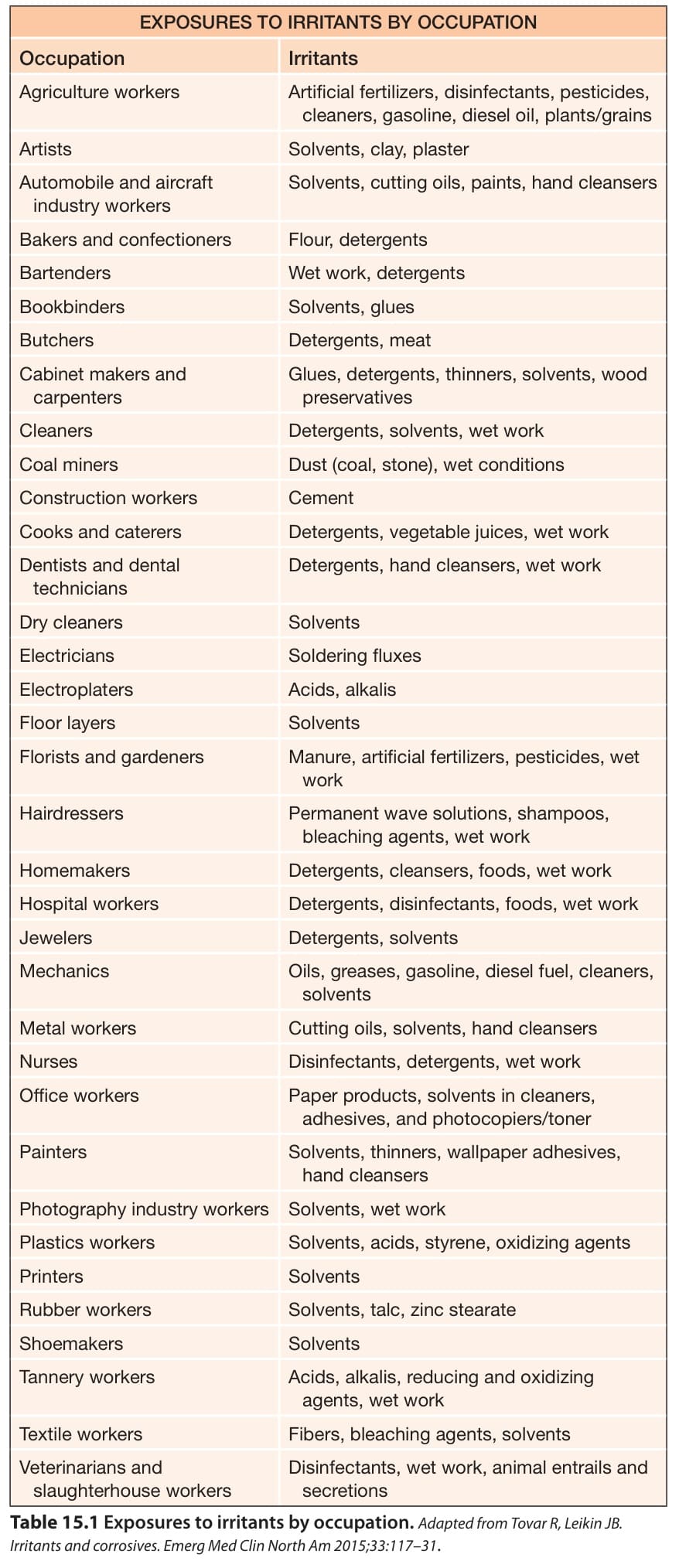
Table 15.1 Exposures to irritants by occupation. Adapted from Tovar R, Leikin JB. Irritants and corrosives. Emerg Med Clin North Am 2015;33:117–31.