DIFFERENTIAL DIAGNOSIS
Despite their different pathogeneses, allergic and irritant contact dermatitis, especially of the chronic type, show a remarkable similarity with respect to clinical appearance, histopathology, and immunohistology. Clinically, the reactions often look identical, with erythematous plaques, xerosis, scaling, fissures, and lichenification locally distributed and sharp borders delineating the areas of contact. In the clinical setting, the substance in question is often unknown, as is the concentration and duration of exposure. As a result, the diagnosis of ICD has remained a diagnosis of exclusion – when the dermatitis cannot be explained by a positive patch test to a known allergen. Another helpful, but not conclusive, clinical feature is the more frequent complaint of burning, pain, and stinging with ICD, in contrast to pruritus in areas of allergic contact dermatitis (Fig. 15.7).
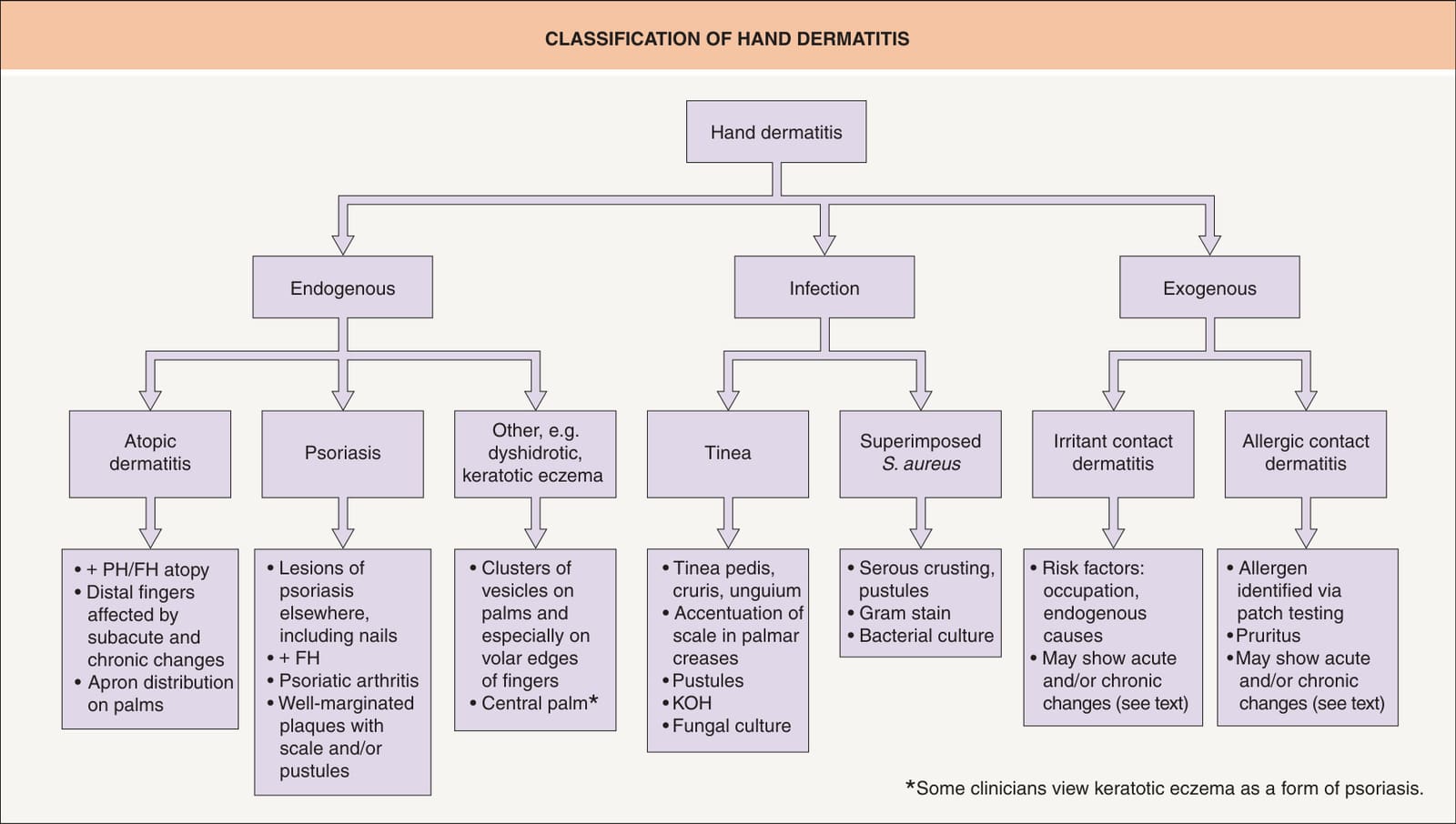
Fig. 15.7 Classification of hand dermatitis. More than one etiology may be present, e.g. atopic dermatitis plus irritant contact dermatitis. Keratolysis exfoliativa is usually not confused with hand dermatitis. Also see Figure 17.1. FH, family history; PH, personal history. (For further details, see Seidenari S, Giusti F, Pepe P, Mantovani L. Contact sensitization in 1094 children undergoing patch testing over a 7-year period. Pediatr Dermatol. 2005;22:1–5.)