INTRODUCTION
Urticaria is a common reason for patients to present to primary care practitioners, emergency rooms, dermatologists, and allergists. It is characterized by the rapidity of its fluctuation. As a rule, individual wheals last no more than 24 hours, but the entire affliction usually lasts much longer. With nearly all clinical patterns of urticaria, wheals may be accompanied by angioedema, but the occurrence of isolated angioedema (without wheals) is of special significance because some of these patients will have a deficiency of C1 esterase inhibitor (C1 inh). The latter is due to bradykinin formation rather than release of mast cell mediators. C1 inh deficiency is a rare disorder that is often inherited and because it can prove fatal without treatment must be considered in any patient with isolated angioedema. Urticarial vasculitis is an important disorder to exclude in patients with chronic urticaria. It is a systemic disease defined by damage to small blood vessels rather than transient vasodilation and vascular permeability (see Ch. 24). Urticarial vasculitis sometimes presents with wheals or angioedema that, without confirming a duration of more than 24 hours (by serial examination of marked lesions) and a lesional skin biopsy, can be indistinguishable from chronic spontaneous urticaria (CSU). While urticaria rarely progresses to anaphylaxis, wheals are often a feature of that condition. Good management of urticaria depends on a thorough understanding of etiologies, triggers, and aggravating factors, in addition to the most appropriate drug therapies.
Definition of Urticaria
Urticaria is often used as a descriptive term for recurrent whealing of the skin, with angioedema being viewed as a physical sign. However, there is increasing acceptance that the term “urticaria” also defines an entity that may be acute or chronic. Thus, when viewed as a disease, urticaria may present with wheals, angioedema, or both.
Wheals are pruritic, pink or pale swellings of the superficial dermis that have an initial erythematous flare around them (Fig. 18.1). Lesions may be a few millimeters in diameter or as large as a hand, and the number can vary from a few to numerous. The hallmark of wheals is that, by definition, individual lesions come and go rapidly, generally within 24 hours. However, larger coalescing wheals may take longer to resolve. Angioedema swellings occur deeper in the dermis and in the subcutaneous or submucosal tissue. They may also affect the oropharynx and rarely the bowel in hereditary angioedema. The areas of involvement tend to be normal or faint pink in color, painful rather than pruritic, larger, and less well-defined than wheals, and they often last for 2 to 3 days (Fig. 18.2).
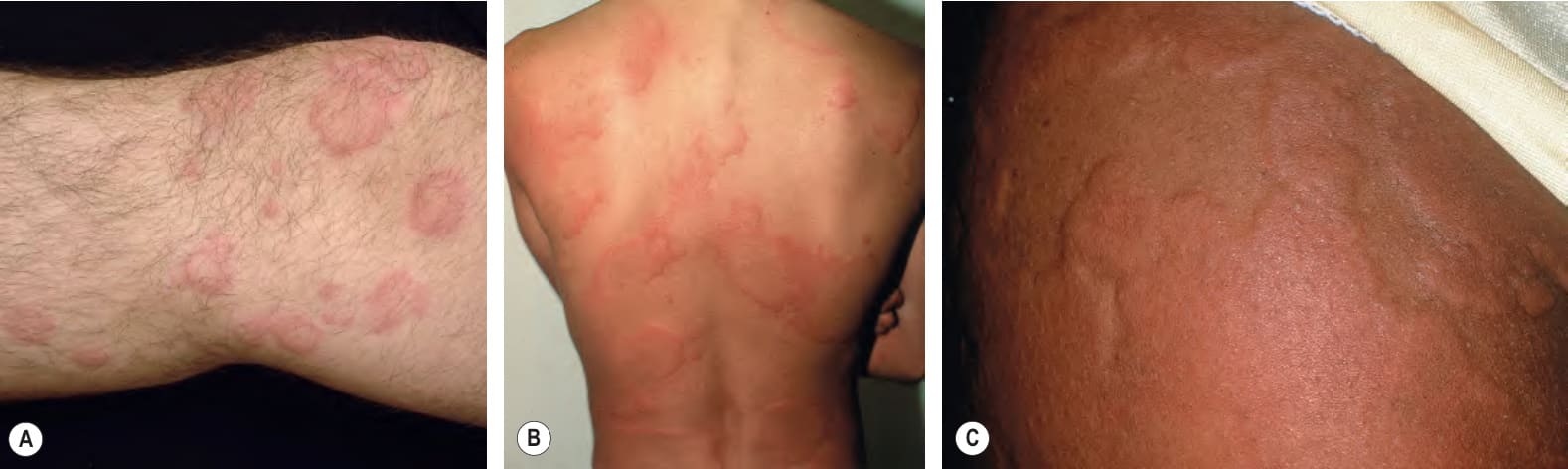
Fig. 18.1 Wheals.A, B Wheals can vary in size from small to large as well as be annular, but they still retain the classic central pallor and erythematous flare. C Occasionally, more uniform edematous plaques are seen.
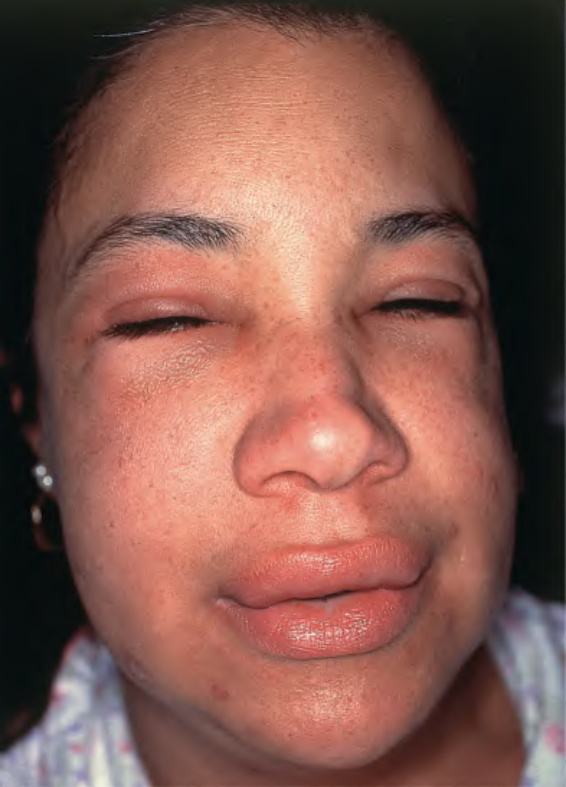
Fig. 18.2 Angioedema.