PATHOGENESIS
Drug-induced skin reactions are mediated by either an immunologic or a non-immunologic mechanism (Table 21.4). In the former, drugs or their metabolites act as haptens, inducing a specific cell-mediated or humoral response. In the latter, some of the reactions are predictable given their relationship to the dose and/or the pharmacologic properties of the drug. However, the responsible pathophysiology may be difficult to identify simply on the basis of clinical appearance as the skin responds to a wide variety of stimuli through a limited number of morphologic reaction patterns. This may explain, at least in part, why the underlying mechanism of many cutaneous drug eruptions is still unknown.
Immunologically Mediated Drug Reactions
●IgE-dependent drug reactions (formerly type I, Gell–Coombs classification): urticaria, angioedema, and anaphylaxis.
●Cytotoxic drug-induced reactions (antibody against a fixed antigen; formerly type II): petechiae secondary to drug-induced thrombocytopenia.
●Immune complex-dependent drug reactions (formerly type III): vasculitis, serum sickness, and certain types of urticaria.
●Delayed-type, cell-mediated drug reactions (activation of CD4+ and CD8+ T cells; formerly type IV): exanthematous, fixed, and lichenoid drug eruptions, as well as Stevens–Johnson syndrome (SJS) and TEN. This group has been further subdivided into the following:
• Th1 immune reaction (IVa): monocytes are preferentially recruited and activated by IFN-γ, leading to CD8+ T cell activation and a proinflammatory response (TNF, IL-12)
• Th2 immune reaction (IVb): eosinophils are preferentially recruited and activated in part by IL-4, -5, -13, and eotaxin, as in drug reaction with eosinophilia and systemic symptoms (DRESS)/drug-induced hypersensitivity syndrome (DIHS), hereafter referred to as DRESS in the text
• Cytotoxic immune reaction (IVc): involves CD4+ and CD8+ T cells with release of perforin and granzyme B and/or Fas–FasL interactions, as in SJS/TEN (see Fig. 20.6)
• Neutrophil and T cell-based immune reaction (IVd): mediated via chemokines (e.g. CXCL8) and cytokines (e.g. GM-CSF), as in acute generalized exanthematous pustulosis (AGEP) Several immunologic mechanisms have been proposed to explain SCARs including: (1) the hapten/pro-hapten concept – the drug or its metabolite covalently binds to an endogenous peptide and the resultant hapten is recognized by a highly restricted major histocompatibility complex (MHC); (2) the pharmacoimmune reaction (“p-i concept”) – drugs induce formation of HLA–drug complexes that can directly activate T cell immune responses without the need for a specific peptide ligand; and (3) direct HLA–drug interactions – certain drugs such as carbamazepine, abacavir, and sulfamethoxazole bind non-covalently within the peptide groove of a specific HLA and modify the antigenbinding cleft, thereby altering the endogenous peptide repertoire. Interestingly, adoptive transfer of T cells expressing a public αβ T cell receptor to HLA-B*15:02 transgenic mice receiving oral carbamazepine has been shown to induce a SCAR-like reaction.
Genetic factors
Specific HLA alleles have emerged as important genetic risk factors for SCARs, especially SJS/TEN and DRESS (see Table 21.3). Given the strong associations between HLA-B15:02 and carbamazepine-triggered SJS/TEN in Asians and between HLA-B57:01 and abacavir-triggered DRESS, pretreatment genetic testing is systematically performed in some countries in order to reduce the risk of SCARs. In patients with HLA-B15:02 who are also carriers of CYP2C93 (portends intermediate or poor drug metabolizing phenotype), phenytoin should not be used as a therapeutic alternative to carbamazepine.
Non-immunologic Mechanisms (see Table 21.4)
Overdose
The clinical manifestations of a drug overdose are predictable and represent an exaggeration of the medication’s pharmacologic actions. It may occur as a consequence of a prescribing error, deliberate or inadvertent excess by the patient, or altered absorption, metabolism, or excretion. For example, overdose-related methotrexate toxicity can occur in patients with reduced renal function or in patients who erroneously take methotrexate daily instead of once weekly (Fig. 21.1).
Pharmacologic side effects
These reactions include undesirable or toxic effects that cannot be separated from the desired pharmacologic actions of the drug. An example would be alopecia and mucositis due to chemotherapeutic agents that target more rapidly dividing cells.
Cumulative toxicity
Prolonged exposure to a medication or its metabolites may lead to cumulative toxicity. For example, methotrexate can lead to hepatic fibrosis and accumulation of minocycline, hydroxychloroquine, amiodarone, or rarely levofloxacin within the skin can lead to cutaneous discoloration.
Delayed toxicity
This corresponds to a toxic, dose-dependent effect that occurs months to years after the discontinuation of a medication. Examples include squamous cell carcinomas and palmoplantar keratoses following exposure to arsenic and acute leukemia due to alkylating agents.
Drug–drug interactions
Interactions between two or more drugs administered simultaneously may occur at several different steps: (1) intestinal drug interactions; (2) displacement from binding proteins or receptor sites; (3) enzyme stimulation or inhibition; and (4) altered drug excretion (see Ch. 131). Examples of each include the interactions between tetracycline and calcium, methotrexate and sulfonamides, cyclosporine and azoles, and methotrexate and probenecid. A different scenario is a morbilliform eruption or TEN following the administration of both a common culprit drug (e.g. cephalosporin) and an immune checkpoint inhibitor (e.g. nivolumab) whereas re-exposure to just the immune checkpoint inhibitor does not lead to a CAR.
Alterations in metabolism
Drugs may induce cutaneous changes by their effects on the nutritional or metabolic status of the patient. Bexarotene may induce severe hypertriglyceridemia and eruptive xanthomas, while isoniazid may be associated with pellagra-like changes.
Exacerbation of disease
A variety of drugs can exacerbate pre-existing dermatologic diseases, such as androgens in patients with acne vulgaris, interferons in patients with sarcoidosis and psoriasis, or paradoxically TNF inhibitors in patients with psoriasis.
Photosensitivity
Systemically administered drugs in combination with light (ultraviolet or visible) may cause cutaneous photosensitivity, classically either phototoxicity (e.g. doxycycline, quinolones) or photoallergy (e.g. quinine, sulfonamide antibiotics). Topical medications may also lead to photosensitizing reactions (e.g. ketoprofen-induced photoallergic dermatitis). In addition, drugs can act as photocarcinogens, even after short use (e.g. voriconazole-induced squamous cell carcinomas). Oral medications may even induce systemic (e.g. hydralazine, minocycline) and cutaneous lupus erythematosus (e.g. terbinafine, hydrochlorothiazide).
Idiosyncratic With a Possible Immunologic Mechanism (see Table 21.4)
The pathophysiology of drug-induced skin reactions such as exanthematous drug eruptions, DRESS, AGEP and TEN, as well as the increased susceptibility of HIV-infected patients, may be partially explained by an interplay between a virus with its subsequent immune mechanisms and genetic predisposition.
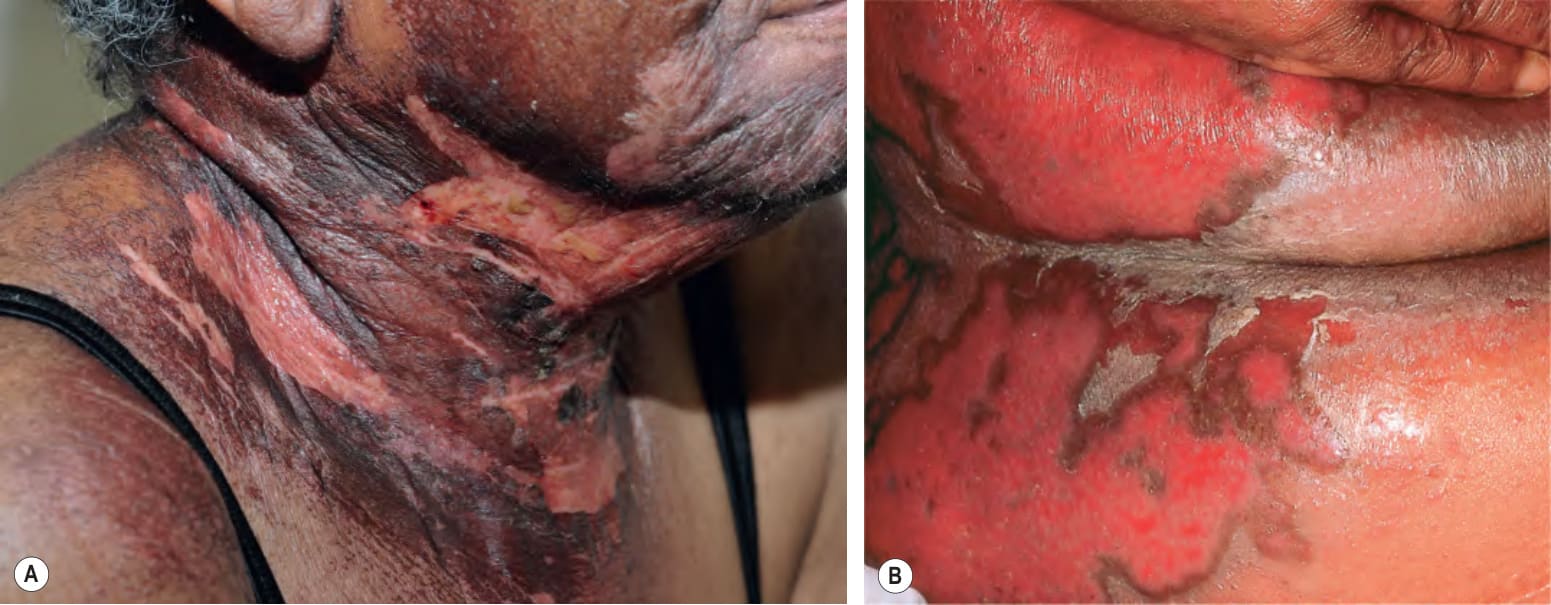
Fig. 21.1 Methotrexate toxicity. Increased serum levels of methotrexate secondary to decreased renal excretion can lead to epidermal necrosis. A Large erosions and areas of epidermal necrosis with a shellac-like appearance in a patient with rheumatoid arthritis. B Epidermal necrosis limited to psoriatic plaques. A, Courtesy Kalman Watsky, MD.
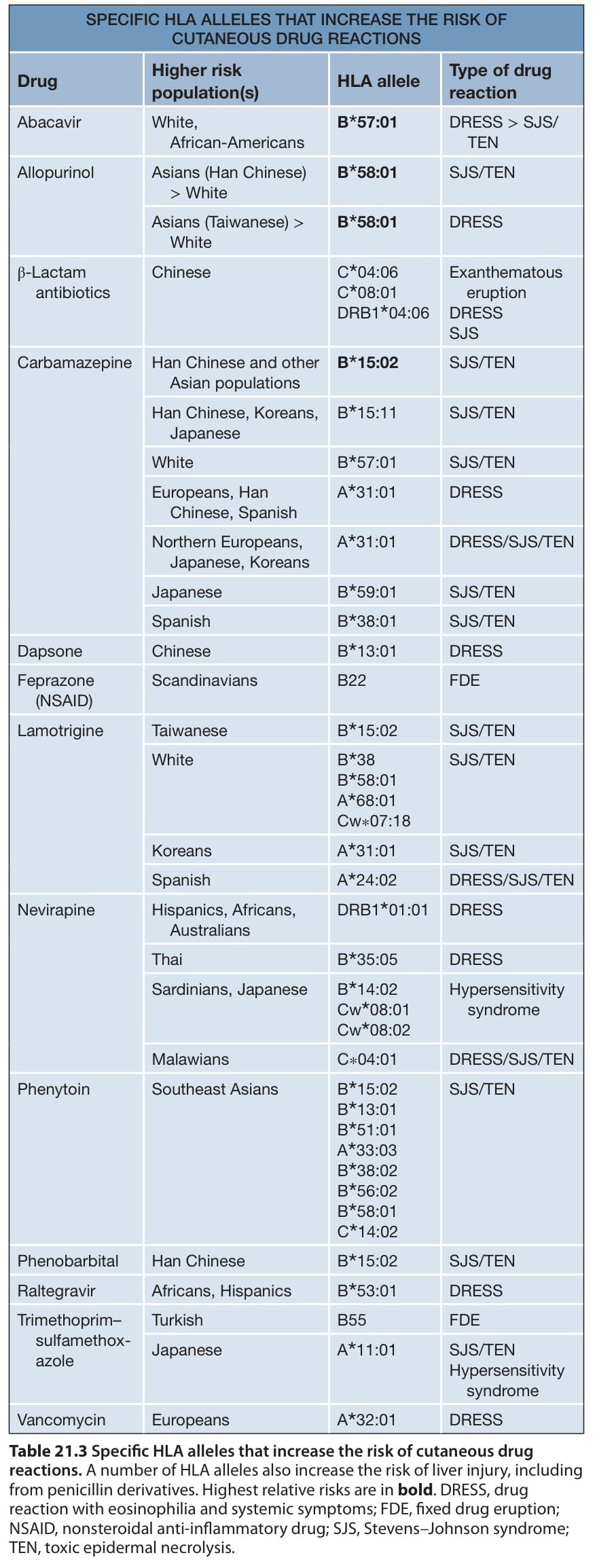
Table 21.3 Specific HLA alleles that increase the risk of cutaneous drug reactions. A number of HLA alleles also increase the risk of liver injury, including from penicillin derivatives. Highest relative risks are in bold. DRESS, drug reaction with eosinophilia and systemic symptoms; FDE, fixed drug eruption; NSAID, nonsteroidal anti-inflammatory drug; SJS, Stevens–Johnson syndrome; TEN, toxic epidermal necrolysis.
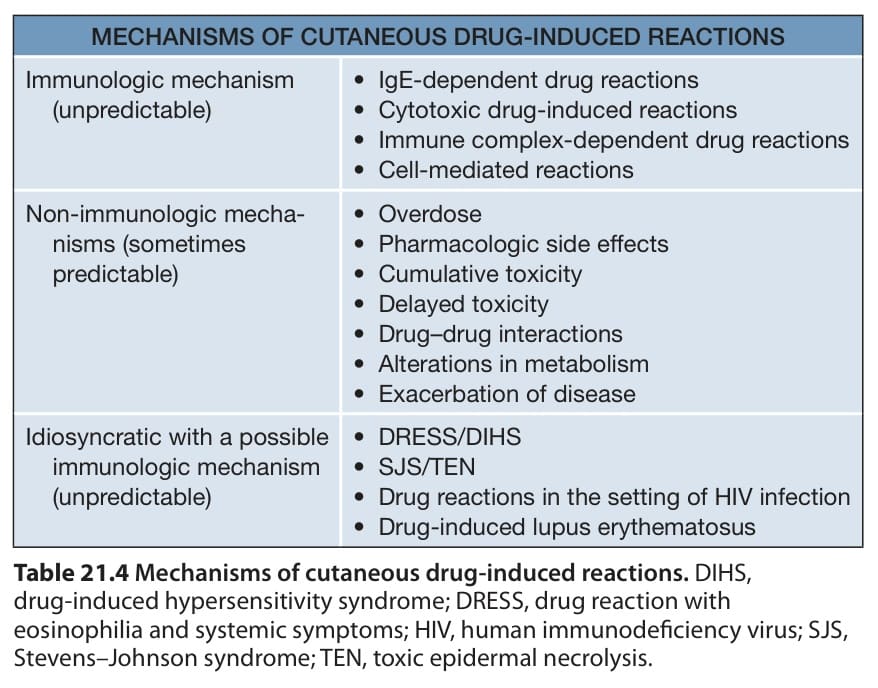
Table 21.4 Mechanisms of cutaneous drug-induced reactions. DIHS, drug-induced hypersensitivity syndrome; DRESS, drug reaction with eosinophilia and systemic symptoms; HIV, human immunodeficiency virus; SJS, Stevens–Johnson syndrome; TEN, toxic epidermal necrolysis.