INTRODUCTION
Vasculitis is defined as inflammation and destruction of blood vessels with resultant downstream ischemic tissue damage. Any organ system can be affected, and clinical manifestations correlate with the size of affected blood vessels, such that disorders are generally classified according to vessel size. Cutaneous vasculitis may represent: (1) a manifestation of a systemic vasculitis; (2) a skin-limited or skinpredominant variant of a systemic vasculitis; or (3) a single-organ vasculitis with no detectable systemic involvement.
Vasculitis can affect small, medium-sized, or large vessels of the arterial and/or venous systems (Table 24.1). Small vessels include arterioles, capillaries, and postcapillary venules, which are found in the superficial and mid dermis of the skin. Medium-sized vessels refer to the small arteries and veins that reside within the deep dermis or subcutis. Large vessels include the aorta and named arteries. Cutaneous involvement occurs almost exclusively with vasculitis of small and medium-sized vessels; therefore, the large vessel vasculitides are discussed only briefly or mentioned in Table 24.1.
Terminology
In this chapter, “cutaneous vasculitis” generally refers to vasculitis with any underlying etiology and affecting any sized vessel in which the clinical manifestations include, but are not necessarily limited to, the skin. Cutaneous small vessel vasculitis (CSVV), on the other hand, is a term defined as a single-organ, skin-limited type of vasculitis involving small blood vessels. Leukocytoclastic vasculitis (LCV) is a histopathologic term for vasculitis involving the small postcapillary venules of the dermis with neutrophilic inflammation. Patients whose cutaneous lesions have histologic findings of LCV may have skin-limited vasculitis, but this is not always the case; a careful and systematic evaluation is required to identify a particular vasculitis subtype and/or etiology. In summary, these three terms are not synonymous and should not be used interchangeably without appropriate clarification.
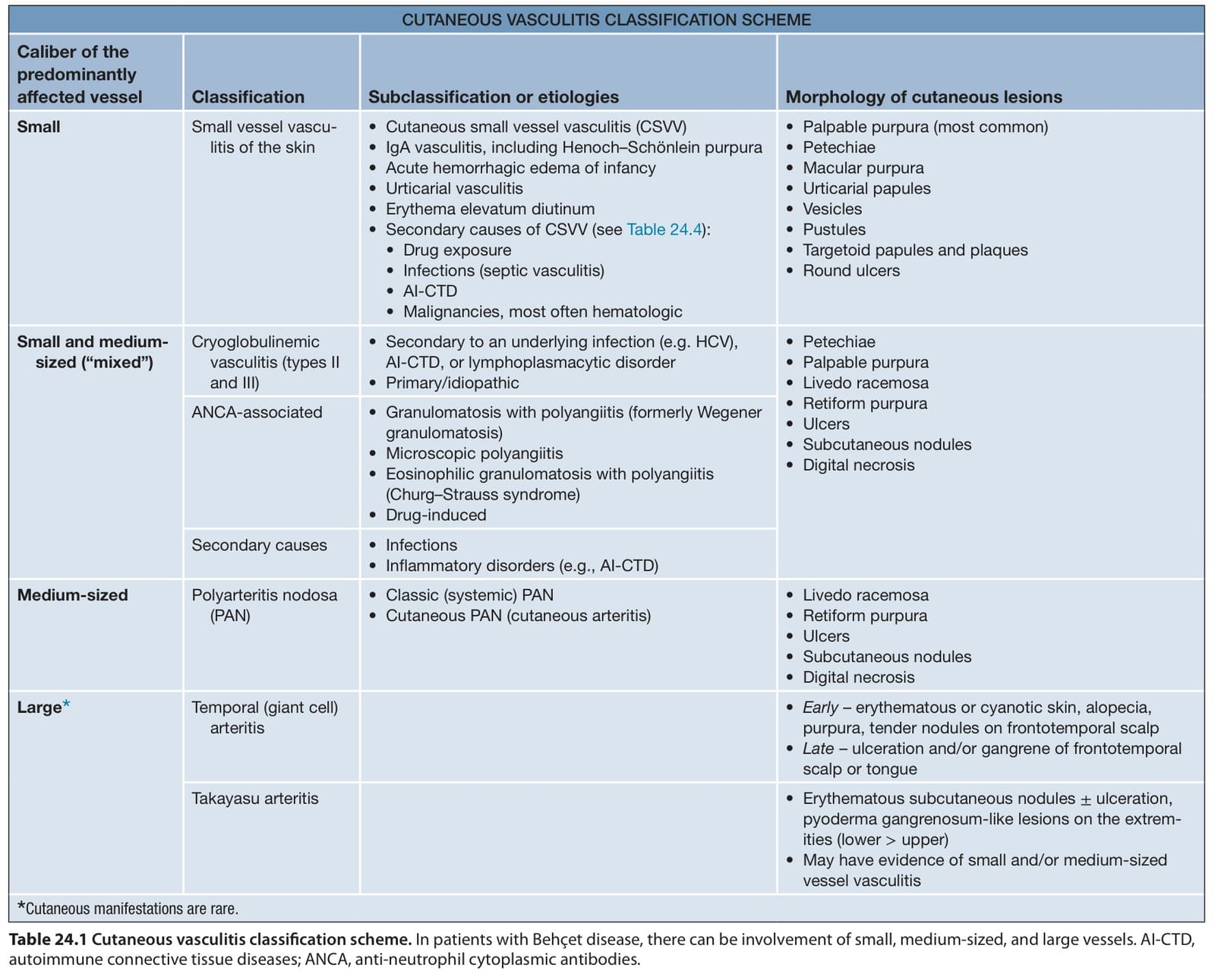
Table 24.1 Cutaneous vasculitis classification scheme. In patients with Behçet disease, there can be involvement of small, medium-sized, and large vessels. AI-CTD, autoimmune connective tissue diseases; ANCA, anti-neutrophil cytoplasmic antibodies.