EPIDEMIOLOGY
The prevalence of pemphigus vulgaris and pemphigus foliaceus in men and women is approximately equal. The mean age of onset of disease is 50 to 60 years, although the range is broad and disease arising in the elderly and in children has been described. Pemphigus can be found all over the world. Although limited data are available regarding the incidence of pemphigus, in general, it ranges from 0.76 to 5 new cases per million per year, with a higher incidence observed in the Middle East, Southeast Europe, and India. However, the incidence is much higher (16 to 32 cases per million per year) in those of Jewish ancestry, particularly Ashkenazi Jews. Occasionally, this ancestry may not be readily apparent, as in the descendants of the conversos (Jews from the Iberian peninsula who were forced to convert to Catholicism), who currently reside in the southwestern USA and Latin America.
In most countries, pemphigus vulgaris is more common than pemphigus foliaceus; exceptions include Finland, Tunisia, and Brazil. For example, in Japan (incidence of pemphigus: 3.5 cases per million per year), the ratio of pemphigus vulgaris to pemphigus foliaceus is 2 : 1. In France (incidence: 1.7 cases per million per year), pemphigus vulgaris accounts for the majority of all cases (~75%), as it does in Bulgaria. In contrast, in Finland (incidence: much lower at 0.76 cases per million per year) and in Tunisia (incidence: 6.7 cases per million per year), pemphigus foliaceus is twice as common as pemphigus vulgaris. More interestingly, the female-to-male ratio in Tunisia is 4 : 1, and the incidence is higher in young women ages 25 to 34 years (15.5 cases per million per year). In addition to Brazil, Tunisia may have endemic foci of pemphigus foliaceus as may the Mt. Kilimanjaro area.
Fogo Selvagem
Patients with fogo selvagem are clinically, histologically, and immunopathologically similar to patients with sporadic pemphigus foliaceus. However, fogo selvagem occurs in an endemic fashion in certain regions of Brazil and is thought to be caused by an environmental factor(s). Unlike sporadic pemphigus foliaceus, which is a disease of mostly middle-aged and older patients, fogo selvagem affects young adults and children of either sex or any race who are exposed to the local ecology in rural areas, and the incidence gradually decreases as the area is developed. The majority of patients live close to rivers and within the 10–15 km flying range of black flies (Simulium spp.), which may be the vector that precipitates the disease. There is also a high frequency of hematophagous insects (bedbugs and kissing bugs) in the homes of patients with fogo selvagem. Of note, a salivary protein from the sand fly Lutzomyia longipalpis was shown to induce cross-reactive antibodies to Dsg1.
Fogo selvagem frequently occurs in genetically related family members, although it is not contagious, and, to date, spread by blood products or body fluids has not been documented. In rural Brazil, the ratio of pemphigus foliaceus to pemphigus vulgaris is a remarkable 17:1. The prevalence in some rural areas of Brazil is as high as 3.4% of the population. Furthermore, in these areas, more than 50% of normal individuals have anti-desmoglein 1 (anti-Dsg1) IgG autoantibodies, and it has been shown that the onset of the disease is preceded by a sustained antibody response consisting of non-pathogenic IgG1 and IgG4 antibodies. In certain genetically predisposed individuals, predominant IgG4 antibodies directed against the N-terminal extracellular EC1 and EC2 domains of Dsg1 are responsible for inducing disease (Fig. 29.2). Certainly, fogo selvagem provides a fascinating model for understanding the pathophysiologic and immunologic mechanisms involved in triggering an autoimmune response against skin components.
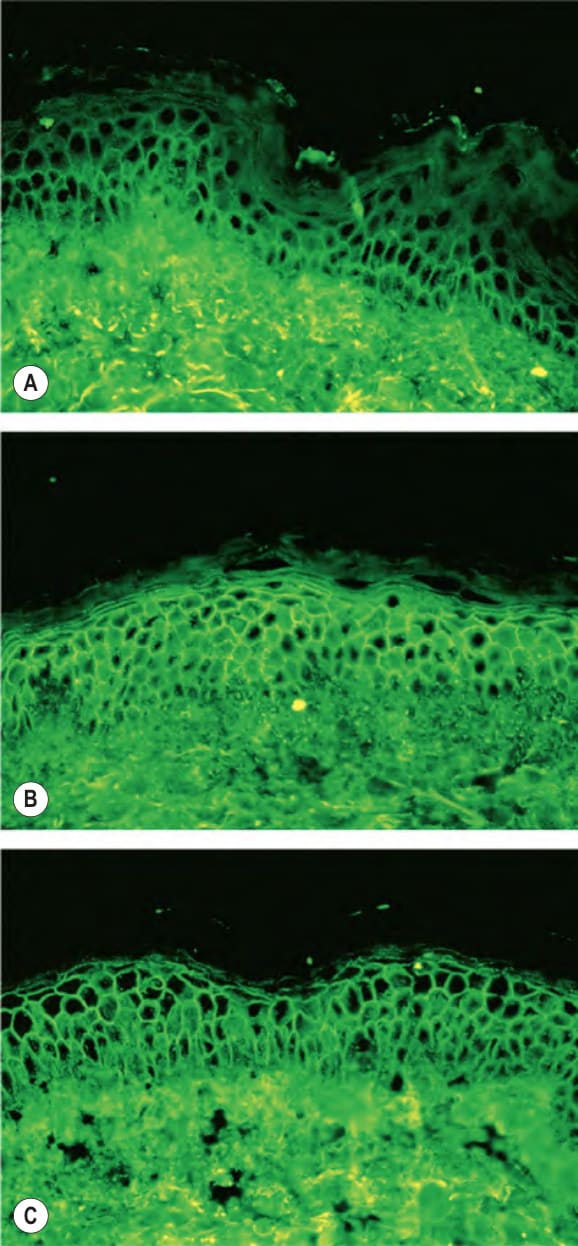
Fig. 29.1 Indirect immunofluorescence of pemphigus sera with normal human epidermis as a substrate. The hallmark of pemphigus is the finding of IgG autoantibodies directed against the cell surface of keratinocytes. A Pemphigus vulgaris sera containing anti-desmoglein 3 (anti- Dsg3) IgG alone stain predominantly the cell surfaces in the lower epidermis. B Pemphigus vulgaris sera containing both anti-Dsg3 IgG and anti-Dsg1 IgG stain the cell surfaces throughout the epidermis. C Pemphigus foliaceus sera, which contain only anti-Dsg1 IgG, stain the cell surfaces throughout the epidermis, but more intensely in the superficial layers.
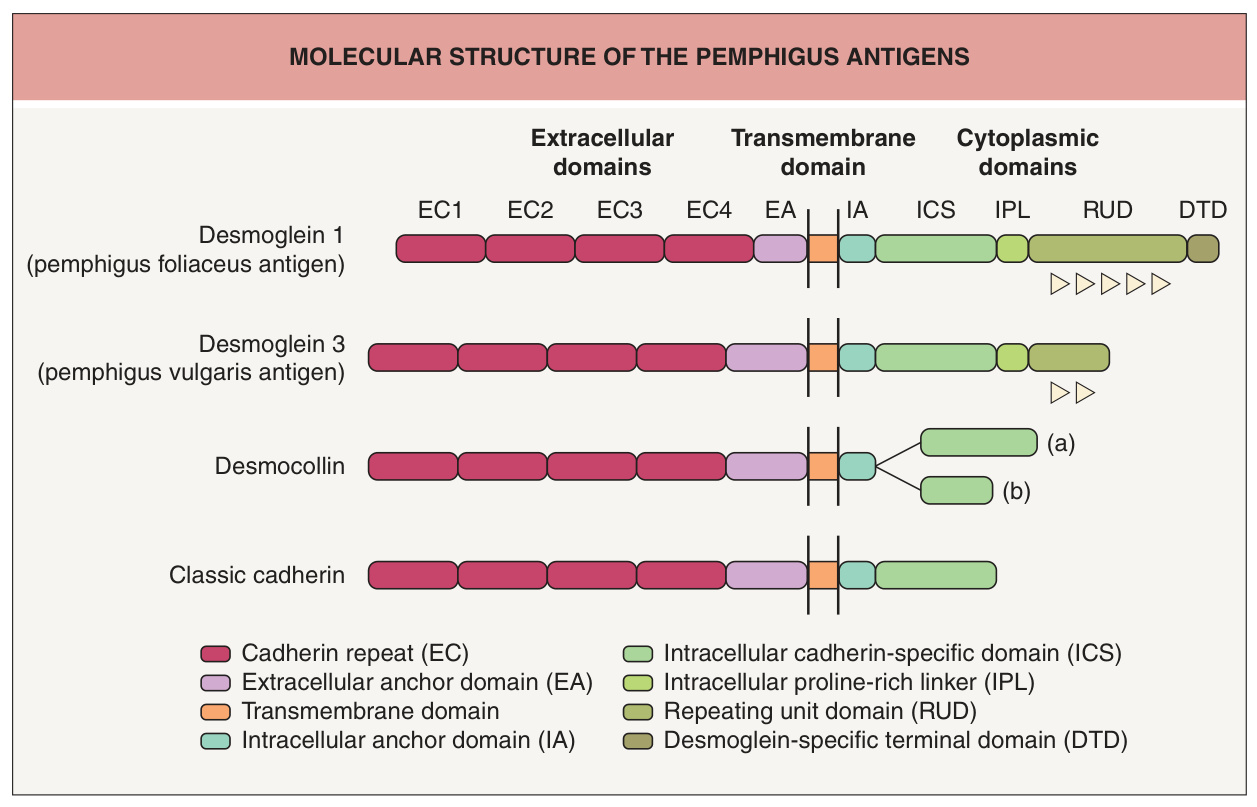
Fig. 29.2 Molecular structure of the pemphigus antigens. The extracellular (EC) region has four cadherin repeats, which have calcium-binding motifs. The intracellular cadherin-specific (ICS) domain is well conserved among cadherins and it is responsible for interactions with β-catenin or plakoglobin (see Fig. 29.3). Desmogleins have their own unique sequences (repeating unit domain [RUD]) of repeats of 29 ± 1 residues (arrowheads). Each desmocollin isotype has two products (a and b) derived from alternatively spliced transcripts of a single gene.
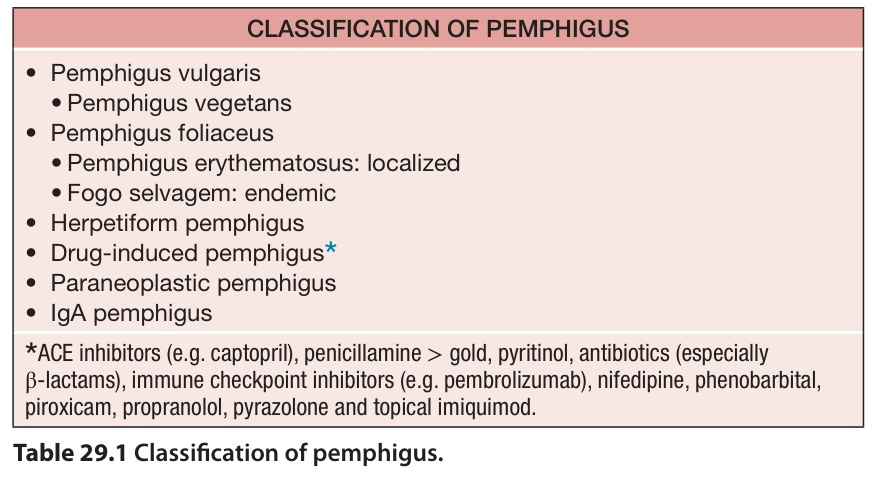
Table 29.1 Classification of pemphigus.