TREATMENT
Pemphigus Vulgaris
Before the advent of systemic corticosteroids, pemphigus vulgaris was usually a fatal disease; most patients died within 2–5 years of the onset of the disease because large areas of the skin lost their epidermal barrier function, leading to the loss of body fluids or to secondary bacterial infections. Pemphigus foliaceus had a better prognosis, except for the occasional acute cases with generalized involvement. Because pemphigus is caused by pathogenic autoantibodies, therapy must be
designed to reduce autoantibody production, not just to suppress local inflammation. The introduction of systemic corticosteroids and immunosuppressive agents has greatly improved the prognosis of pemphigus; however, the morbidity, and occasional mortality, is still significant due to complications of therapy. Systemic corticosteroids are the mainstay of therapy for pemphigus. Immunosuppressive agents are often used for their corticosteroid-sparing effect in order to reduce the side effects of the corticosteroids (Table 29.9), with the goal of therapy being to control the disease with the lowest possible dose of corticosteroids. High-dose IVIg, which is non-immunosuppressive, and anti-CD20 monoclonal antibodies have been recently added to the therapeutic armamentarium for pemphigus. Introduction of PDAI (pemphigus disease area index) and ABSIS (autoimmune bullous skin disorder intensity score) allow for more standardized assessment of disease extent and response to treatment.
Systemic corticosteroid therapy, usually in the form of oral prednisone, is standard treatment (see Ch. 125). Prednisone at 1 mg/kg/day (usually 60 mg/day) is a typical initial dosage. The therapeutic effects are clinically estimated by the number of new blisters per day and the rate of healing of new lesions, and the prednisone is then gradually tapered. Once clinical remission is obtained, changes in the titer of circulating autoantibodies, as determined by IIF or ELISA, are helpful in gauging the dose of prednisone. If there is no response in 3–7 days, other options may be employed, as discussed below. Intravenous pulse therapy with 1 g/day methylprednisolone (over a period of 2–3 hours, with continuous cardiac monitoring) for 3–5 consecutive days is an alternative choice for severe cases.
In general, immunosuppressive agents, such as azathioprine, mycophenolate mofetil and cyclophosphamide, when combined with corticosteroids, may result in gaining early control of the disease and an increased percentage of clinical remissions. For example, in patients with mild to moderate disease who received corticosteroids plus either placebo or mycophenolate mofetil in a prospective, randomized trial, the latter group showed faster and more durable responses. Azathioprine is used at a dose of 2–4 mg/kg/day (usually 100–300 mg/ day) and its major side effects are nausea and dose-dependent myelosuppression (see Ch. 130). Mycophenolate mofetil is used at a dose of 2–3 g/ day and it has a similar action to azathioprine, with less myelosuppression but more gastrointestinal toxicity. Cyclophosphamide is given at a dose of 1–3 mg/kg/day (usually 50–200 mg/day) orally or 500–1000 mg/ m every four weeks intravenously and its major side effects are hemorrhagic cystitis, sterility and leukopenia, with an increased risk of bladder carcinoma long-term; there is a movement away from lower doses of daily cyclophosphamide in an effort to possibly reduce the risk of bladder cancer. Chlorambucil, like cyclophosphamide, is an alkylating agent and although there is no bladder toxicity, side effects include myelosuppression and long-term an increased risk of developing leukemia.
If complete remission is achieved with the combined therapy, the dosage of the immunosuppressive drug is maintained while the prednisone is slowly tapered; when a dose of 5–10 mg/day is reached, careful taper then discontinuation of the immunosuppressive drug is attempted. In young patients, the potential increase in malignancies that might be associated with the use of these drugs must be taken into account. In some patients, especially those who are elderly with limited disease or those in whom corticosteroids are contraindicated, immunosuppressive agents alone may be used.
While cyclosporine (3–5 mg/kg/day) has been used as an immunosuppressive agent in some patients with pemphigus vulgaris, a randomized trial found that the addition of cyclosporine to corticosteroids did not offer a benefit. Also, gold is rarely utilized nowadays.
Plasmapheresis is useful for quickly reducing the titers of circulating autoantibodies and should be considered for severe pemphigus if the disease is unresponsive to a combination of prednisone and immunosuppressives. Concomitant immunosuppression with corticosteroids and cyclophosphamide prevents a post-plasmapheresis rebound increase in the production of autoantibody.
High-dose IVIg is another option for resistant disease. IVIg is a blood product prepared from pooled plasma that has immunomodulatory effects when used in a high dose. It is thought to exert its effect via multiple modes of action, including modulation of expression and function of Fc receptors and the cytokine network; provision of anti-idiotypic antibodies; and modulation of dendritic cell, T cell, and B cell activation, differentiation, and effector functions. A multicenter, randomized, placebo-controlled, double-blind trial demonstrated that high-dose IVIg is an effective and safe treatment for steroid-resistant pemphigus.
Rituximab is a potent B cell-depleting chimeric anti-CD20 monoclonal antibody that was first used to treat B cell malignancies, but increasingly is used for a variety of autoimmune diseases, including pemphigus. CD20 is a transmembrane glycoprotein specifically expressed on B cells (from the pre-B stage in the bone marrow to the activated and memory B stage in blood or secondary lymphoid organs), but its expression is lost upon plasma cell differentiation. Rituximab seems not only to induce a depletion of CD20+ B cells and a decline in IgG (including anti-desmoglein autoantibodies), but also decreases desmoglein-specific T cells. When used as adjuvant therapy in non-randomized prospective studies, rituximab led to a complete remission in most of the patients with refractory pemphigus vulgaris and foliaceus. A prospective,
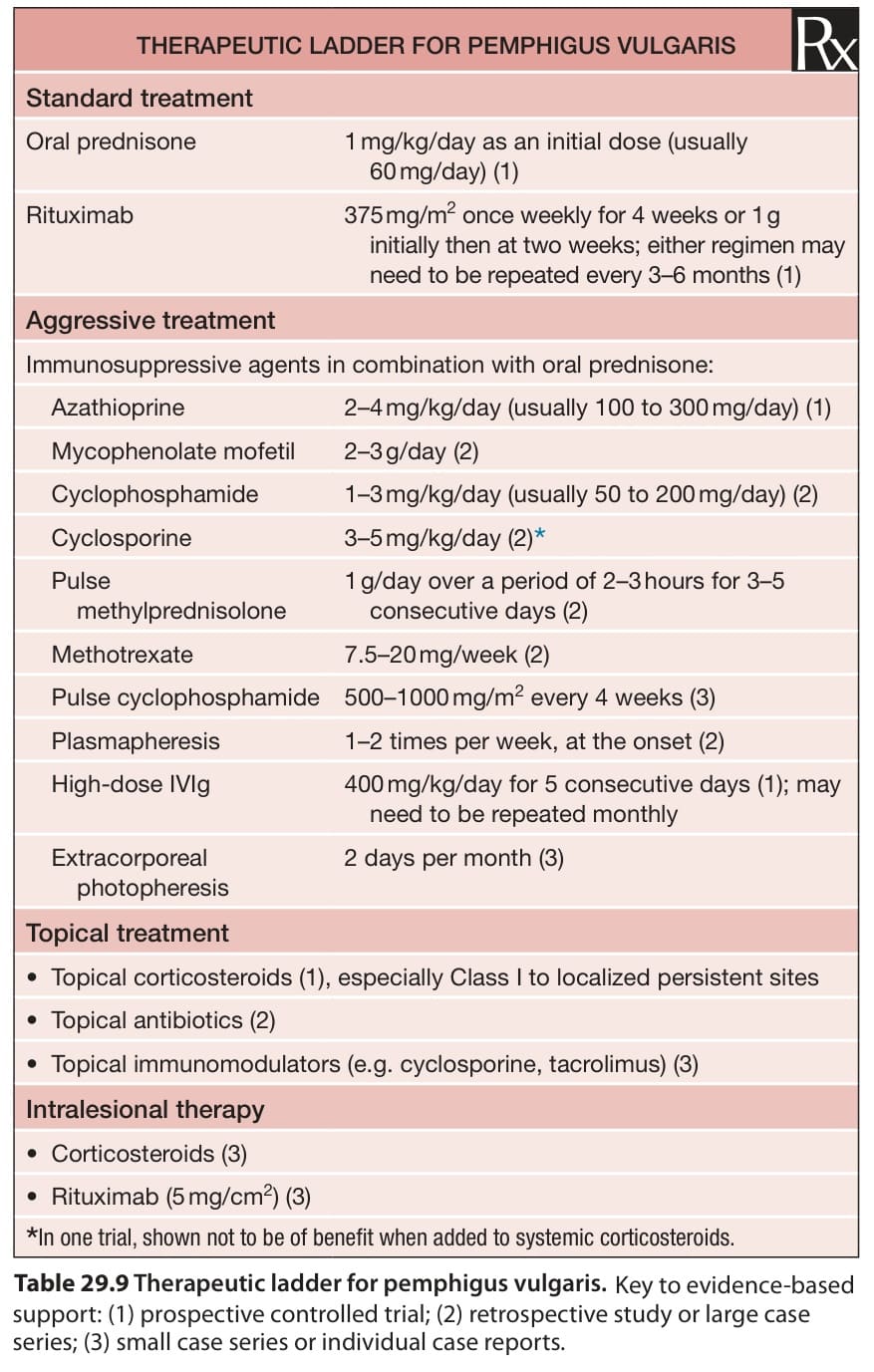
Table 29.9 Therapeutic ladder for pemphigus vulgaris.Key to evidence-based support: (1) prospective controlled trial; (2) retrospective study or large case series; (3) small case series or individual case reports.
open-label, randomized trial demonstrated that as an adjuvant therapy rituximab led to a greater proportion of patients achieving complete remission off-therapy, compared with corticosteroid treatment alone. The US FDA has approved rituximab for moderate-to-severe pemphigus and a consensus group has suggested that it be considered early in the course of disease rather than just for patients with recalcitrant disease. The side effects of rituximab, including infusion reactions, reactivation of hepatitis B virus, and progressive multifocal leukoencephalopathy, are discussed in Chapter 128. Because rituximab is a chimeric biologic agent, patients may develop anti-drug antibodies and in theory a lower therapeutic response. As in primary cutaneous B cell lymphoma, there are reports of the use of intralesional injections of rituximab for refractory pemphigus vulgaris. Humanized anti-CD20 antibodies, e.g. obinutuzumab, ofatumumab, may become alternative options for B cell depletion.
Desmoglein-specific immune suppression, via targeting T cells or B cells, would represent an ideal therapeutic strategy given that the target antigens and pathophysiological mechanisms of pemphigus have been well characterized. In 2020, the FDA granted DSG3-CAART, which targets Dsg3-specific B cells, orphan drug designation for the treatment of pemphigus vulgaris. Lastly, in a recent phase II trial, efgartigimod, an inhibitor of the neonatal Fc-receptor (FcRn) led to early disease control in 28 of 31 patients with either pemphigus vulgaris or pemphigus foliaceus.
When pemphigus foliaceus is active and widespread, the treatment is, in general, similar to that for pemphigus vulgaris. In some patients, pemphigus foliaceus may be localized for many years; they do not necessarily have to be treated with systemic therapy, and superpotent topical corticosteroids may be sufficient to control the disease. Dapsone can also be used when neutrophils are dominant histologically.
Patients with benign tumors, such as thymomas or localized Castleman disease, should have the tumor surgically excised. The majority of these patients will either improve substantially or clear completely. However, it may take 6–18 months to see complete resolution of lesions after excision of a benign neoplasm. In patients with malignant neoplasms, there is no consensus on a standard effective therapeutic regimen. Administration of tumor-specific chemotherapy or targeted therapy may result in complete resolution of the malignancy and a slow resolution of the skin lesions. Cutaneous lesions respond more rapidly to therapy, in contrast to the stomatitis, which is generally refractory to most forms of treatment. Overall, the prognosis of paraneoplastic pemphigus is poor due to its resistant nature to treatment.
Dapsone is the drug of choice for most patients with IgA pemphigus. A clinical response usually occurs within 24–48 hours. If dapsone is not well tolerated, sulfapyridine and acitretin are useful alternatives. Occasionally, those drugs are not effective, and low- to medium-dose prednisone may be considered, as well as photochemotherapy (PUVA) or colchicine.
Bruckner AL, eds. Fitzpatrick’s Dermatology. 9th ed. New York: McGraw-Hill; 2019:909–933.2. Kasperkiewicz M, Ellebrecht CT, Takahashi H, et al.