EPIDEMIOLOGY
Currently, over 35 000 allogeneic HSCTs are performed worldwide each year. Although a variety of donor and recipient factors ultimately impact GVHD incidence (e.g. older age, T cell-replete graft), the most important predictor of GVHD remains HLA compatibility between donor and recipient. With traditional immunosuppression consisting of a calcineurin inhibitor plus either methotrexate or mycophenolate mofetil, ~40% of HLA-identical HSCT recipients and 60%–70% of HLA-mismatched HSCT recipients will develop GVHD. Of note, post-transplant cyclophosphamide (given on days +3 and +4) significantly reduces the incidence and severity of acute and chronic GVHD via enrichment of regulatory T cells. In addition, abatacept has recently been approved for prophylaxis against acute GVHD.
Because of ease of acquisition and more rapid engraftment, peripheral blood has surpassed bone marrow as the predominant source of stem cells. The one disadvantage is that peripheral blood has been associated with an increased risk of chronic GVHD (cGVHD). Cord blood stem cells are used primarily in children because of higher rates of non-engraftment in adults. The two major advantages of cord blood transplantation are: (1) decreased incidence of GVHD; and (2) nearly universal availability of donors for patients who lack matched related or unrelated donors.
Several other trends in HSCT are affecting the natural history of GVHD. Removal of donor T cells (“T cell depletion”) prior to transplantation through ex vivo graft manipulation (e.g. cell separation), or in vivo treatment of the recipient (e.g. antithymocyte globulin, alemtuzumab), significantly decreases the risk of GVHD, but at the expense of increased infection rates. The advent of reduced intensity conditioning regimens has decreased conditioning-related toxicities (e.g. mucositis) and allowed for HSCT in older patients and those with comorbidities. While these regimens appear to decrease the risk of acute GVHD (aGVHD), they may also delay the appearance of “classic” aGVHD manifestations. The use of total body irradiation for conditioning (in place of or in conjunction with chemotherapy) may confer an increased risk for the later development of cGVHD. Finally, donor lymphocyte infusions (DLI), administered to the recipient post-HSCT to augment the graft-versus-tumor effect or to attempt to reverse falling donor chimerism, can alter the traditional timing of both “acute” and “chronic” disease. For instance, DLI may induce classic aGVHD manifestations even when administered after the 100-day time period.
The skin is the most frequently affected organ in both aGVHD and cGVHD. Approximately 80% of patients who develop aGVHD have skin involvement at the time of diagnosis. The incidence of skin involvement in patients with cGVHD ranges from 30%–40%. In one institutional review of 270 consecutive patients following HLA-identical HSCT, only 7 (13%) of 53 patients with cGVHD manifested sclerotic features. In contrast, in a cross-sectional cohort of 206 NIH cGVHD patients enriched for refractory disease, sclerotic features were detected in 109 (53%).
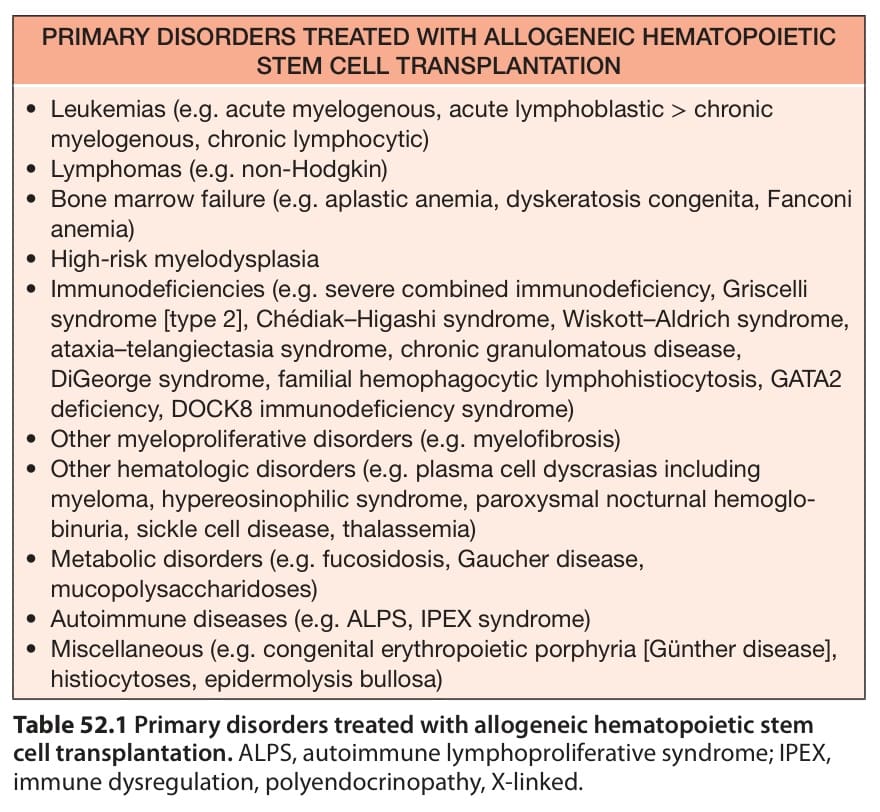
Table 52.1 Primary disorders treated with allogeneic hematopoietic stem cell transplantation. ALPS, autoimmune lymphoproliferative syndrome; IPEX, immune dysregulation, polyendocrinopathy, X-linked.