COMPLEX GENETIC TRAITS
Classic Mendelian disorders represent only a small proportion of genetic diseases. Many common conditions develop as a consequence of multiple genetic factors that confer disease susceptibility, interacting with each other and the environment. Such complex (multifactorial) traits tend to cluster or aggregate in families (Fig. 54.5). In contrast to the predictable recurrence risks for Mendelian traits, the risks for complex traits are estimated based on epidemiologic data. Examples of complex traits in dermatology include atopic dermatitis, psoriasis, vitiligo, and alopecia areata.
Attempts to define the genetic basis of complex disorders have included twin studies, parametric linkage analysis, and genomewide association studies (GWAS). The comparison of concordance rates in monozygotic (identical) and dizygotic (fraternal) twins represents a powerful technique for determining the genetic and epigenetic components of human diseases. For psoriasis and alopecia areata, concordance rates of ~50%–70% in monozygotic twins compared to ~10%–20% in dizygotic twins demonstrate a strong genetic basis. In investigations utilizing GWAS, several hundred thousand SNPs can be analyzed in thousands of individuals to help determine the genetic architecture of complex diseases.
Our understanding of the complex genetic and epigenetic architecture underlying polygenic diseases has been greatly facilitated by endeavors such as the Human Genome Project that mapped all human genes (completed in 2003), the Encyclopedia of DNA Elements (ENCODE) that catalogs all the functional regulatory elements in the human genome, and the Roadmap Epigenomics Project. The field of functional genomics is also playing a key role in the mission to decode the genetic architecture of complex traits. This progress will continue to elucidate disease mechanisms and facilitate the development of targeted therapies.
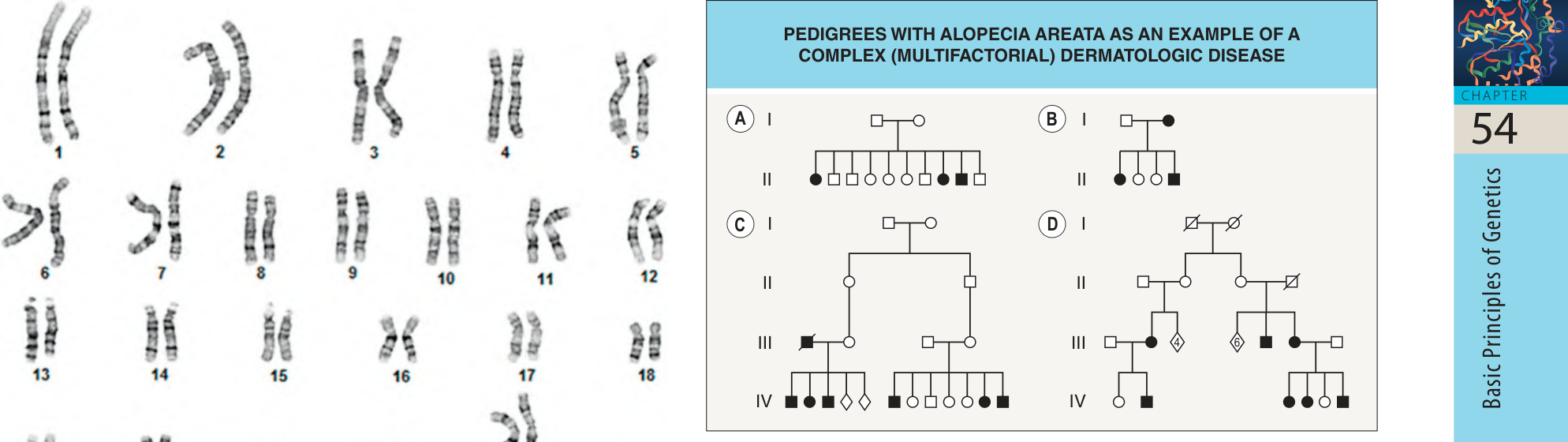
Fig. 54.5 Pedigrees with alopecia areata as an example of a complex (multi- factorial) dermatologic disease. Although some of the pedigrees individually can mimic Mendelian patterns of inheritance (A, B), others show a more complex pattern (C, D). In some cases, the disease can be inherited through two unrelated branches of the family (C). A single mode of inheritance cannot be established for the disease as a group. The key for symbols commonly used for pedigree drawing is indicated at the bottom of Fig. 54.1.