DIFFUSE PALMOPLANTAR KERATODERMAS WITH ICHTHYOSIS
Loricrin keratoderma and keratosis linearis–ichthyosis congenita– sclerosing keratoderma (KLICK) have distinctive skin findings beyond the palms and soles. PPK is also a component of other ichthyoses that are discussed in Chapter 57 (see Table 58.2).
Loricrin Keratoderma
Synonyms: Camisa variant of Vohwinkel syndrome Mutilating keratoderma with ichthyosis Variant Vohwinkel syndrome Vohwinkel syndrome with ichthyosis
This disorder is caused by mutations in the gene encoding loricrin, a glycine-rich cornified envelope protein (see Ch. 56). Mutant loricrin is transported to the nucleus, where it is thought to interfere with regulation of cornification. Recombination-induced revertant mosaicism leading to small “islands” of unaffected skin has been described.
Clinical and histologic features
Generalized desquamation or features of a collodion baby may be evident at birth, with subsequent evolution to a mild generalized ichthyosis. During childhood, diffuse NEPPK develops, with a “honeycomb” pattern and associated findings that overlap with those of Vohwinkel syndrome, including keratotic digital constrictions (pseudoainhum), knuckle pads, and warty keratoses on extensor surfaces. However, the absence of deafness as well as the presence of ichthyosis distinguish loricrin keratoderma from Vohwinkel syndrome. The differential diagnosis may also include ichthyosis hystrix Curth–Macklin due to mutations in the variable tail region of keratin 1 (see Ch. 57).
Histologic features of loricrin keratoderma include hyperkeratosis with parakeratotic cells, scattered transitional cells, and a broad stratum granulosum with focal perinuclear vacuolization. Keratinocyte nuclei demonstrate distinctive immunoreactivity for loricrin.
Management
Isotretinoin has been reported to improve hyperkeratosis and prevent digital amputation.
Keratosis Linearis–Ichthyosis Congenita– Sclerosing Keratoderma (KLICK)
Synonym: KLICK syndrome
KLICK is an autosomal recessive disorder caused by mutations in POMP, which encodes proteasome maturation protein. The resulting proteasome insufficiency disturbs terminal epidermal differentiation and interferes with processing of profilaggrin.
Patients present with mild congenital ichthyosis and diffuse, transgredient PPK with development of digital constriction bands. Other features include flexion deformity of the fingers with associated sclerosis
and parallel linear arrays of keratotic papules in the flexural areas of the extremities. Erythrokeratoderma, presenting as well-demarcated erythematous, hyperkeratotic plaques on the extremities and trunk, has also been described. Development of aggressive squamous cell carcinoma (SCC) in affected skin has been reported.
Histologic evaluation shows orthohyperkeratosis, focal parakeratosis, acanthosis, and hypergranulosis with characteristic irregular keratohyalin granules. Immunostaining for filaggrin is positive in the cornified layer rather than the granular layer.
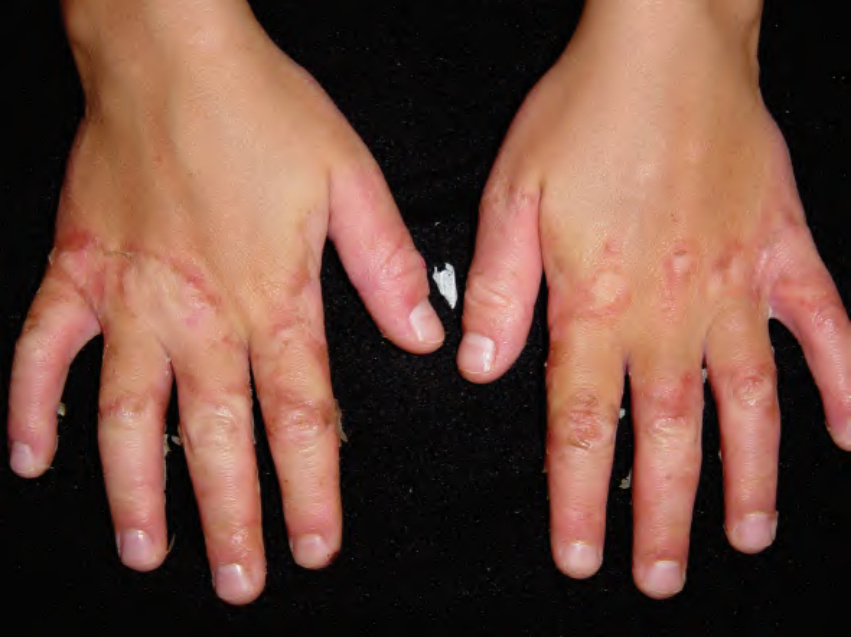
Fig. 58.8 Keratolytic winter erythema (“Oudtshoorn disease”). Recurrent erythema followed by centrifugal peeling of the hands and feet. Courtesy Sian Hartshorne, MD.
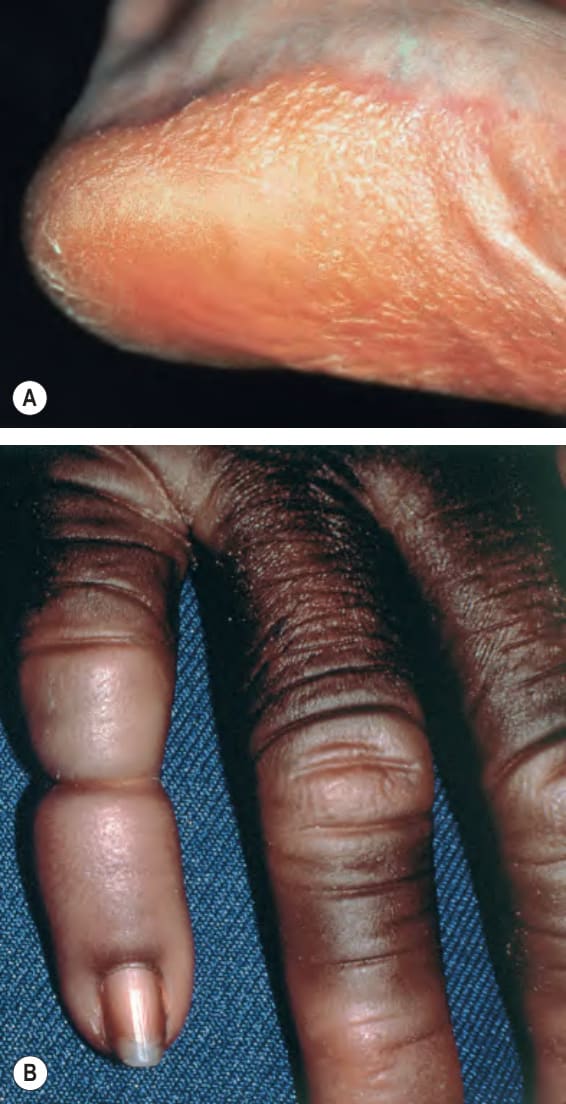
Fig. 58.9 Mutilating palmoplantar keratoderma in Vohwinkel syndrome. A Diffuse honeycombed keratoderma of the sole. B Pseudoainhum formation. A, Courtesy Alfons Krol, MD, and Dawn Siegel, MD.
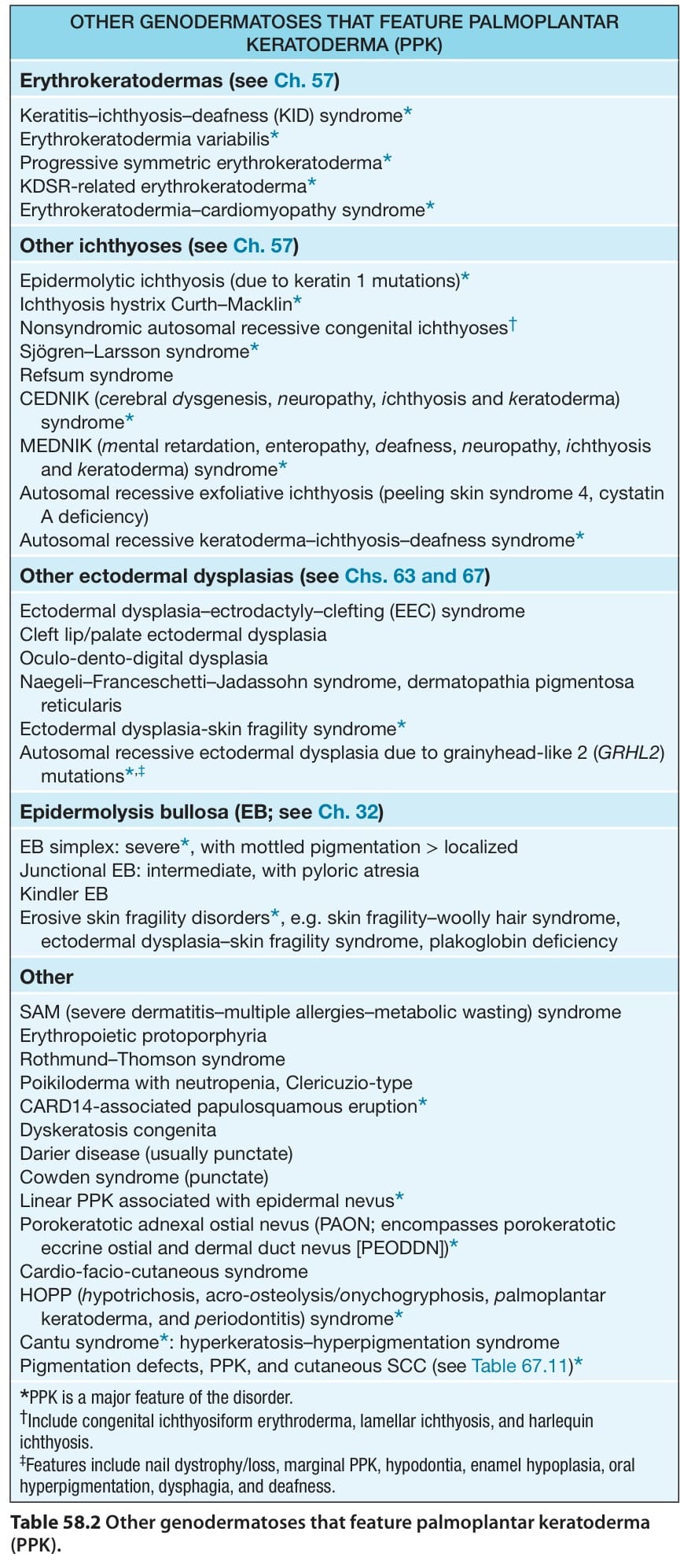
Table 58.2 Other genodermatoses that feature palmoplantar keratoderma (PPK).