VASCULAR MALFORMATIONS
Mosaic mutations have been identified as the cause of multiple types of sporadic and familial vascular malformations (see Ch. 104). In addition to the entities discussed below, mosaic mutations underlying lymphatic (PIK3CA) and arteriovenous (MAP2K1, BRAF, KRAS, HRAS) malformations have also been identified (see Table 104.2).
Venous and Glomuvenous Malformations
Heterozygous somatic activating mutations in TEK, which encodes the TIE-2 endothelial cell tyrosine kinase receptor, or PIK3CA are frequently
found in sporadic venous malformations. A subset of these lesions therefore represents a simple segmental (type 1) mosaic form of the autosomal dominant multiple cutaneous and mucosal venous malformation syndrome caused by germline TEK mutations. Verrucous venous malformations (“verrucous hemangiomas”) result from heterozygous somatic mutations in MAP3K3 (MAPK kinase kinase 3). Large segmental plaque-type glomuvenous malformations, which are typically congenital, can occur as a superimposed (type 2) mosaic manifestation of hereditary glomuvenous malformations due to heterozygous germline GLMN (glomulin) mutations.
Capillary Malformations (Port-Wine Birthmarks)
Somatic activating mutations in GNAQ are found within affected tissues in most patients with Sturge–Weber syndrome and non-syndromic portwine birthmarks. This gene encodes a Q-class G protein α-subunit, activation of which increases MAPK signaling. Somatic mutations in GNAQ and the related GNA11 are also found in blue nevi and nevus of Ota. It is therefore not surprising that patients with phakomatosis pigmentovascularis type II have the same activating GNAQ or GNA11 mutation in both their port-wine stain and dermal melanocytosis (Fig. 62.14). Of note, somatic activating mutations in GNAQ, GNA11, GNA14, and RAS have been identified in congenital hemangiomas (noninvoluting and rapidly involuting variants), pyogenic granulomas (RAS), and other vascular tumors. GNAQ, GNA11, and GNA14 mutations have only been reported in mosaic form and are likely otherwise lethal. RASA1 and EPHB4 mutations are responsible for the autosomal dominant capillary malformation–arteriovenous malformation syndrome, in which lesions have been shown to demonstrate loss of heterozygosity.
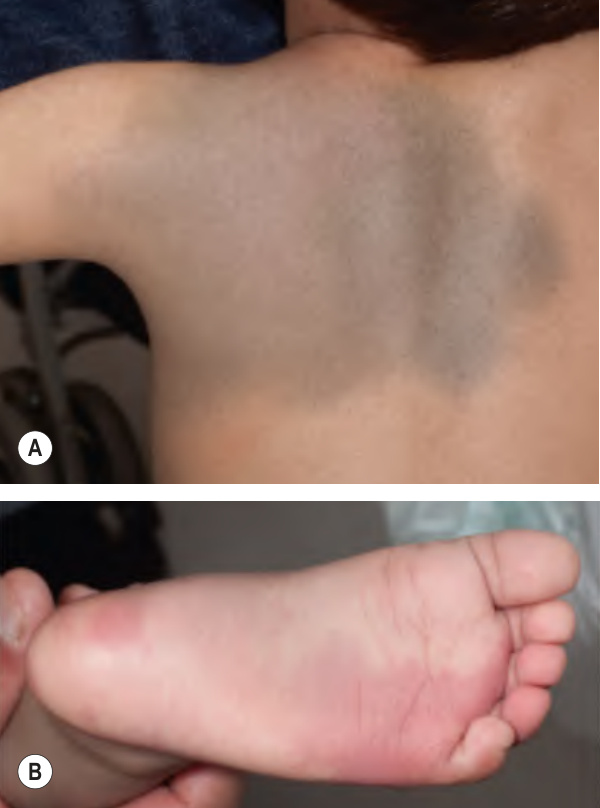
Fig. 62.14 Dermal melanocytosis (A) and port wine birthmarks (B) in phakomatosis pigmentovascularis type II. Note the block-like segmental distributions. Courtesy Veronica Kinsler, MD, PhD.