Accessory Tragi
Synonyms: Preauricular tags Preauricular appendages
Accessory tragi are relatively common congenital anomalies of the first branchial arch, and they are found in 3–6 per 1000 live births. Familial occurrence has been reported, sometimes with a consistent anatomic site within kindreds. During development, the external ear is formed by the fusion of six tubercles, three each from the first and second branchial arches; the tragus and anterior crus of the helix are the only portions of the ear derived from the former. Whereas preauricular pits and cysts reflect defective fusion of the tubercles (see Ch. 110), accessory tragi represent remnants of and/or extra tubercles originating from the first branchial arch.
Accessory tragi most often manifest as skin-colored papules or nodules in the preauricular area, but they also may be found on the mandibular cheek or on the neck along the anterior border of the sternocleidomastoid muscle (also referred to as congenital cartilaginous rests of the neck, see below) (Fig. 64.21). The latter locations reflect the embryologic migration of the external ear from the neck to the side of the head as the mandible develops. Accessory tragi are occasionally multiple (see Fig. 64.21B) and are bilateral in ~10% of affected individuals. They are typically covered by vellus hairs and can be either soft or firm due to a cartilaginous core.
Although they usually represent an isolated malformation, accessory tragi are sometimes associated with other developmental anomalies of the first branchial arch, such as cleft lip and palate. Together with ipsilateral facial hypoplasia, ear deformities, epibulbar dermoids, and vertebral abnormalities, accessory tragi are a cardinal feature of hemifacial microsomia (Goldenhar syndrome). Accessory tragi may be seen in a number of other multiple congenital anomaly syndromes, including Nager acrofacial dysostosis, Townes–Brocks syndrome, Treacher Collins–Franceschetti syndrome, VACTERL association, Wildervanck syndrome, and Wolf–Hirschhorn syndrome (www.ncbi. nlm.nih.gov/omim). Controlled studies have failed to confirm purported associations between isolated accessory tragi and urinary tract abnormalities or hearing impairment.
Histologically, accessory tragi are polypoid lesions with numerous tiny, mature hair follicles, a prominent connective tissue framework within abundant subcutaneous fat, and often a central plate of elastic cartilage. When accessory tragi are surgically excised for cosmetic reasons, care must be taken to remove any protruding portion of under-lying cartilage. Evaluation of an infant with an accessory tragus should include assessment of hearing and examination for other dysmorphic features.
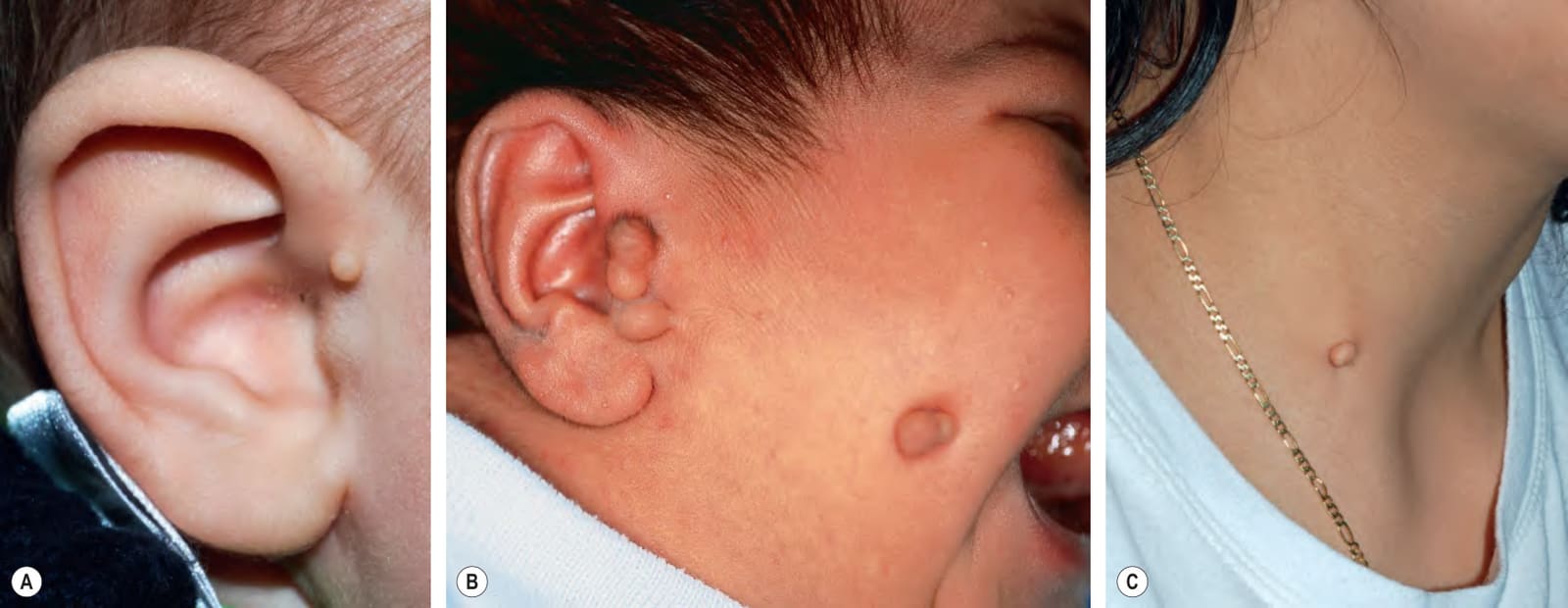
Fig. 64.21 Accessory tragi.A Typical small preauricular papule. B Multiple skin-colored papulonodules on the mandibular cheek as well as in a preauricular location. C Congenital cartilaginous rest of the neck, which is considered to represent a cervical subtype of accessory tragus.