DERMATOPATHIA PIGMENTOSA RETICULARIS
Key features
Autosomal dominant disorder due to mutations in the keratin 14 gene
Persistent reticulated hyperpigmentation with truncal predominance
Non-scarring alopecia of the scalp, eyebrows, and axillae
Onychodystrophy
Absent dermatoglyphics and punctate keratoderma in some patients
Introduction and Pathogenesis
DPR is a rare genodermatosis that was recognized as a distinct entity in the 1970s. Like NFJ (see above), a heterozygous truncating mutation in the non-helical head domain of the keratin 14 gene has been shown to cause DPR.
Clinical Features
DPR presents by the second year of life with the triad of reticulated hyperpigmentation, non-scarring alopecia, and onychodystrophy. The reticulated hyperpigmentation has a predilection for the trunk but also occurs on the proximal extremities, and it persists during adulthood (Fig. 67.24). The nail involvement may result in pterygia formation. Variable features include absent dermatoglyphics, hypo- or hyperhidrosis, and a punctate palmoplantar keratoderma.
Pathology
Histologically, the hyperpigmented skin demonstrates pigment incontinence, i.e. melanophages in the upper dermis.
reticularis. Persistent hyperpigmentation in a reticulated pattern extending from the lower abdomen to the thigh in a young man. Courtesy Julie V. Schaffer, MD.
Differential Diagnosis
There is clinical overlap with the NFJ syndrome (e.g. reticulated hyperpigmentation, nail dystrophy, punctate keratoderma, absent dermatoglyphics), but the latter lacks alopecia and has less persistent hyperpigmentation. Additional diagnostic considerations are as discussed above for NFJ.
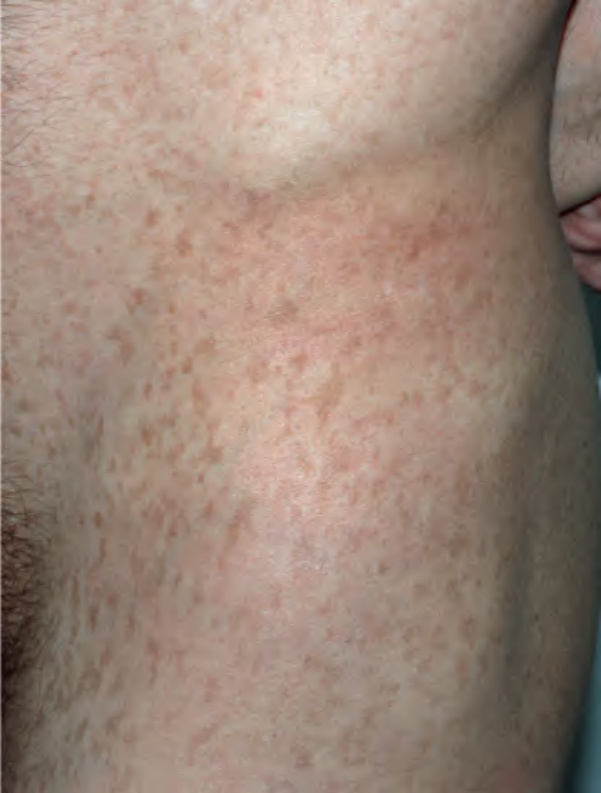
Fig. 67.24 Dermatopathia pigmentosa