INFECTIONS
Acute Paronychia
Key features
Painful whitlow
Recurrent when due to herpes simplex virus (HSV)
Viral and bacterial cultures are mandatory
The affected digit becomes swollen, red, and painful and typically there is involvement of one of the nail folds. Compression of the nail fold may produce purulent drainage. Acute paronychia is most commonly due to bacteria, in particular Staphylococcus aureus or Streptococcus pyogenes, and it follows minor trauma to the nail. Recurrent episodes of acute paronychia in the same digit should raise the suspicion of an HSV infection. A Tzanck smear, along with PCR, direct immunofluorescence assay or viral culture, can confirm the diagnosis.
Treatment
Drainage of the abscess, followed by systemic or topical antibiotics or systemic antivirals when due to HSV.
Warts
Periungual warts are common in nail biters, in whom they are multiple and involve several nails (see Ch. 79). The warts appear as keratotic papules, and when localized to the proximal nail fold, they frequently produce periungual hyperkeratosis simulating a hyperkeratotic cuticle. For subclinical presentations, dermoscopy can aid in diagnosis. Nail bed warts lead to uplifting of the nail plate with onycholysis and subungual hyperkeratosis. SCC can arise in or mimic a verruca; therefore, suspicious lesions must be further evaluated.
Treatment
Therapeutic options are outlined in Table 71.10.
Onychomycosis (Tinea Unguium)
See Chapter 77.
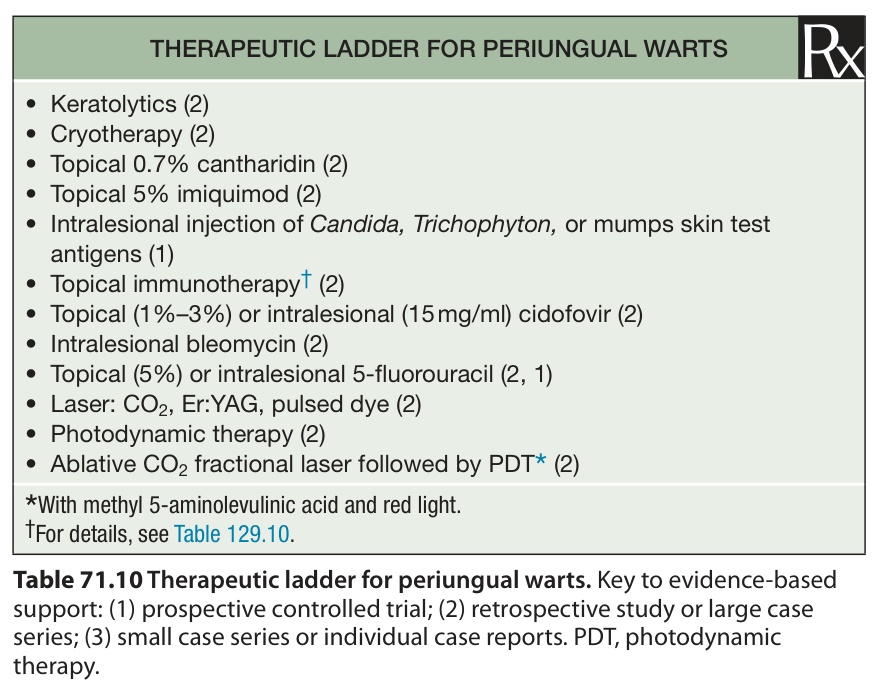
Table 71.10 Therapeutic ladder for periungual warts. Key to evidence-based support: (1) prospective controlled trial; (2) retrospective study or large case series; (3) small case series or individual case reports. PDT, photodynamic therapy.