ALLERGIC AND IMMUNOLOGIC DISEASES
Recurrent Aphthous Stomatitis
Synonyms: Recurrent oral aphthae Aphthous ulcers Canker sores Variants: Minor aphthae Major aphthae Herpetiform aphthae Complex aphthosis
Key features
The etiopathogenesis is unknown, but immunologic factors may play a role
Although individual ulcers often heal spontaneously, topical corticosteroids and systemic medications can be used to address disease activity
Introduction
Recurrent aphthous stomatitis (RAS) is a relatively common ulcerative disorder of the oral cavity. While the etiology remains obscure, it is likely multifactorial and influenced by a host of predisposing factors. Although most commonly idiopathic, RAS can be associated with Behçet disease, inflammatory bowel disease, cyclic neutropenia, HIV infection, and possibly hematinic (iron, folate, or vitamin B) deficiencies (Table 72.3). Complex aphthosis is defined as nearly constant disease with ≥3 oral ulcers +/− genital ulcers and requires a search for an underlying disease or syndrome.
Epidemiology
RAS is a common disorder affecting >20% of the population. Idiopathic disease usually presents during the second or third decades of life, with severity and frequency diminishing with age.
Clinical features
Four clinical subtypes of RAS have been described: minor, major, herpetiform, and complex (severe). Minor aphthae, the most common
form, are characterized by round to ovoid, shallow, painful ulcers that are usually <1 cm in diameter (Fig. 72.14). The ulcers are typically limited to the non-keratinized (“movable”) oral mucosa, with common sites of involvement including the labial and buccal mucosa, floor of the mouth, ventral surface of the tongue, soft palate, and oropharyngeal mucosa. These lesions usually heal without scarring within 1–2 weeks.
Major aphthae are characterized by larger, deeper ulcers, typically >1 cm. They persist for up to 6 weeks and may heal with scarring. Lesions are associated with considerable oral pain and are sometimes accompanied by fever and malaise. Herpetiform aphthae are uncommon, consisting of multiple (>10) small, painful ulcers that resemble primary HSV infection. They are typically confined to non-keratinized mucosa and after coalescing can mimic major aphthae. In complex aphthosis (severe aphthae), there are continuous recurrences of minor aphthae (see definition above).
Pathology
Histopathologic features are relatively nonspecific. They include an ulceration with overlying fibrin and neutrophils and an underlying inflammatory infiltrate. In most patients, however, the appearance and distribution of lesions allow for the diagnosis to be made clinically.
Treatment
The primary goals of therapy are promotion of healing, management of pain and nutrition, and prevention of recurrence. Typically, analgesia and topical corticosteroids significantly reduce pain and time to healing. The frequency of episodes is often reduced following topical corticosteroid therapy. Patients with complex aphthosis may require systemic therapy (Table 72.4).
Behçet Disease
Synonym: Behçet syndrome
Key features
Recurrent oral and genital aphthae
Anterior or posterior uveitis and/or retinal vasculitis
Erythema nodosum-like and papulopustular lesions
Behçet disease is a rare chronic multisystem disorder that is more prevalent in individuals whose ancestry includes regions along the ancient Silk Route (see Ch. 26). Disease activity may be inter-mittent, with exacerbations and remissions of unpredictable duration
and frequency. Multiple oral aphthae are often the first sign of the disease and are present in the vast majority of patients.
Systemic manifestations, clinical criteria for the diagnosis of Behçet disease, and treatment options are outlined in Tables 25.12, 25.14 and 25.15, respectively.
Autoimmune Bullous Diseases
Multiple erosions or ulcerations occur in several autoimmune bullous diseases, most commonly pemphigus vulgaris, but also
mucous membrane pemphigoid, paraneoplastic pemphigus, bullous pemphigoid, epidermolysis bullosa acquisita, and linear IgA bullous dermatosis (see Chs. 29–31). The differential diagnosis includes multiple fixed drug eruption, herpetic infections, Mycoplasma pneumoniae-induced rash and mucositis (MIRM), and hemorrhagic bullous angina. The latter is an idiopathic or trauma-induced disorder that presents with recurrent hemorrhagic bullae within the oral cavity (usually the soft palate).
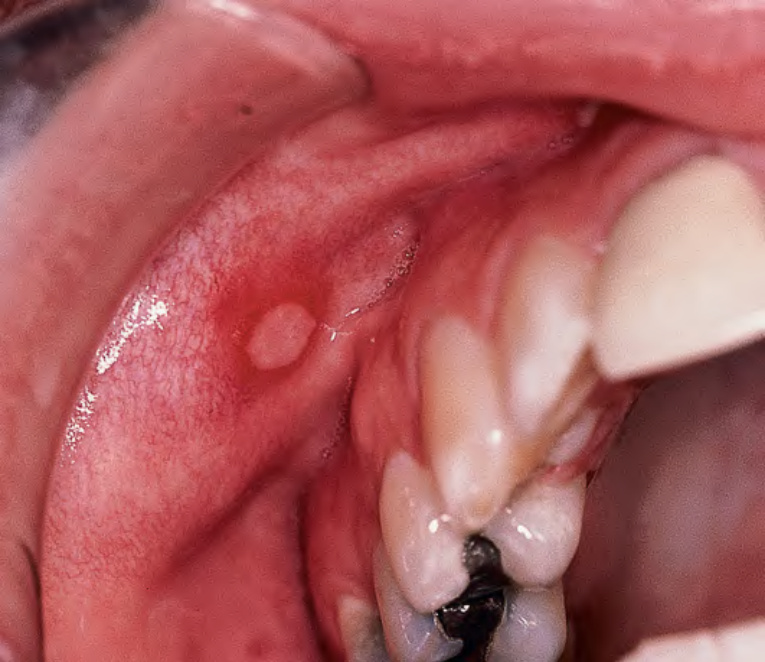
Fig. 72.14 Recurrent aphthous stomatitis. Adjacent minor aphthous ulcers arising in non-keratinized mucosa. The ulcerations are shallow with a creamy white surface and surrounded by an intensely red halo, a characteristic finding. Courtesy Carl M. Allen, DDS, MSD and Charles Camisa, MD.
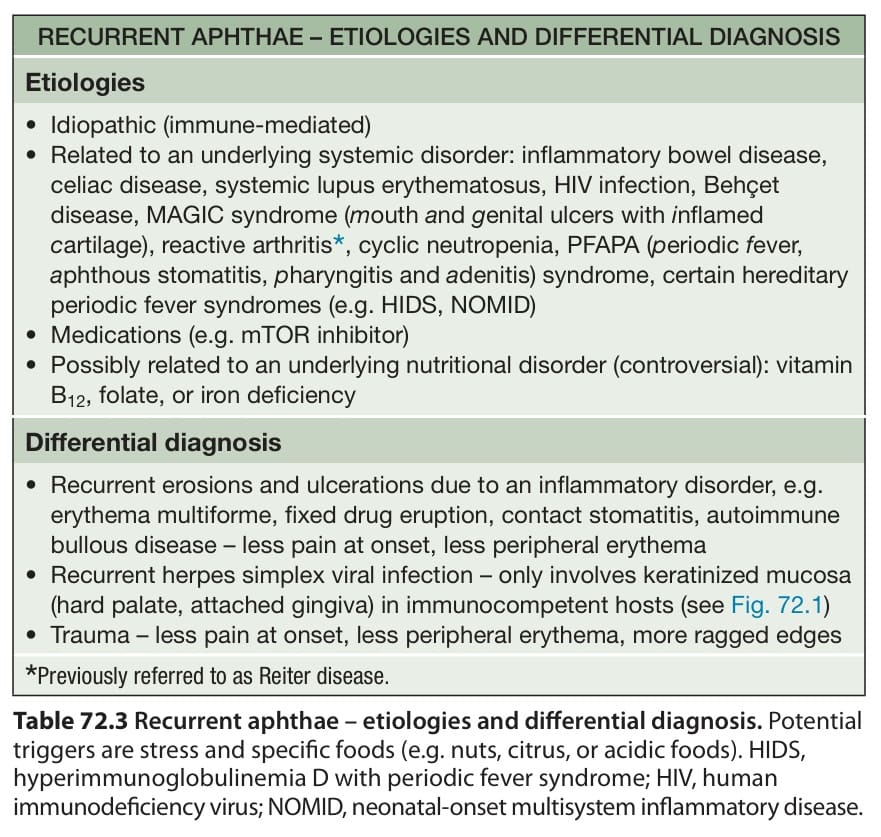
Table 72.3 Recurrent aphthae – etiologies and differential diagnosis. Potential triggers are stress and specific foods (e.g. nuts, citrus, or acidic foods). HIDS, hyperimmunoglobulinemia D with periodic fever syndrome; HIV, human immunodeficiency virus; NOMID, neonatal-onset multisystem inflammatory disease.
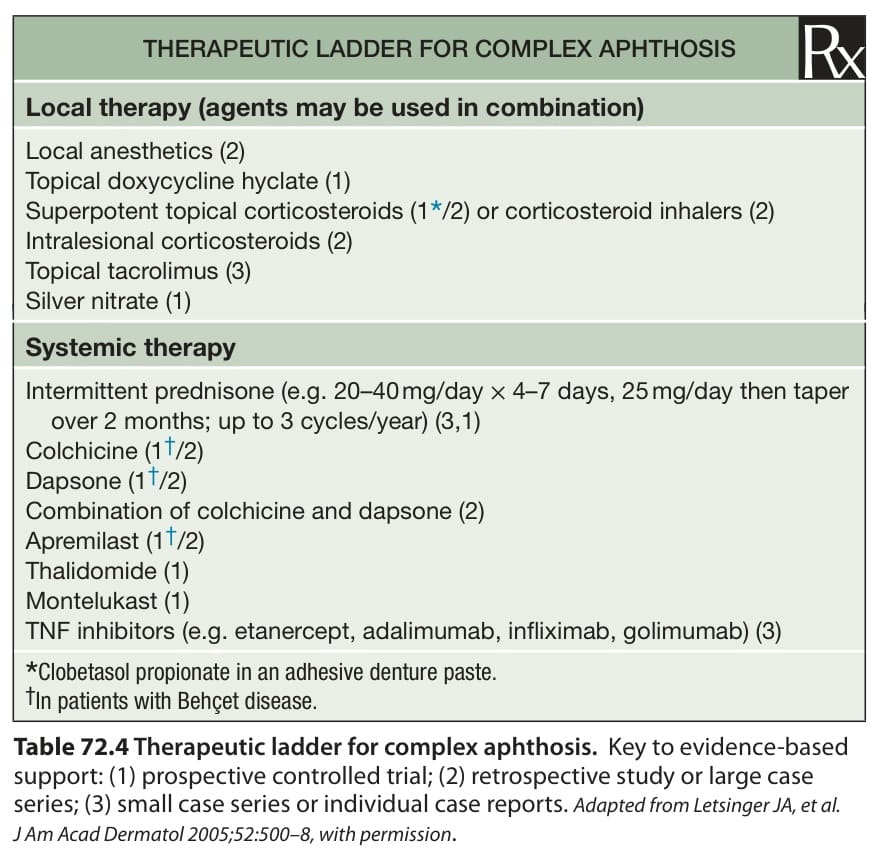
Table 72.4 Therapeutic ladder for complex aphthosis. Key to evidence-based support: (1) prospective controlled trial; (2) retrospective study or large case series; (3) small case series or individual case reports. Adapted from Letsinger JA, et al. J Am Acad Dermatol 2005;52:500–8, with permission.